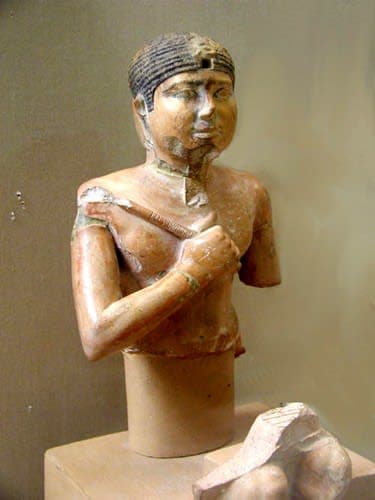

For a long time, the personality of Neferefre was shrouded in mystery. There was not even clarity about from whom he inherited the crown. Modern theories, supported by archaeological discoveries at Abusir, indicate that Neferefre was the eldest son of Pharaoh Neferirkare Kakai and Queen Khentkaus II, as well as the elder brother of the future great builder Niuserre.
The question of the length of his reign long misled historians. The ancient chronicler Manetho attributed to him a full 20 years of power, but the stones tell a different story. Careful study of the Turin Papyrus revealed only a single vertical stroke in the column of his regnal years, which signifies a term of merely 1–2 years. This fact is confirmed by construction marks: on a corner block of the foundation of his unfinished pyramid there is an inscription dated precisely to the first year of his reign. Apparently, the young king only managed to lay the foundation of his eternal dwelling before he died.
Neferefre began construction of his funerary complex at the southernmost point of the Abusir plateau. The pyramid received the majestic name Netjer-bau Neferefre (“The ba of Neferefre are divine”). However, due to the ruler’s sudden death, the grand project turned into an architectural makeshift.


His brother Niuserre, who ascended the throne after a brief period of turmoil and the rule of the mysterious Shepseskare, did not complete the pyramid in its original form. The tall structure, which was supposed to reach 50 meters, was hastily converted into a low square mastaba only 7 meters high. From a distance this monument resembles not a pyramid but a flat platform or a “tennis court.” Over time, the internal blocks were quarried for other constructions, leaving only the external outline of unrealized grandeur.
A real sensation occurred in the 1980s, when an expedition from Charles University in Prague under the leadership of Miroslav Verner began excavations of Neferefre’s funerary temple. Although the temple itself was built mainly of mudbrick, it contained treasures scarcely paralleled in the Old Kingdom:
Abusir Archive: Hundreds of fragments of papyri and clay tablets were discovered. These are detailed administrative records: priestly duty rosters, inventories of gold vessels, and even reports on the distribution of food supplies. Thanks to them, we know how the temple economy functioned on a daily basis.
Solar boats and seals: The finds confirmed that the cult of Neferefre was actively maintained by his successors.
The face of the pharaoh: Archaeologists uncovered a magnificent series of statues of the king. The most famous of them is a sculpture of pink limestone (or slate) depicting the young pharaoh under the protection of the falcon Horus.
The portrait of Neferefre is striking in its individuality: he has plump cheeks, a thin nose, and — a rare detail for that time — neat mustache bristles following the line of the lips. Behind his head, as in the famous statue of Khafre, the falcon Horus embraces the king’s head with its wings, symbolizing divine protection.
One of the most important results of the excavations was the discovery of mummy fragments in the burial chamber. Anthropological analysis showed that the remains belonged to a young man who died at the age of 20–23. This finally refuted Manetho’s claim of a 20-year reign and confirmed the theory of the sudden death of a young leader who did not live to realize his ambitions.
The pharaoh also planned to build a solar temple called Hotep-Ra, but like his pyramid, this sanctuary probably remained only on paper, as no trace of it has yet been found in the sands of Abusir.


