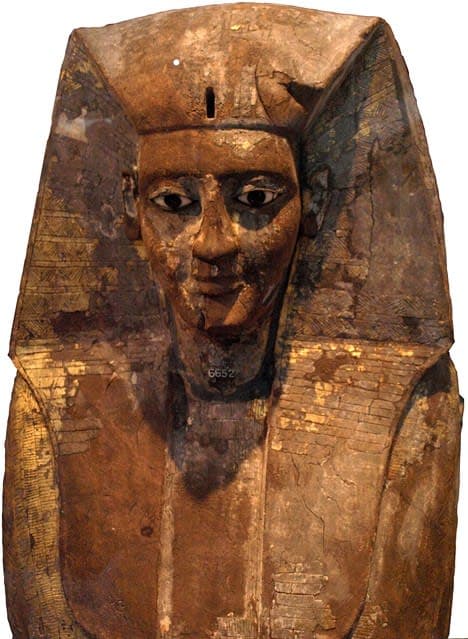
In the twilight of the Second Intermediate Period, when Egypt was fractured by the power of foreign Hyksos invaders in the north and the ambitions of local rulers in the south, the figure of Nebkheperre Intef (traditionally assigned to the Seventeenth Dynasty) rises as a symbol of a new, decisive era. This ruler is rightly regarded as the founder of a strong branch of Theban pharaohs whose activity ultimately became an existential threat to Hyksos domination in the Delta. Historical analysis indicates that Intef belonged to a new lineage distinct from his predecessors; evidence for this lies in the fact that he reused the amulet of his predecessor, Sekhemre Shedtawy Sobekemsaf II, which in ancient Egyptian practice often signaled a change of ruling line while maintaining continuity of authority.
His place in chronology is confirmed by crucial monuments. In the Karnak King List, the name of Nebkheperre Intef (under number 28) stands beside the great names of Senakhtenre and Seqenenre Tao II, who stood at the origins of the war of liberation. The archaeological similarity of his anthropoid coffin, now kept in the British Museum, to that of Seqenenre Tao II underscores their close cultural and temporal connection. Moreover, his throne name demonstrates an obvious linguistic and ideological affinity with the name Wadjkheperre Kamose, the last king of the Seventeenth Dynasty. Even the location of his tomb in the Dra Abu el-Naga necropolis — north of the burials of Sekhemre Wepmaat Intef V and Sobekemsaf II — indicates not that he was their ancestor, but that he laid the foundation for a new series of royal burials, marking the beginning of the “golden age” of Thebes.

A special place in the history of Intef’s reign is occupied by the so-called “Decree from Coptos,” dated to the 25th day of the 3rd month of the season Peret (Emergence) of the 3rd year of his reign. This text, roughly carved on the pylon of the temple of Senusret I in Gebtu (Coptos), is invaluable evidence of the administrative severity and political tension of the time. The essence of the decree was the exile of a nobleman named Teti, son of Minhotep, who had entered into a criminal conspiracy with the king’s enemies. Although modern scholars suggest that the “enemies” may have been thieves of magical figurines, the text is permeated with the spirit of a struggle for real power. At that time, Coptos was a key strategic hub: caravan routes to the Red Sea, Sinai, and Arabia passed through it. Any betrayal here opened the way for hostile desert tribes or Hyksos agents into the very heart of Upper Egypt.


The text of the decree is striking in its mercilessness. The king not only strips Teti of his position in the temple of the god Min but also curses his entire lineage, forbidding the mention of his name and ordering the destruction of any records about him in the “White House” (treasury). The curse extended even to future kings or nobles: anyone who dared to pardon the traitor would be deprived of the White and Red Crowns and the Throne of Horus. This severity indicates that Egypt at that time was fragmented into many small principalities, and Intef had to assert his authority with an iron hand to unite the country.
Despite political instability, Nebkheperre Intef proved himself an energetic builder and restorer. His full titulary reflected his ambitions: the throne name Nebkheperre (“Golden Creation of the Sun God”), the Horus name Neferkheperu (“Beautiful Creation”), the Nebty name Heruhernesetef (“He Who Is Upon His Throne”), and the personal name Intef. He carried out large-scale works at Coptos, leaving numerous stone slabs with reliefs, and at Abydos (Abedju), where he erected temple structures.
An interesting detail is the use of the title “heq” (ruler) before his cartouche on one of the stelae. This term, previously borrowed from the Hyksos, began under Intef to change its meaning, transforming from a designation of a dependent ruler into a full synonym for royal authority. The king’s entourage also reflected the era: his vizier Yahnefer and his son Nakht, who bore the title “Chief of Archers,” attest to the formation of a strong military and administrative elite that would later form the backbone of the Eighteenth Dynasty.
The martial character of Intef’s reign is confirmed not only by traditional reliefs showing him smiting Asiatics and Nubians with a mace in the presence of the god Min, but also by real finds. In his burial were discovered two bows and six arrows with flint arrowheads. Artifacts such as a panther head made of blue paste and a statuette from the Lee Collection depicting triumph over enemies further reinforce the image of the king as defender.
The history of Nebkheperre Intef’s burial in Dra Abu el-Naga is full of dramatic turns. According to the Abbott Papyrus, during the Twentieth Dynasty (centuries after the king’s death) a state commission inspected his tomb. Officials recorded an attempted robbery: thieves had cut a passage through the masonry 2.5 cubits deep but were unable to penetrate further because of the ruins of the neighboring tomb of an official named Yurai (or Shurai). At that time, the tomb held.


However, in 1827 it was finally opened by professional looters. The magnificent “rishi”-type coffin (decorated with feathers), a silver diadem with a golden uraeus (now in Leiden), and other treasures fell into the hands of collectors. A dramatic fate befell the two obelisks that stood before his pyramid: during an attempt to transport them to Cairo in 1881, the ship sank, and they remained forever at the bottom of the Nile.
The spiritual legacy of that era is considered to be the famous “Harper’s Song,” whose text, according to tradition, adorned the walls of Intef’s tomb. This philosophical poem, with its central motif “Eat, drink, and be merry, for tomorrow we die,” reflected the melancholic yet life-hungry worldview of people living in an age of upheaval.
Only in 2000 did an expedition led by Daniel Polz finally succeed in locating the tomb’s position. It was established that a small brick pyramid (11 by 13 meters) once rose above the burial, which has now completely disappeared. Although the physical monuments suffered from time and human actions, the name of Nebkheperre Intef has remained in history as that of the man who laid the first stone in the foundation of the great New Kingdom.


