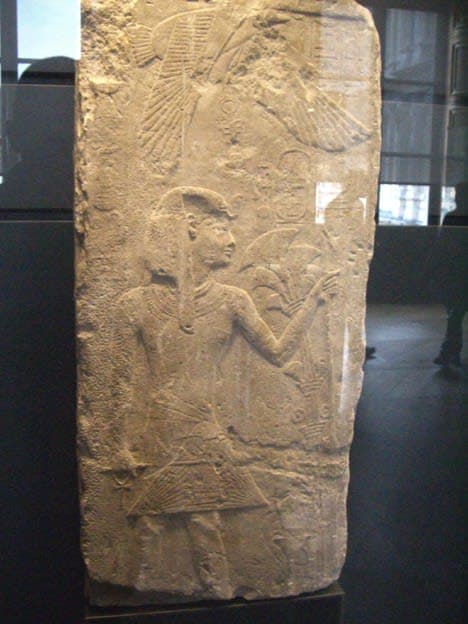

The origin of Menkauhor still provokes heated debate in scholarly circles. For a long time he was considered the son of Pharaoh Niuserre, based on reliefs from the funerary temple of the latter’s mother, Khentkaus II. There a prince named Khentkauhor is depicted, who was previously believed to have ascended the throne under the name Menkauhor.
However, archaeological discoveries of the 21st century have significantly revised this version:
A find in 2008 at Saqqara, in the mastaba of Prince Urkare, revealed an inscription bearing the name “Menkauhor.” Notably, the name is written without royal titles. This proves that the pharaoh bore this name even before coronation and was probably the second son of Niuserre or his close relative (possibly the brother of the aforementioned Khentkauhor).
Menkauhor is one of the few rulers of his era whose name is confirmed in all major historical documents: the Abydos and Saqqara king lists, as well as the Turin Papyrus — all of which record a reign of 9 years.
Despite the short duration (about 8–9 years), the pharaoh continued an active foreign policy. The only documented event of his reign was a large-scale expedition to the Sinai Peninsula. In Wadi Maghara a heavily damaged rock inscription has survived, indicating that Menkauhor, like his predecessors, sought to control valuable copper and turquoise deposits.

The main mystery of Menkauhor concerns his constructions: the pyramid Netjer-sut (“Sacred Place”) and the solar temple Akhet-Ra (“Horizon of Ra”). For a long time scholars could not locate either structure, although the titles of priests confirmed their real existence.
Today, the most likely candidate for Menkauhor’s tomb is Lepsius Pyramid No. 29 in northern Saqqara.

Why is it called “headless”? Only the massive base of the structure survives, while the upper portion was completely dismantled already in antiquity.
Evidence of attribution: Although no hieroglyphic inscriptions have been found inside, the architectural style (use of huge blocks of red granite, a simple chamber layout, and a sarcophagus lid made of gray slate) clearly points to the Fifth Dynasty.
Menkauhor apparently became the last pharaoh of the Old Kingdom to order the construction of a solar sanctuary — Akhet-Ra. Five known priests proudly mentioned service in this temple in their tombs. However, the “Horizon of Ra” itself still lies hidden beneath the sands of Abusir or Saqqara, remaining one of the most desired targets for modern Egyptologists.
The only surviving three-dimensional image of the pharaoh is a small alabaster statuette (47.5 cm high), presumably found in Memphis.
In this statue Menkauhor is depicted in the ritual attire of the Sed festival and wearing the White Crown of Upper Egypt. The craftsmen of that time paid close attention to details: the pharaoh’s eyes are outlined with cosmetic shading, and the facial features, despite damage to the nose and beard, convey the majesty of the monarch.


