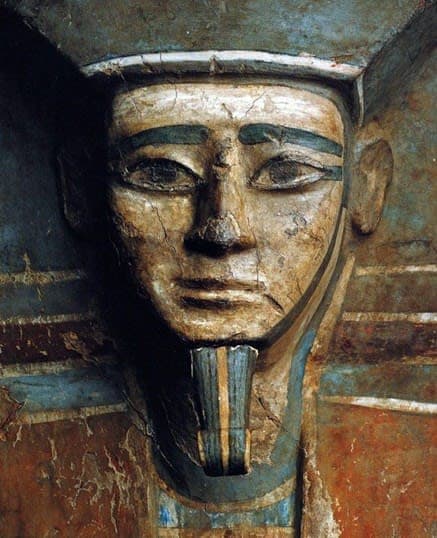
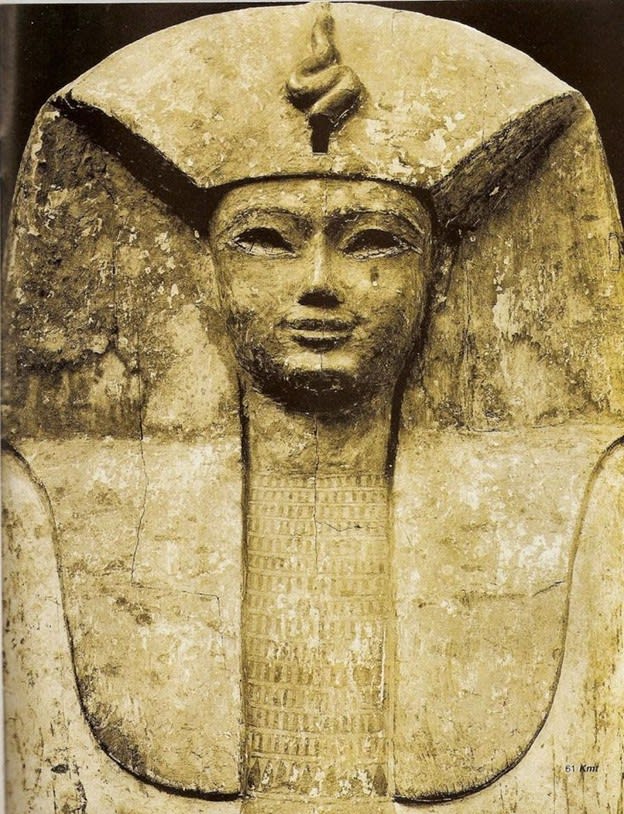
After the tragic death of Seqenenre Tao II on the battlefield, the Theban throne passed to Kamose, a figure as resolute as he was enigmatic. The question of his relationship to his predecessor and successor, Ahmose I, remains the subject of intense debate among Egyptologists. The traditional view regarded him as the son of Seqenenre; however, the absence of his name from the lists of the deceased king’s numerous children and the significant age difference between him and the young Ahmose point to a different picture. Most likely, Kamose was the brother of Seqenenre — an adult, experienced man who assumed power at a critical moment when Egypt needed not a child on the throne but a leader. To strengthen his legitimacy, he apparently married his brother’s widow, the great queen Ahhotep I, in whose sarcophagus objects bearing his name were later found.

Upon ascending the throne, he adopted the programmatic throne name Wadjkheperre, meaning “He Who Causes the Creation of the Sun God to Flourish.” The root wadj (greenery, prosperity) symbolized the awakening of the land after the long winter of foreign domination. His Horus name became Sedjef-tawy (“He Who Nourishes the Two Lands”), and his personal name was Kamose (“Born of the Ka”). In inscriptions he proudly styled himself pa heq ken — “the brave heq-ruler,” boldly appropriating this title from the Hyksos and filling it with new meaning — the meaning of true authority and valor.
At the beginning of Kamose’s reign, Egypt presented a bleak spectacle, divided into three parts. Kamose ruled the territory from the First Cataract of the Nile to Cusae. To the north, from Memphis to Avaris in the Delta, the Hyksos held power. To the south, beyond Elephantine, lay the Kingdom of Kush.
A particular humiliation for Kamose was that the Hyksos king Aauserre Apopi and the ruler of Kush were allied. Apopi condescendingly referred to the Nubian king as his “son,” emphasizing the vassal dependence of the south on the north and effectively squeezing Thebes in a vice. This situation became the spark from which Kamose ignited the flame of the war of liberation.
In the third year of his reign, Kamose convened a council of nobles. The surviving sources — the “Carnavon Tablet I” (a school copy on wood) and two magnificent Karnak stelae — convey the drama of this meeting. Kamose addressed his entourage with bitter words:
“I sit in alliance with an Asiatic and a Nubian… My desire is to liberate Egypt and to crush the Asiatics.”
However, the nobles, accustomed to the stability of a “bad peace,” showed caution. They pointed out that the Hyksos allowed Egyptians to pasture cattle in the Delta, while the southern borders were protected by the fortress of Elephantine. “We are secure in possession of Egypt,” they insisted, preferring economic comfort to national pride. But Kamose was unyielding. For him, the very existence of a foreigner in Avaris was an insult to the title “King of Upper and Lower Egypt.”

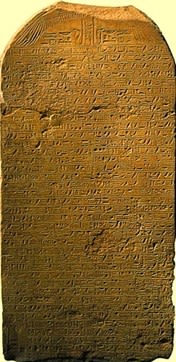
Without waiting for the consent of his timid advisers, Kamose equipped a powerful fleet and army, reinforced by contingents of Medjay — brave Nubian mercenaries. The offensive was swift. The forces moved down the Nile, exploiting the element of surprise. The first major target was the city of Nefrusi (“Nest of the Asiatics”), where the Hyksos ally Teti, son of Piopi, was entrenched. Kamose besieged the city, repelled a relief attempt, and at dawn the next day breached the walls. The city was devastated, and the plunder was so great that it brought fame to the campaign throughout the south.
The Second Karnak Stela describes the subsequent triumph. Kamose did not merely wage war — he punished. He destroyed a Hyksos fleet of 300 ships, captured the harbor of Per-Djedkenu, and advanced north to the XVI and XVII nomes, seizing the city of Saka. His tactics were ruthless: cities of collaborators were turned into “mounds of ashes,” erasing even the memory of their betrayal. From Saka he dispatched a detachment of archers to seize the oasis of Djesdjes (Bahariya), effectively taking control of the western desert routes.
At the height of the campaign, Kamose’s soldiers accomplished a feat that changed the course of history. In the desert they intercepted a messenger from the Hyksos king Apopi to the ruler of Kush. In the letter, Apopi implored the Nubians to attack Thebes from the rear while Kamose’s army was occupied in the north, promising to divide the Egyptian lands equally. The interception of this message thwarted the enemy’s plans and allowed Kamose, having secured his rear, to return triumphantly to Thebes. He entered the capital amid popular jubilation, adopting a new epithet — Kamose-ken (“Kamose the Victorious”).
Contrary to earlier assumptions, Kamose likely subdued Nubia even before the main thrust northward. This is indicated by his inscriptions at Arminna and Toshka. It was then that he subdued the Medjay tribes, transforming them from potential enemies into his most loyal elite warriors.
An interesting detail is the rock inscriptions where Kamose’s name appears alongside that of the young Ahmose I. Both are styled “Given Life,” indicating a period of coregency in the final years of Kamose’s life (year 4 or 5). Kamose likely understood that his time was limited and was preparing his nephew (or brother) to continue the great cause.
Kamose’s reign ended suddenly, around his fifth year. The circumstances of his death remain shrouded in mystery — whether he fell in another clash or died of wounds is unknown. His small brick pyramid at Dra Abu el-Naga remained undisturbed for a long time, as confirmed by the Abbott Papyrus some 450 years later.
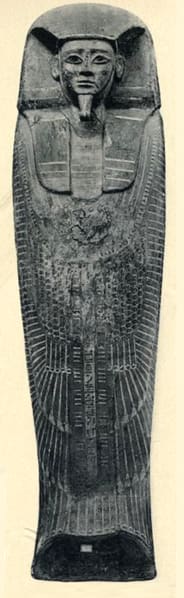
However, in 1857 researchers Auguste Mariette and Heinrich Brugsch discovered his mummy not in a splendid tomb but in a modest, unadorned coffin hidden within a heap of construction debris. The mummy had largely disintegrated, but inside were found the treasures of a warrior: a dagger of gold and silver, amulets, and a pectoral bearing the name of Ahmose. This modest burial suggests that the soldier-king died in the midst of war, and the country simply had no time to erect a monument worthy of his greatness. Unfortunately, the mummy itself was lost in the nineteenth century, left among debris after examination.
Although Manetho formally begins the Eighteenth Dynasty with Ahmose I, it was Kamose who made this possible. He broke the psychological barrier of fear before the Hyksos, demonstrated the superiority of Egyptian arms, and unified the country’s resources for the final blow. Kamose did not live to see the fall of Avaris, but it was his fury and political will that transformed a small Theban principality into the nucleus of a future empire.


