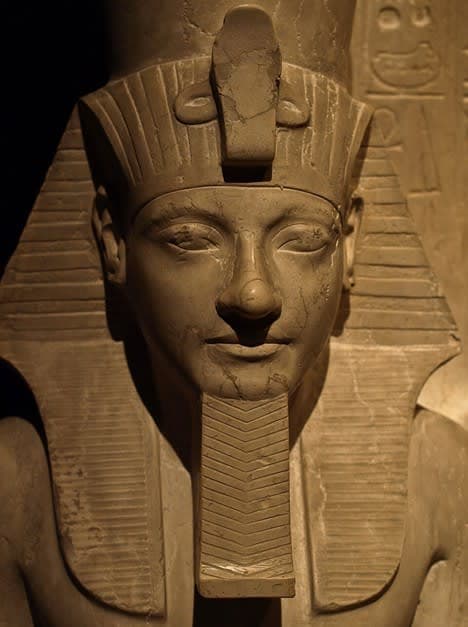

Horemheb originated from a family of nomarchs of the city of Ha-nisa (Greek Hipponon), the “House of the King,” located in the 18th nome of Upper Egypt. His name, meaning “Horus in celebration,” he bore in honor of the local falcon-headed god, to whom he invariably attributed his incredible rise. History keeps silent about his parents, which only underscores his status as a man who owed his success exclusively to talent and will.
Horemheb’s personal life was marked by two marriages. His first wife, Amenia, was his faithful companion during the years of service under Tutankhamun but died before his accession. His second wife was Mutnedjmet. Historians still debate her происхождение: was she the younger sister of Nefertiti or the daughter of the aged pharaoh Ay? Be that as it may, she was unable to leave Horemheb an heir — her mummy was found in a Memphite tomb beside the remains of a premature child, which became a personal tragedy for the pharaoh whose line ended with him.
Horemheb’s military career began already under Amenhotep III, but his true ascent came during the turbulent years of Amarna. It is believed that under Akhenaten he may have borne the name Paatonemheb, adapting to the demands of the Aten cult in order to preserve influence. However, Horemheb’s true hour came under the young Tutankhamun.
Having become “Chief over the Two Lands,” he concentrated in his hands all the military power of Egypt. While the boy-pharaoh restored temples, Horemheb led troops on Asiatic campaigns, effectively acting as ruler under a living king. In his tomb at Saqqara, built while he still held the rank of noble, he styled himself “Chosen of the King” and “Commander of Commanders,” emphasizing his exceptional political position.


The death of Tutankhamun triggered a chain reaction of events. When the widowed Ankhesenamun in desperation asked the Hittite king Suppiluliuma I to send her a husband-prince, the prince Zannanza perished under mysterious circumstances at the border of Egypt. The Hittites openly accused the “falcon” — hinting at Horemheb.
While the commander restrained Hittite expansion in the north, the vizier Ay occupied the throne. However, after his four-year reign, the army and the Theban priesthood, longing for a return to the old order, placed their stake on Horemheb. Under the patronage of the god Amun he was solemnly crowned in Thebes. The first act of the new king was to methodically erase the memory of his predecessor Ay, usurping his temples and obliterating his cartouches, thereby restoring the “legitimate” line of succession directly from Amenhotep III.

Horemheb understood that after decades of chaos Egypt needed not merely a god, but law. His Great Edict, inscribed on the walls of Karnak, became the first detailed code in history against corruption and abuse of power.
Fight against corruption: Officials were punished mercilessly for bribery and extortion of the population — by cutting off the nose and exile to the border fortress of Tjaru.
Army reform: The army was divided into two corps — Southern and Northern. The pharaoh personally guaranteed the material support of the soldiers from palace resources, turning the army into his principal pillar.
Judicial division: Judicial authority was clearly divided between the viziers of Memphis and Thebes, which allowed better control over the vast territories of the country.

Horemheb completely destroyed Atenism. By his order Akhetaten was razed to the ground. The stone blocks — talatats, from which the temples of Aten had been built, were used in the construction of the internal parts of new pylons at Karnak. The pharaoh proclaimed himself the direct heir of Thutmose III, whom he called “the father of his fathers.” By his order the architect Maya restored the tomb of Thutmose IV, which had suffered from robbers — this gesture symbolized Egypt’s return to its origins.
Interestingly, Horemheb, being a protégé of the army, did not allow the priests of Amun to seize absolute power: he appointed his military comrades — officers whose loyalty was beyond doubt — to the highest spiritual posts.
Horemheb also restored Egypt’s military prestige.
Nubia: In the semi-rock temple of Gebel el-Silsila his triumphant campaign to the south is recorded. On the reliefs the pharaoh appears as a “lion who invaded the land of Kush,” receiving tribute and submission from Nubian chiefs.
Syria and the Hittites: In the lists of his victories at Karnak appear Kadesh, Qatna, Tunip, and even northern Ugarit. Despite clashes with the powerful Hittite kingdom, Horemheb proved himself a wise diplomat, concluding peace on terms recognizing the current status quo, which allowed Egypt to catch its breath and accumulate strength.
Punt: Like his great predecessors, he organized an expedition to Punt. Reliefs depict the princes of this distant land bringing sacks of gold and swearing by the name of the pharaoh, “the sun of the nine foreign peoples.”
The question of the length of Horemheb’s reign remains the subject of heated debate. Manetho assigns him only 4 years, but the inscription of the nobleman Mes from the time of Ramesses II mentions Horemheb’s 59th year. Scholars believe that Horemheb deliberately included in his reign the years of the “heretics” (Akhenaten, Smenkhkare, Tutankhamun, and Ay), effectively being in power for about 27–28 years. His colossal building projects at Karnak (including the Hypostyle Hall and three pylons) confirm a long tenure on the throne.
Horemheb left behind two burial places. The first, in Saqqara, was built by him during his time as commander and became the resting place of his wives. The second, the royal tomb KV57 in the Valley of the Kings, amazes with its reliefs, some of which remained at the draft stage, giving us a unique opportunity to see the work of ancient masters “from within.”


Horemheb left no heir, but he did something greater: he chose his successor — his comrade-in-arms Paramessu, the future Ramesses I. Thus he became the father-founder of the new, 19th Dynasty and the creator of the state machine that enabled Egypt to reach the peak of its power under Seti I and Ramesses II the Great.


