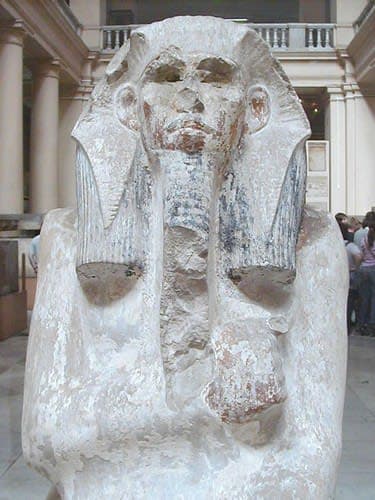
The era of Egypt’s Old Kingdom begins not merely with a new dynasty but with a genuine civilizational explosion, personified by Pharaoh Djoser. He entered history as a great innovator, sage, and the first builder of pyramids.
To his contemporaries this ruler was known by the “Horus name” Netjerikhet, meaning “Divine of Body.” It is this name that proudly shines on the monuments of his time. The name “Djoser” (“Holy” or “Sacred”) became attached to him much later, during the Middle Kingdom, as a kind of honorific title.
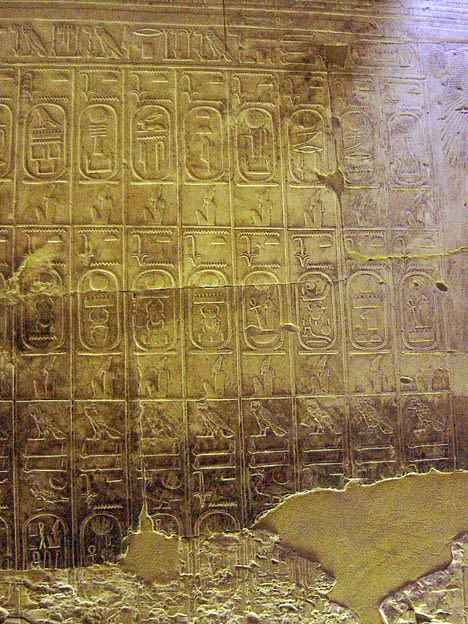
Ancient king lists preserved only echoes of his greatness. In the Abydos List he appears as Djoser-Sa, while the Turin Papyrus calls him Djoserti. The Greek historian Manetho, writing centuries later, transformed his name into Tosorthros and endowed the pharaoh with almost divine qualities, claiming that he was so skilled in medicine that he was regarded as the equal of the god Asclepius himself. The duration of his reign remains debated: the Turin Papyrus indicates 19 years and 3 months, whereas Manetho insists on 29 years. Modern scholars tend to place greater trust in the papyrus, although the scale of his achievements seems astonishing for such a short period.
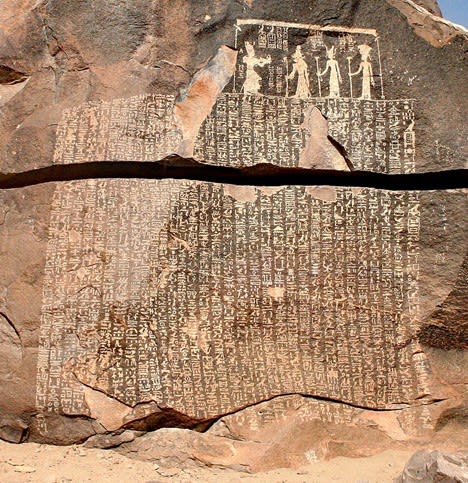
One of the most vivid legends about Djoser is the story recorded on the famous “Famine Stela” on the island of Sehel. Although the inscription itself dates to the Ptolemaic period, it recounts events from the 18th year of Djoser’s reign. According to the text, Egypt was struck by a terrible calamity: for seven consecutive years the Nile failed to rise high enough to irrigate the fields.
The pharaoh describes his condition as deep sorrow: “My heart is in great distress because of a grievous calamity… the granaries are opened, but only air comes out.” In search of salvation, Djoser turned to ancestral wisdom and learned that the keys to the Nile’s inundation lay in the hands of the god Khnum on the island of Elephantine. After the king’s personal visit to the temple and his sincere prayers, Khnum appeared to him in a dream and promised to restore fertility. In gratitude, Djoser granted the god’s priests the vast region of the Dodekaschoinos (“The Twelve-Mile Land”), establishing taxes for the temple from all who lived by the river’s bounty. This text emphasizes Djoser’s image as a pious ruler responsible for the well-being of the entire people.
Djoser was not merely a builder and philosopher; he was also an energetic warrior who expanded Egypt’s borders. His expeditions to the Sinai Peninsula were large-scale operations. At Wadi Maghara, reliefs survive in which Netjerikhet is depicted in the classic pose of a triumphant pharaoh, raising a mace over a fallen enemy.


The purpose of these campaigns was to seize the rich deposits of copper and turquoise. The expedition was not simply a raid but an organized military operation led by a full administrative staff: the commander of troops, the overseer of the desert region, and even a “royal carpenter.” These conquests supplied Egypt with resources and vast labor forces necessary for ambitious building projects in Heliopolis, Gebelein, and, of course, Saqqara.
Djoser’s most outstanding achievement was the creation of his funerary complex at Saqqara. Under the direction of the brilliant architect and chancellor (vizier) Imhotep, the world’s first pyramid was built — the first monumental stone structure in human history.
Construction of the pyramid proceeded in six stages, clearly demonstrating the evolution of engineering thought:
Initial mastaba: A traditional square structure made of limestone.
Expansion: Enlargement of the mastaba on all four sides.
Elongation: Addition of an eastern section, transforming the square into a rectangle.
Birth of the pyramid: Construction of four stepped tiers reaching 40 meters in height.
Final grandeur: Extension to the north and west with two additional steps added.
Facing: Covering the structure with white Tura limestone slabs.
The final height reached 61 meters. Yet the pyramid was only the visible tip of the complex. Beneath it lay a vast labyrinth, which archaeologists compare to a “rabbit warren.” At a depth of 27.5 meters was the pharaoh’s burial chamber, lined with Aswan granite and sealed by a three-ton block. Nearby were chambers prepared for his wives and children — one contained the remains of a child, while others yielded an extraordinary collection of 30,000–40,000 stone vessels bearing the names of even earlier pharaohs.

Djoser’s success is inseparable from the personality of Imhotep. His name was so significant that it was inscribed on the base of the pharaoh’s own statue — an honor rarely granted to a non-royal individual. Imhotep was “first after the king,” a priest of Heliopolis, physician, and sculptor. He was the first to risk using stone to imitate traditional materials: stone columns in his complex resemble bundled papyrus stalks, and gateways are carved as if made of wood. This “stone fairy tale” became the model for all subsequent generations of Egyptian builders.
An element of intrigue in Djoser’s biography is a massive mudbrick mastaba at Beit Khallaf. Inside were found seal impressions of Netjerikhet and his mother Nimaathap. Some scholars suggest that the pharaoh’s true tomb lies there, while the pyramid at Saqqara is merely a cenotaph (a symbolic burial). However, most researchers believe that Beit Khallaf served as the burial place of the queen mother or another high-ranking member of the royal family.
Djoser was revered throughout Egyptian history. Two thousand years later, kings of the Twelfth Dynasty erected statues in his honor, and priests of the Twenty-Sixth Dynasty continued to celebrate the cult of his spirit. He remained in the memory of posterity as the ruler who not only mastered stone but also succeeded in negotiating with the gods themselves, securing eternal prosperity for his state.


