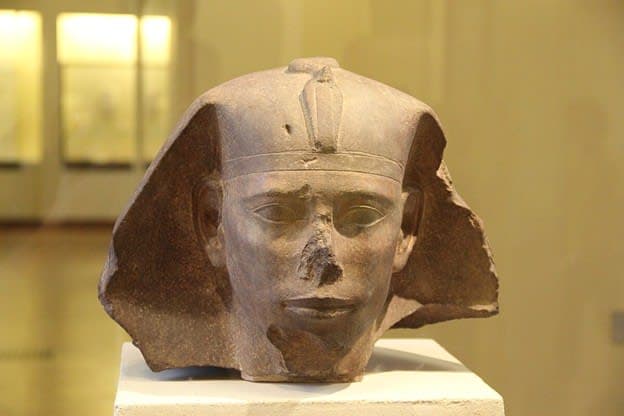

Djedefre entered history as a ruler who carried out a crucial theological transformation. His name, which translates as “Ra Has Established Himself” or “Ra Endures,” became the first royal name in Egyptian history to incorporate the name of the sun god Ra. It was under Djedefre that the epithet “Son of Ra” (Sa-Ra) was introduced into the official titulary of pharaohs, becoming for millennia an essential attribute of Egyptian kingship. This indicates a sharp rise in the influence of the Heliopolitan priesthood and the definitive establishment of the solar cult as a state priority.

His Horus name — Kheper (“Manifested”) or, according to other versions, Netjerkhet (“Sacred Body”) — likewise emphasized his divine nature.
The question of how Djedefre came to power was long debated. Although ancient authors such as Manetho placed him after Khafre and Menkaure, older king lists (Saqqara and Abydos) clearly identify him as Khufu’s successor. Decisive proof of his immediate succession was the discovery of his cartouche on the sealing blocks of the “dock” containing Khufu’s solar boat. This indicates that Djedefre presided over the burial ceremonies of his great predecessor — a role that, according to Egyptian tradition, confirmed his legitimate right to the throne.
The length of his reign remains uncertain. The Turin Papyrus records 8 years, whereas Manetho attributes 25 years to him. However, an inscription referring to the “11th cattle count” found on blocks near Khufu’s pyramid may indicate that he ruled at least 11 years (if the count was annual) or possibly about 22 years (if conducted every two years).


Little is known about internal affairs during this period, but surviving evidence suggests a continuation of Khufu’s active policies. Like his father, Djedefre dispatched large expeditions to the Dakhla Oasis in the Libyan Desert. The purpose of these hazardous journeys was to obtain rare mineral pigments. At the foot of a cliff known as the “Waters of Djedefre’s Mountain,” storage facilities and wells were established to support Egyptian penetration deep into the desert.
Records also mention the construction of a monument to the goddess Bastet and the production of gigantic granite slabs over 7 meters high, demonstrating the advanced level of stoneworking at the time.
The Pyramid at Abu Rawash: “Star of Sehedu”
Unlike his father and brothers, Djedefre chose not the Giza Plateau but a rocky elevation at Abu Rawash, 10 kilometers to the northwest, for his burial monument. This decision was not due to modesty but to strategic calculation: Abu Rawash is the highest point in the Memphite region. The pyramid, named Sekhedu-Djedefre (“Djedefre Is the Star of Sehedu”), was intended to dominate the entire Delta and the Giza Plateau.
Architecturally, Djedefre’s pyramid differed from the “Horizon of Khufu”:
Whereas Khufu’s pyramid gleamed with white limestone, Djedefre ordered the lower courses of his monument to be clad in imposing red granite from Aswan.
The original base measured 106.2 meters, and its height may have reached 66 meters.
The burial chamber was constructed using an “open pit” method — a massive trench cut into the bedrock and later covered with stone blocks.
Unfortunately, Djedefre’s pyramid became a victim of its convenient location. From Roman times until the nineteenth century it was used as a quarry. Archaeologist William Flinders Petrie noted that even in his day up to 300 camels per day carried away building stone from the site. Today only a “pathetic heap of ruins” and a deep shaft of the burial chamber remain.

One of the most disturbing discoveries at Abu Rawash was a trench for a solar boat about 10 meters deep. Instead of a vessel, archaeologists found hundreds of fragments of the pharaoh’s statues, deliberately smashed with particular brutality. Among these fragments was the famous red sandstone head of a sphinx — the earliest known example of a sphinx bearing the portrait features of a pharaoh.
The intentional destruction of Djedefre’s images led scholars to suspect dynastic conflict. It is hypothesized that his brother and successor Khafre (Chephren) may have seized power in a coup and attempted to erase Djedefre’s memory by destroying his cult statues. Nevertheless, despite this apparent “damnatio memoriae,” Djedefre’s cult survived discreetly: during the Saite Revival (26th Dynasty), priests once again performed rites in his honor, acknowledging him as an important link in the great lineage of pyramid builders.


