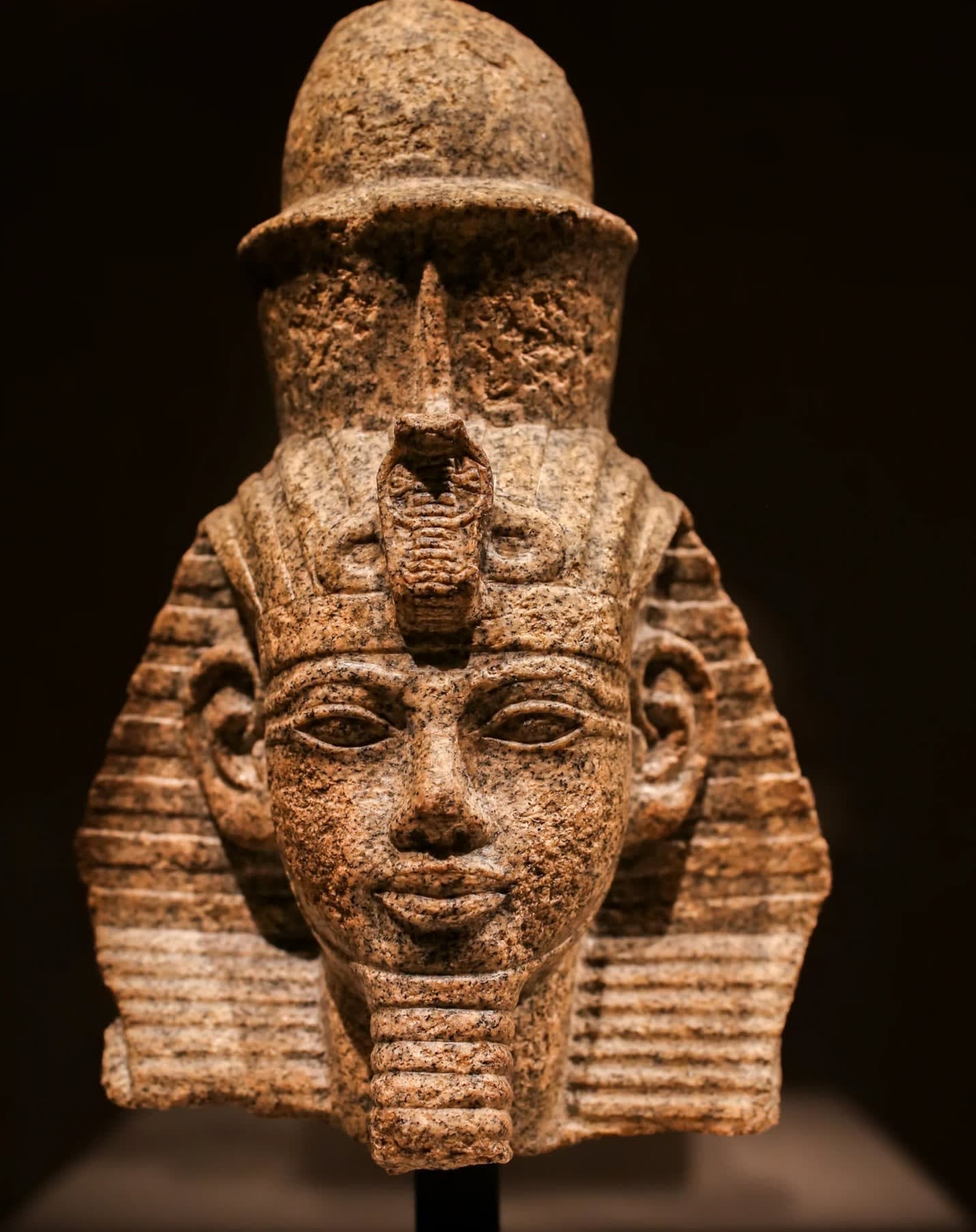

Amenhotep III, whose name means “Amun is satisfied,” was born in Thebes sometime between 1440 and 1390 BCE. His parents were Pharaoh Thutmose IV and his secondary wife, Queen Mutemwiya. The fate of the prince had been predetermined in advance: documents confirm that he was proclaimed heir during his father’s lifetime. However, the throne came to him too early — the boy was not yet ten years old when Thutmose IV died prematurely.
The first years of the young king’s reign passed under the guardianship of a regent, who was most likely his mother. This was a period of stability: the transition of power proceeded so smoothly that not a single key noble lost his position. The vizier and High Priest of Amun, Ptahmose, even strengthened his standing, effectively becoming the right hand of the young monarch.
In the very first year of his reign, Amenhotep III committed an act that violated centuries-old canon: he chose as “Great Royal Wife” Tiye, a girl of non-royal origin from the provincial city of Akhmim. Her parents, Yuya and Thuya, were noble but did not belong to the ruling house (although there are hypotheses about their distant kinship with the founders of the dynasty).

Tiye became not merely a wife but a full co-ruler. She was a woman of exceptional intelligence and energy, whose influence on state affairs was acknowledged even by foreign monarchs. The strength of their union is evidenced by commemorative scarabs — a series of “information bulletins” of the time distributed throughout the empire. On them, the pharaoh recorded the most important events: from their wedding to the creation of the giant artificial lake Birket Abu in 15 days, built especially for Tiye.
The couple had many children: the eldest son Thutmose (who died young), the future reformer Amenhotep IV (Akhenaten), the possible successor Smenkhkare, and five daughters. Later, following ancient traditions of self-deification, the pharaoh elevated his elder daughters — Sitamun and Isis — to the rank of “Great Royal Wives,” emphasizing the sacred character of his family.

Egypt under Amenhotep III became a “golden magnet” for the entire Ancient Near East. The pharaoh used dynastic marriages as an instrument of geopolitics. His harem was replenished with princesses from the greatest powers:
The Mitannian princesses Gilukhepa and Tadukhepa;
Daughters of the Babylonian kings Kurigalzu I and Kadashman-Enlil I;
Princesses from Arzawa and Syrian principalities.
Curiously, this diplomacy was a “one-way game.” When the Babylonian king requested an Egyptian princess as a wife, Amenhotep replied with a famous refusal: “Never has a daughter of the king of Egypt been given to anyone.” Egyptian gold was so abundant that Tushratta, king of Mitanni, wrote in his letters: “In the land of my brother, gold is like dust underfoot.” This correspondence, which became part of the Amarna archive, reveals a world of intrigue, gifts, and supplication before the pharaoh’s power.

Amenhotep III transformed Thebes into an architectural wonder. In the art of this period, massiveness of form was combined with extraordinary softness of lines.
Luxor Temple: One of the most harmonious structures of antiquity, dedicated to Amun-Ra.
Karnak: The pharaoh erected a new pylon and a temple of the goddess Mut here.
Malqata Palace: An enormous suburban complex, the “House of Rejoicing,” with luxurious paintings.
Mortuary Temple and the Colossi of Memnon: His funerary temple was the largest in Egypt but was not spared by time. Only two colossal statues have survived, each 21 meters high and weighing about 700 tons — the famous “Colossi of Memnon,” which guarded the entrance to the sanctuary.
These grand projects were overseen by the king’s namesake — the sage Amenhotep, son of Hapu, who was later deified by the Egyptians.

Amenhotep III advanced self-deification further than all his predecessors. He proclaimed himself Neb-Maat-Ra (“Lord of Truth, the Sun”) and the “Visible Sun” (Aten) while still alive. His cult was promoted in Nubia (Temple at Soleb), and at Sedeinga a temple was built where his wife Tiye was worshipped as a goddess. The pharaoh sought to demonstrate that he himself was the embodiment of the world order — Ma’at.
Although his reign was remarkably peaceful, in his fifth year he conducted a campaign in Nubia to suppress a revolt led by the chieftain Ikheny. Inscriptions pompously describe a “lion tearing apart his enemies,” although in reality the campaign was led by the viceroy Merimose.
Toward the end of his reign, the situation in Asia began to deteriorate. The movement of the Habiru (outcasts) emerged, and in Syria an aggressive state of Amurru arose under Abdi-Ashirta. From the north, the growing power of the Hittite kingdom posed a threat. The Hittites captured Qatna and began pressing Egypt’s allies, while Amenhotep limited himself largely to diplomatic gestures and small detachments.

The health of the “Solar Pharaoh” also declined. Toward the end of his life he suffered from obesity and serious illnesses (likely problems with his teeth and joints). The Mitannian king even sent him an idol of the goddess Ishtar, famed for her healing power, in hopes of easing the suffering of his “brother.”
Amenhotep III died in the 38th year of his reign at the age of about 40–50. His original resting place in the Valley of the Kings (WV22) was abandoned, and his mummy was later transferred to the cache KV35.
He left to his son, Amenhotep IV (Akhenaten), a country bathed in gold yet standing on the threshold of colossal religious and foreign-policy upheavals. The traits of the “solar deity” that Amenhotep III had begun to assume would soon become the foundation for the radical Aten reform, forever changing the history of Egypt.


