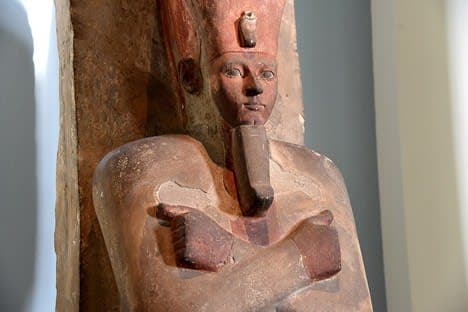

The question of dating the reign of Amenhotep I is one of the most fascinating detective stories in Egyptology. In the Ebers Papyrus, a record has been preserved of the heliacal rising of Sirius in the 9th year of his reign.

Astronomical calculations show that if the observation was made from Memphis, the year would be 1537 BCE, and if from Thebes — 1517 BCE. Most scholars favor the “Theban” option, which gives us an accession date of around 1526 BCE (although the date 1546 BCE also remains under discussion).
Having assumed power (probably at about 20 years of age after the death of his elder brother Ahmose-Sapairi), the king donned the sacred titulary:
Throne name: Djeserkare (“Holy Spirit of the Sun God”).
Horus name: Kauaf (“He Who Is Inherent in the Bull-God”).
Personal name: Amenhotep (“Amun Is Satisfied”).
Amenhotep I systematically expanded the domains established by his father. The pharaoh personally led a campaign up the Nile. The famous warrior Ahmose, son of Ebana, reports that the king slew a Nubian chieftain in the midst of his warriors. The campaign was so rapid that the fleet returned to Egypt from the “Upper Well” in just two days. The commander Turi was appointed “King’s Son of Kush,” and Egyptian presence advanced to the island of Sai, where a temple was erected.
In the west, Amenhotep fought the Libyan tribes of Kehek (possibly ancestors of the Libu), preventing their attempts to penetrate the Nile Delta. As for Syria and Palestine, direct records of Amenhotep I’s campaigns are scarce; however, his successor Thutmose I stood on the Euphrates already in the second year of his reign. This would have been impossible without deep penetration into Asia accomplished by Amenhotep I. The architect Ineni confirms this by mentioning “Asiatic copper” brought by the king as booty.

The wealth of Nubia and trophies from Asia enabled Amenhotep to undertake grand construction projects.
Karnak: Here he erected massive gates over 10 meters high made of dazzling Tura limestone and an alabaster sanctuary whose doors were covered with sheets of copper and electrum.
Medinet Habu: The pharaoh built here the first mortuary temple, surrounded by a garden and an artificial lake.
Deir el-Bahri: A mudbrick shrine of the goddess Hathor was created, where Amenhotep I was depicted alongside Mentuhotep, emphasizing continuity from the great kings of the Middle Kingdom.
One of the king’s most important achievements was the foundation of Deir el-Medina — a special settlement of craftsmen who built royal tombs. The cult of Amenhotep I and his mother Ahmose-Nefertari flourished there for centuries; the workers revered them as divine patrons of their craft.
Amenhotep I died at about 40 years of age, having lived, in the words of the architect Ineni, “in happiness and peace.” Since he probably died without surviving heirs (his firstborn Siamun died in childhood), the throne passed to Thutmose I.
The mummy of Amenhotep I was found in the Deir el-Bahri cache. It is unique in that Egyptologists chose not to unwrap it, preserving intact the exquisite funerary mask and garlands of delphinium flowers. The king’s coffin, surprisingly, proved to be modest — made of painted wood, in contrast to his lifetime wealth.



