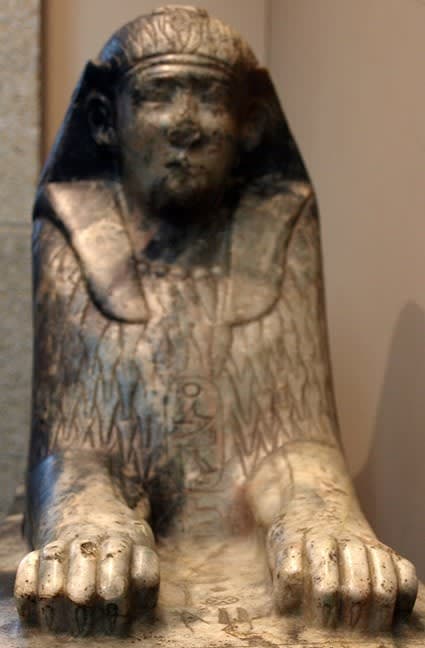

The question of how Amenemhat IV came to power remains one of the most intriguing mysteries of Egyptology. He succeeded the great long-lived Amenemhat III, possibly after a brief period of coregency. Numerous artifacts in which their cartouches stand side by side point to this. Nevertheless, the inclusion of his throne name — Maakherure (“The True of Voice is the Sun God”) — in the Abydos and Saqqara king lists confirms that he was recognized as a legitimate and independent ruler.

The identity of his mother, a woman named Hetepi, is shrouded in mystery. In the temple of Renenutet at Medinet Madi she is explicitly called the “mother of the king,” yet the absence of the titles “king’s wife” or “king’s daughter” has given rise to the hypothesis that she did not belong to the ruling house. This makes the origin of Amenemhat IV himself controversial: whether he was the son of Amenemhat III by a non-noble concubine or his grandson is unknown. If he was a son, then he ascended the throne already at a mature age, which would explain the relative brevity of his reign.
Despite the shortness of his rule, Amenemhat IV proved himself an energetic administrator who maintained control over all key regions of Egyptian influence.
Egyptian presence in Nubia remained unshaken: an inscription at Kumma from the 5th year of his reign records measurements of the Nile level at the Second Cataract. In his 2nd year, the pharaoh sent the assistant treasurer Sahathor to Wadi el-Hudi to obtain amethysts.
Particularly significant were the expeditions to Sinai (Wadi Maghara and Serabit el-Khadim). Monuments record mining operations in the 4th, 6th, 8th, and 9th years of his reign. It is important to note that these were the last large-scale state expeditions of the Middle Kingdom; the next Egyptian inscription would appear here only 200 years later, under Ahmose I in the New Kingdom.

Egyptian dominance in Syria and Lebanon at this time was unquestionable. The rulers of the city of Byblos continued to bear the Egyptian title “hati-a” (prince) and to write their names in hieroglyphs. In the tomb of Prince Ibshemuabi, luxurious gifts from the pharaoh were found: an obsidian box in a gold setting and an elegant vase.
On the Red Sea coast, at Wadi Gawasis, recent excavations uncovered an ostracon describing an expedition to the legendary land of Punt in the 8th year of the reign under the leadership of the scribe Djedi. Evidence of his activity (stelae of the 7th year) has also been discovered at Berenike.
Amenemhat IV saw his mission as completing the grand projects of his predecessor.
He finished the construction of the elegant temple of the cobra goddess Renenutet and the god Sobek, originally begun by Amenemhat III. Archaeologists discovered here not only the foundations of the sanctuary but also entire quarters of administrative buildings and granaries.

He is also likely the author of a temple in northeastern Faiyum. In Sinai he completed the development of the sanctuary of Hathor.
In the country’s principal religious center at Karnak, a pedestal of a sacred barque decorated with the names of both Amenemhats was found, emphasizing the unbroken continuity between their reigns.

Several expressive monuments have survived to the present day, including a diorite sphinx and fragments of yellow quartzite. The British Museum preserves a personal item of one of his officials — a cosmetic box belonging to the “keeper of the kitchen” Kemen, inscribed with the pharaoh’s name.
The eternal resting place of Amenemhat IV is considered to be the Southern Pyramid at Mazghuna, located near Dahshur. Although no direct inscriptions bearing the king’s name have been found there, its architectural style — a labyrinth of passages and the use of mudbrick — unmistakably points to the end of the Twelfth Dynasty.
The pyramid had a base of about 52.5 meters. Its design represented the height of engineering ingenuity in protection against robbers:
Southern entrance: Instead of the traditional northern one, the entrance was hidden in a deep shaft on the south.
Blocking stones: Inside were two niches with massive stone blocks intended to be slid into place after the burial, permanently sealing the passage. Curiously, one of the blocks remained in its niche.
Quartzite monolith: The burial chamber was crowned with a gabled roof, and inside stood an empty quartzite sarcophagus.
Undulating wall: The entire complex was surrounded by an unusual wavy mudbrick wall, behind which stood a mortuary temple with a hall for offerings.
After the death of Amenemhat IV, who left no male heirs, the throne passed to his sister (or widow) Neferusobek. With her brief reign, the great era of the Twelfth Dynasty came to an end, leaving Amenemhat IV in history as the last great “Amun-is-at-the-head” ruler of classical Egypt.


