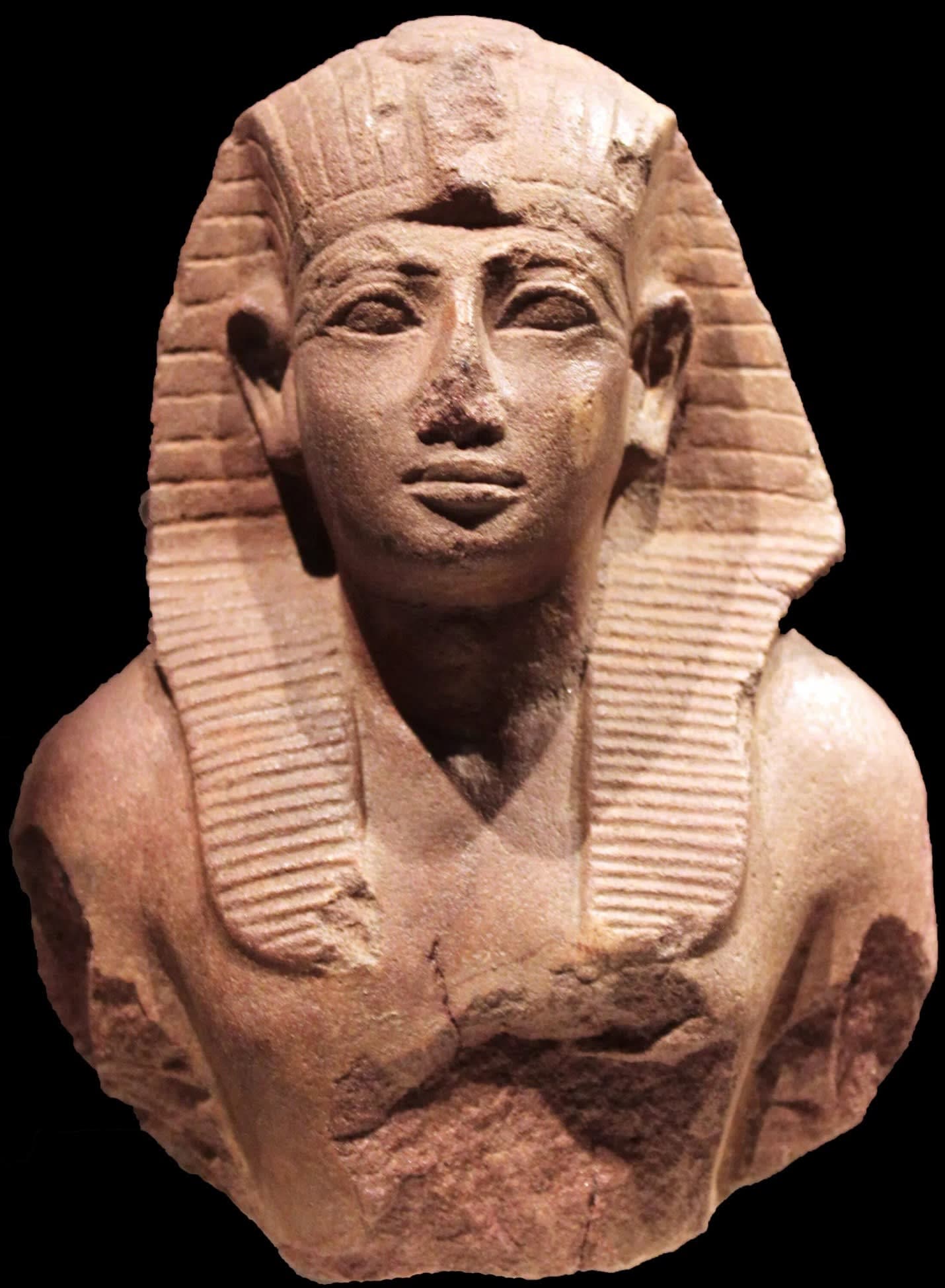

Amenemhat II was the son of Senusret I and his principal wife, Queen Neferu (Neferu). His path to power began with a three-year period of co-regency with his father, which ensured a smooth and legitimate transfer of the throne. At the time of Senusret I’s death, Amenemhat was already a mature man — historians suggest he was about 40 years old.
In total, he spent 39 years on the throne (including the years of co-regency), living to a venerable age for that era — about 75 years. His personal name, Amenemhat (“Amun is at the head”), emphasized loyalty to the Theban god, while the shortened forms Ameni or Amenu were commonly used by contemporaries.
Amenemhat II’s reign entered history as a period of relative calm and unprecedented expansion of foreign contacts. Although fragments of annals (the Memphis Chronicle) mention a military campaign in southern Palestine in the first year of his reign, the remaining thirty years were marked by diplomacy.
One of the most striking testimonies to Egypt’s wealth and international influence was the discovery in the foundation of the temple of Montu at Tod. Archaeologists found four bronze chests bearing the pharaoh’s name, filled to the brim with:
Silver cups from Lebanon and the islands of the Aegean Sea
Babylonian cylinder seals
Amulets made of lapis lazuli
Since silver at that time was valued in Egypt more highly than gold, these gifts (or tribute) underscored Egypt’s status as a global power. The pharaoh’s influence extended as far as Syria and Mesopotamia: a sphinx bearing the name of his daughter Iti was found at Qatna, and in Byblos local rulers began using Egyptian hieroglyphs.
Peaceful trade led to a stream of migrants from Asia into Egypt. Texts increasingly mention “Asiatic” men and women, and the Egyptian language began to borrow Lebanese words. Contacts with Crete are confirmed by finds of Minoan pottery at Abydos and Lahun.
Amenemhat II revived the tradition of long-distance maritime expeditions. In the 28th year of his reign, the official Khentikhetyur returned safely from the legendary land of Punt (modern Somalia region). The expedition arrived at the port of Saww (Wadi Gawasis), bringing myrrh and incense. Contemporary texts also mention the noble Huy, who visited Punt a record eleven times, indicating the regularity of such voyages.


The internal economy also prospered through intensive resource extraction:
Sinai: Mining of copper and turquoise (expeditions in the 4th and 24th years)
Aswan: Quarrying granite for colossal statues (Year 14)
Nubia: Lower Nubia was so pacified that the official Sihathor became the first Egyptian to reach the region of Heh near the Second Cataract, inspecting gold mines and “striking terror” among local inhabitants by the pharaoh’s name alone
For his burial, Amenemhat II chose Dahshur, returning to the necropolis of the Old Kingdom to symbolically link his dynasty with the great builders of the past. His pyramid, named Ameni-sekhem (“Possession of Ameni”), is known today as the “White Pyramid” because of its dazzling white limestone casing.
The construction technique was unusual: stone walls radiated outward from the center, and the spaces between them were filled with sand. Although the pyramid is now badly ruined, its internal chambers preserve evidence of complex architecture — the burial chambers were roofed with massive blocks arranged in an inverted “V” shape.

The most significant discoveries in the complex were the intact tombs of the princesses It and Khenmet. The jewelry found there is considered the pinnacle of Middle Kingdom craftsmanship:
Diadems of extremely fine gold wire decorated with flowers of lapis lazuli and carnelian
Gold pendants shaped like butterflies and shells
Bronze daggers with gold hilts inlaid with precious stones
In the 33rd year of his reign, the aged pharaoh appointed his son Senusret II as co-ruler. Inscriptions on the rocks at Aswan preserve instances where the son’s name appears before the father’s — perhaps because the 70-year-old Amenemhat II had already transferred actual governance to his heir.
The pharaoh died in the 39th year of his reign. Manetho reports a mysterious detail that Amenemhat was killed by court eunuchs, but many modern historians believe this is an error and that the Greek historian confused him with his grandfather Amenemhat I.
Amenemhat II left Egypt at the zenith of its power: fabulously wealthy, open to the world, and internally cohesive. His reign became the foundation upon which his successors would build the greatest empire of the ancient Near East.


