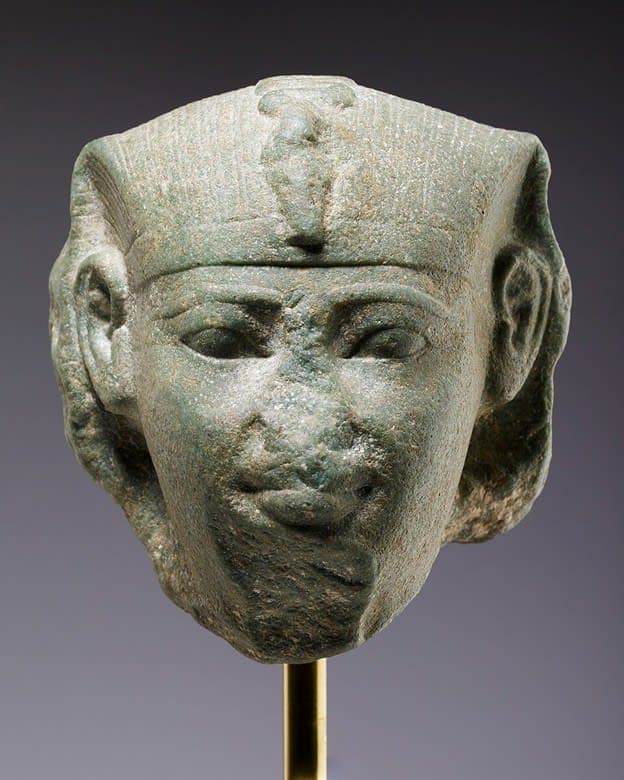

It is likely that the future pharaoh was the same vizier of Nebtawyre Mentuhotep IV, the last ruler of the Eleventh Dynasty, who bore the name Amenemhat. During his vizierate he proved himself a man of exceptional zeal and patriotism. A vivid example of his ambitions was the expedition deep into the Eastern Desert to Wadi Hammamat. Amenemhat personally led the detachment to deliver an enormous stone block for his king’s sarcophagus. Historians believe that the personal participation of such a high-ranking official in a distant and dangerous expedition was rather a political gesture demonstrating his influence and dedication to the cause. A stone slab from Lisht, on which the names of Mentuhotep IV and Amenemhat I are inscribed side by side, suggests that in the final years of his predecessor’s reign Amenemhat was his official co-ruler. It is possible that Mentuhotep IV himself was preparing his energetic vizier to assume the crown, realizing that only such a man could keep the country from disintegration.

To legitimize the authority of a man “of non-royal origin,” a powerful ideological foundation was created. The famous “Prophecy of Neferti,” whose action is formally set in the era of the Old Kingdom, foretold the appearance of a savior named Ameni (a shortened form of Amenemhat). According to the text, the sage Neferti predicted to Pharaoh Sneferu a time of chaos, when “the land will perish” and “people of a foreign land will drink from the river of Egypt.” In this moment of darkness, a king from the south was to arise, born to a woman from Nubia in Upper Egypt. He would unite the Two Crowns, reconcile Horus and Seth, and build the “Wall of the Ruler” to forever block the path of Asiatic nomads.

Upon ascending the throne, the pharaoh adopted the name Amenemhat, meaning “Amun is at the head” or “Amun is before him.” This was a programmatic manifesto: until then Amun had been only a local deity of Thebes, but with the accession of the new dynasty he began to displace the ancient war god Montu, gradually becoming the supreme lord of the pantheon. Manetho confirms the Theban origin of the dynasty, although Amenemhat I sought to emphasize his connection with earlier rulers as well, venerating Intef II the Great as his ancestor.

The pharaoh’s throne name — Sehetepibre (“He who pacifies the heart of the Sun god”) — reflected his desire for harmony in the state. His Horus and Golden Horus name was Nemmesut, translated as “Repeating the history of creation” or “He who is reborn.” This emphasized his role as the demiurge of a new era, called to restore order from the chaos of the First Intermediate Period.
The transfer of power was not peaceful. Amenemhat I had to suppress at least two claimants. One of them was a Nubian named Segersenti, who found support among southern tribes. To fight the rebels, the pharaoh used a fleet commanded by his loyal associate Khnumhotep I. As a reward for his loyalty, Khnumhotep was appointed nomarch of the Sixteenth nome (Mahedj).
Amenemhat’s internal strategy was based on a delicate balance. On the one hand, he relied on loyal nobility; on the other, he harshly suppressed separatism among local rulers. The pharaoh personally toured the country, restoring ruined cities, installing boundary markers, and regulating access to Nile water. As inscriptions state, he “destroyed evil,” forcing cities to recognize ancient borders and the rights of their neighbors. At the same time, he preserved certain privileges for the nomarchs, creating a system in which strong central authority coexisted with flourishing regional cultural centers. To control property in the nomes, a network of “royal stewards” subordinate to the central treasurer was introduced.
Seeking to distance himself from the Theban priesthood and be closer to the troubled northern frontiers, Amenemhat I took a radical step — he moved the capital. The new center became the city of Itjtawy (“Seizer of the Two Lands”), founded near the Fayum oasis, 24 km south of Memphis. The city was a powerful fortress with crenellated walls, serving as the military and administrative headquarters of the country. Legends of the splendor of the palace of Itjtawy claimed that its ceilings were of lapis lazuli and its walls of silver. Although almost nothing remains of the capital’s buildings, the very fact of its foundation secured for the Twelfth Dynasty the reputation of the “Itjtawy Dynasty.”

A turning point in the reign was a nighttime conspiracy. In his “Instructions,” Amenemhat bitterly describes how, after dinner, when he had fallen asleep, assassins burst into his chambers. The king had to fight alone in the darkness: “I awoke to fight, and I was alone… No strength has he who awakens at night; no fighter is one who stands alone.”
This incident permanently changed the pharaoh’s character, making him suspicious and grim. The main political consequence was the introduction of the institution of co-regency. In the 20th year of his reign he appointed his son Senusret I as full partner on the throne. A stela from Abydos confirms this fact: “Year 30 of Amenemhat corresponds to Year 10 of Senusret.” This practice ensured unprecedented stability in the transfer of power, which lasted for two centuries.
Amenemhat set forth his bitter lessons in the “Instruction,” which became a classic of Egyptian literature:
“Trust not even your brother, know not even your friend… Guard your life yourself even in the hour of sleep, for there is no loyal servant on the day of misfortune.”


Amenemhat I was a warlike ruler who personally led campaigns from Elephantine to the Delta. One of his greatest achievements was the defense of the northeastern borders. To stop uncontrolled migration of Asiatics, he built the “Wall of the Ruler” — a chain of powerful fortifications (probably in the Wadi Tumilat area) blocking the path of Bedouins.
In the 29th year of his reign, the pharaoh’s army defeated the region of Wawat and seized gold mines in the Allaqi Valley.
At the very end of the reign, Senusret I led a campaign against the Libyan Tjehenu tribes, bringing countless captives and livestock into Egypt.
Egyptians resumed copper mining in Sinai and bitumen extraction near the coast of Gebel Zeit.
Despite his devotion to Amun, the pharaoh restored temples throughout the country: Bastet in Bubastis, Ptah in Memphis, Osiris in Abydos. Expeditions to Wadi Hammamat under officials Intef and Idi continued to supply rare stone for royal needs.
Amenemhat built his pyramid, called Ka-nofer (“High and Beautiful”), at Lisht. It became a symbol of the revival of Old Kingdom traditions: during its construction, architects deliberately used blocks taken from the ruins of the pyramids of Khufu and Khafre. The entrance on the north side led to the burial chamber, which today is flooded by Nile groundwater and remains inaccessible to researchers.
The pharaoh died in the 30th year of his reign. “The Tale of Sinuhe” describes this moment with deep drama:
“In Year 30, in the third month of the Inundation season, on day seven, the god ascended to his heavenly horizon… the divine flesh merged with him who created it.”
It remains a mystery whether he was killed as the result of another conspiracy or died of old age, but his legacy was undeniable. He left to his son Senusret I a unified, powerful, and economically stable country. Amenemhat I ruled for 29 full years, laying the foundation for the most stable period in the history of Ancient Egypt, the echo of which resounded in texts and monuments for many centuries thereafter.


