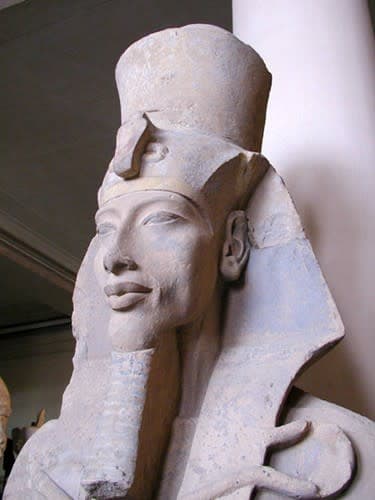

Akhenaten was born in Thebes as the second son of the “Solar Pharaoh” Amenhotep III and his powerful consort Tiye. His childhood passed in an atmosphere of the unprecedented splendor of the New Kingdom. For a long time, his elder brother Thutmose was considered the heir, but his early death cleared the path to power for Amenhotep IV. The question of whether he was a coregent of his father remains one of the most controversial in Egyptology: scholarly opinions range from a complete denial of coregency to recognition of a joint rule lasting 8 or even 12 years.
The pharaoh’s consort became the legendary Nefertiti — a woman of non-royal origin who occupied in official iconography a position unequaled by any queen before her. She was not merely a wife but an ideological collaborator of her husband, whose name was also written in a cartouche. In this union six daughters were born: Meritaten, Meketaten (who died in youth), Ankhesenpaaten (the future wife of Tutankhamun), as well as Neferneferuaten-tasherit, Neferneferure, and Setepenre.

Besides Nefertiti, Akhenaten had other wives: Kiya, who is often associated with the birth of the heir, and the Mitannian princess Tadukhepa. Genetic studies conducted in 2010 indicate that Tutankhamun was the son of Akhenaten and his own sister (known as the “Younger Lady” from tomb KV35), although the identification of the mummies still provokes debate.
The first years of Amenhotep IV’s reign did not foreshadow catastrophe. He continued his father’s traditions, worshiped Amun, and relied on the support of his mother, Queen Tiye. However, already in the second year of his reign the pharaoh began construction in Thebes of a grand temple in honor of Aten — the god embodying the solar disk.

The reform developed rapidly:
Technologies: To accelerate temple construction, talatat — small stone blocks — began to be used, allowing walls to be erected in record time.
Iconography: The image of Aten evolved from a man with a falcon’s head into a solar disk whose rays end in human hands bestowing life.
Ideology: In the fourth year of his reign Akhenaten celebrated the “Sed festival,” during which he proclaimed himself the sole divine embodiment of Aten on earth.
In the fifth year Amenhotep IV finally broke with the past. He changed his name to Akhenaten (“Effective for Aten”) and founded a new capital — Akhetaten (“Horizon of Aten,” now Tell el-Amarna), located 300 km north of Thebes on “virgin land” that had not previously belonged to any god.
The relocation of the court to Akhetaten marked the beginning of the “Amarna Period.” The new capital was built up with magnificent palaces (the facade of the Great Palace was almost 700 m long) and open-air temples where rituals were performed under the direct rays of the sun.
During this period Amarna art was born — a style that broke with age-old canons. Its characteristics include:
Realism and expression: Images ceased to be idealized. Akhenaten appears with a deformed skull, narrow shoulders, a heavy jaw, and a swollen abdomen. Scholars still debate whether this was a sign of a genetic disorder (Marfan or Fröhlich syndrome) or a deliberate symbolism of an androgynous god.
Family intimacy: For the first time the pharaoh is depicted in domestic scenes — he kisses his wife, holds his daughters on his knees, and mourns beside the bed of his dying daughter.


Literature: The “Great Hymn to Aten” appears, whose poetics and metaphors are strikingly close to the 103rd Biblical Psalm.
By the ninth year of his reign Akhenaten’s fanaticism reached its peak. He banned the cults of all the old gods, above all Amun. Throughout Egypt special detachments chiseled the names of the gods off obelisks and temple walls. The word “god” was replaced by the word “ruler,” and Aten was proclaimed the sole lord of the universe.

While the pharaoh was immersed in theological disputes, the Egyptian empire began to disintegrate. The Amarna archive (diplomatic correspondence on cuneiform tablets) preserved desperate pleas from vassals for help.

Hittite threat: The Hittite king Suppiluliuma I actively pressed Egypt’s allies in Syria.
Rebellions in Canaan: The ruler of Amurru, Aziru, and the leaders of the Habiru tribes seized coastal cities such as Byblos and Sidon.
Akhenaten, who once possessed his father’s immense gold reserves, became miserly, sending gilded wood instead of gold to his vassals and practically ceased to intervene in military conflicts, which led to the loss of northern territories.
Akhenaten died in the 17th year of his reign. The circumstances of his death remain mysterious. After him followed a short period of rule by enigmatic figures — Smenkhkare and the female pharaoh Neferneferuaten (who may have been Nefertiti herself or Meritaten).
Soon the throne was occupied by the young Tutankhaten, who under pressure from the old elite and the commander Horemheb changed his name to Tutankhamun, returned the capital to Memphis, and restored the cult of Amun. Akhetaten was abandoned, and the memory of Akhenaten was subjected to a curse (damnatio memoriae). In official king lists he was referred to only as the “enemy” or the “criminal from Akhetaten.”


