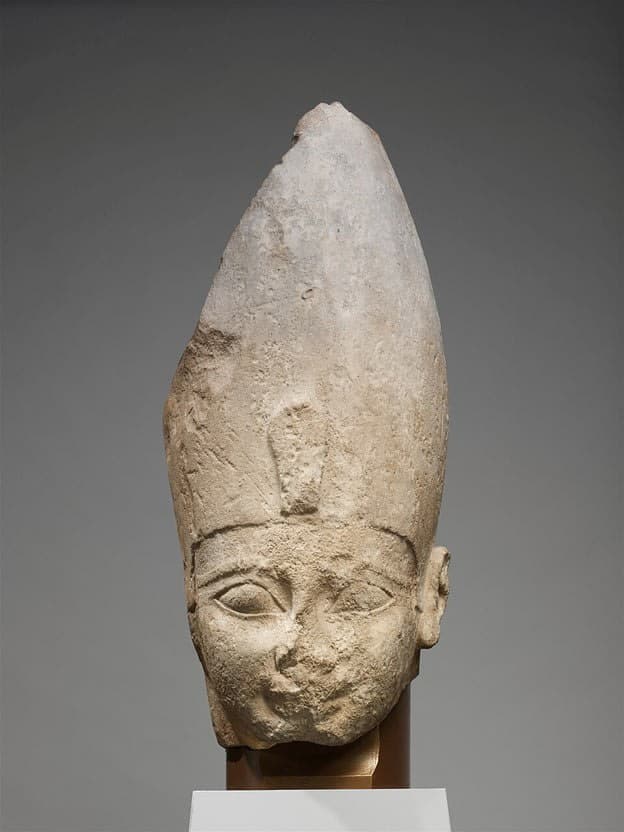
Ahmose ascended the throne at a very young age — probably around 16 years old. Behind him stood three monumental figures who shaped his character and policies:
Tetisheri — his grandmother, the “foremother” of the dynasty, whose authority was unassailable.
Ahhotep — his mother, who was not merely a regent but a true military leader. Hymns praise her as the one who “gathered the army, pacified Upper Egypt, and subdued the rebels.”
Ahmose-Nefertari — his sister and principal wife, who became the first “God’s Wife of Amun,” laying the foundation for the power of this cult for centuries.
At the beginning of Ahmose’s reign, there was a lull, as Egypt gathered strength after the deaths of Kamose and King Apopi. But when the war resumed, it became total. The principal testimony to these events is the biography of Ahmose, son of Ebana, a warrior from El-Kab who fought side by side with the pharaoh.
The siege of the Hyksos capital Avaris was prolonged and included fierce naval battles in the canals of the Delta. Ahmose I personally led the assaults aboard the ship “Shining in Memphis” (which suggests that the ancient capital had already been liberated earlier). The decisive moment was the storming of the city, presumably in the 15th year of the pharaoh’s reign. The Hyksos were defeated and demoralized, and they fled Egypt, leaving behind only captured spearheads as trophies.


Ahmose did not limit himself to expelling the enemy. To prevent any possibility of retaliation, he invaded Palestine and besieged the fortress of Sharuhen — the last Hyksos stronghold — for three years. After its fall, the power of the Asiatic nomads in the region was finally broken.
Having secured the north, Ahmose immediately turned south. In Nubia he carried out a “terrible devastation,” crushing the tribes of archers and restoring the ancient fortress of Buhen, which became the administrative center of the southern territories. It was under Ahmose that the office of the “King’s Son of Kush” originated — a viceroy who governed Nubia on behalf of the crown.

Toward the end of his reign (around year 22), Ahmose launched a campaign into Djahy (Western Syria, Phoenicia). Inscriptions from the quarries of Maasara mention that blocks for temples were transported by oxen captured in the land of the “Fenehu” (Phoenicians). This was Egypt’s first step toward becoming a global superpower.
Ahmose inherited a country in ruins. He reopened the quarries of Tura and Birsa and initiated large-scale restoration of irrigation canals and dams.
He paid special attention to Abydos, where he erected a unique complex:
A mudbrick pyramid and a terraced temple.
A particularly interesting monument is the “Tempest Stela,” which describes catastrophic rainfall and darkness. Modern scholars associate this text with echoes of the eruption of the volcano on the island of Santorini (Thera), which caused climatic upheavals throughout the Eastern Mediterranean.
Ahmose actively employed diplomacy. A Karnak inscription mentions the people of Keftiu (Cretans), who say: “We accompany him.” This indicates a possible military alliance with Minoan Crete against the Hyksos. Ahmose’s second wife, Inhapi, was likely a Libyan princess, which ensured the security of the western borders.

Ahmose had many children, though not all survived to adulthood. The heir became Amenhotep I, although the throne had originally been intended for Prince Ahmose-Sapairi, who died in childhood.
Ahmose I died at about 40 years of age after ruling for roughly a quarter of a century. His mummy, discovered in the Deir el-Bahri cache, reveals the appearance of a conqueror:
Height about 168 cm, robust build, broad shoulders.
Thick dark curly hair and the slightly protruding front teeth characteristic of his lineage.
Studies indicate that in the final years of his life the king suffered from arthritis, which is unsurprising for someone who spent years in the saddle and on the decks of warships.
His burial was supervised by his son Amenhotep I, who left his name on the wrappings of his father.


