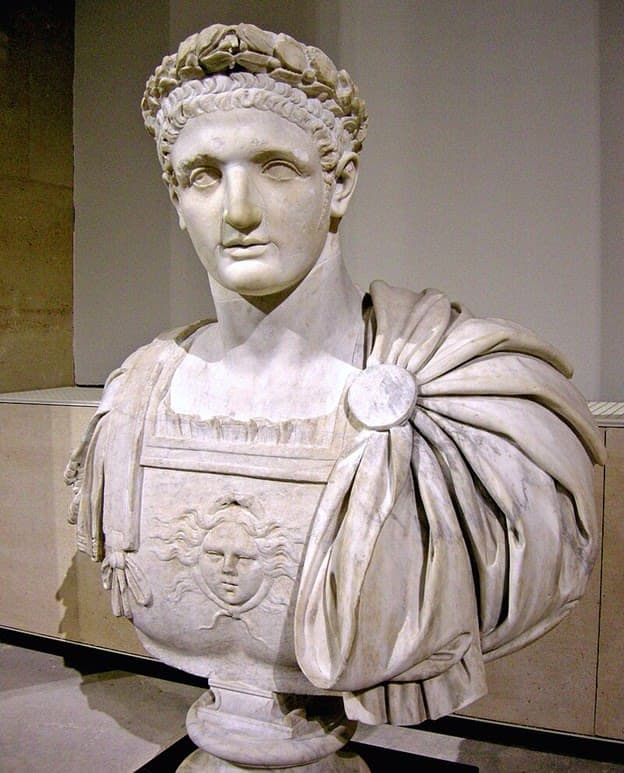

The future emperor Titus Flavius Domitian was born in Rome on October 24, 51 CE. He was the younger son of Vespasian and Flavia Domitilla the Elder, and the younger brother of Titus. His family, the Flavians, did not belong to the old Roman aristocracy, but it rose quickly.

Domitian’s great-grandfather, Titus Flavius Petro, was a common soldier who served in Pompey’s army. He fled the field at Pharsalus, but by marrying a wealthy woman he was able to provide for his son. Domitian’s grandfather, Titus Flavius Sabinus, made a fortune in tax farming and moneylending and, by marrying a noblewoman, secured senatorial status for his sons.
Domitian’s father, Vespasian, pursued a successful career quaestor, aedile, praetor and attained the consulship the year Domitian was born. Under Nero, Vespasian first fell into disgrace but, after Agrippina’s murder, was recalled to service. In 66, when revolt broke out in Judea, he was appointed commander of the Roman army.
Domitian lost his mother and sister when he was only fifteen. His father and brother were away on campaign, so he spent much of his youth far from his closest kin. His upbringing was likely overseen by his uncle, Titus Flavius Sabinus or perhaps even by Marcus Cocceius Nerva, the future emperor and Domitian’s successor.

Unlike Titus, Domitian did not receive an education at court, yet he was well educated. He studied rhetoric and literature, knew the poetry of Homer and Virgil, and wrote verse and legal treatises himself. Some historians, notably Tacitus, thought he used literary studies to conceal his true ambitions. Domitian was also an excellent archer and showed remarkable skill with the bow.
The historian Suetonius describes Domitian as tall, modest in appearance, with a handsome face but a large nose and slightly near-sighted eyes. With age he began to bald and grow stout; he was very sensitive about his baldness and even wrote a book on hair care. Pliny the Younger, by contrast, calls him “a monster of terrifying aspect.”
Ancient authors say Domitian lacked the charisma of his father and brother. He was suspicious, gloomy, and inclined to solitude traits perhaps linked to his isolated childhood. He lived through the upheavals of the 60s and the civil war, which surely shaped his character.
In 68 Nero’s suicide ended the Julio-Claudian dynasty. Chaos followed—the Year of the Four Emperors, when Galba, Otho, Vitellius, and Vespasian fought for power.

Vespasian, in Judea preparing to besiege Jerusalem, decided to wait and sent his son Titus to the new emperor, Galba. Galba was killed and Titus returned. War flared between Otho and Vitellius. Recognizing his strength, Vespasian entered the struggle. His forces in Judea and Egypt controlled Rome’s grain supply. His brother, Titus Flavius Sabinus, was city prefect of Rome.
After Vitellius defeated Otho, Vespasian’s legions proclaimed him emperor. Vespasian accepted and moved against Vitellius, leaving Titus in Judea. Domitian, meanwhile, was in Rome under house arrest as Vitellius’s hostage.
On October 24, 69, Vespasian’s army under Marcus Antonius Primus routed Vitellius’s forces. In desperation Vitellius tried to arrange a surrender, but his soldiers prevented it. On December 18, Vespasian’s supporters in Rome, led by his brother Sabinus, proclaimed him emperor, but were forced back to the Capitoline. Domitian sheltered with them.
On December 19 the Vitellians stormed the Capitoline; Sabinus was captured and executed. Domitian escaped by hiding with a temple watchman and disguising himself as a priest. On December 20 Vitellius was killed. Learning this, Domitian came out to the troops and was proclaimed Caesar. On December 21 the Senate officially declared Vespasian emperor.

Though the civil war had ended, Rome remained chaotic in the first days after Vitellius’s death. Order was restored by Mucianus, but Vespasian did not return to the capital until September 70. During this period the eighteen-year-old Domitian acted as the Flavian family’s representative in the Senate. He received the title Caesar and was appointed praetor with consular powers.
His authority, however, was purely nominal. In Vespasian’s absence real power lay with Mucianus, who made sure Domitian did not exceed his brief. Mucianus removed influential commanders in the city, including the praetorian prefect Arrius Varus, and prevented Domitian from drawing on the popular Antonius Primus.
Domitian sought military glory, but Mucianus curbed his ambitions, fearing the young and inexperienced Caesar would blunder. When the Batavian revolt broke out in Gaul, Domitian pressed for command, but, having learned victory was near, Mucianus tactfully dissuaded him. Domitian withdrew from public affairs and focused on literature.
Setbacks in politics and war were offset by success in his private life. Against his father’s plans—Vespasian wanted him to marry Titus’s daughter—Domitian fell in love with Domitia Longina and, securing her divorce, married her. Politically this suited Vespasian, since Domitia was the daughter of the influential general Gnaeus Domitius Corbulo, executed by Nero; the marriage helped Vespasian mend fences with the Senate.

In 73 a son was born to Domitian, but sadly died in childhood. Domitia received the honorific Augusta, and their son was deified. In 83 Domitian, for unknown reasons, expelled his wife from the palace and lived with his niece, Julia Flavia; the next year Domitia returned, and despite the rumors their marriage seems to have been happy.
In these years Domitian lived in the shadow of his brother. Returning victorious from the Jewish War, Titus was formally declared heir. He shared tribunician power with their father, held seven consulships, and commanded the praetorian guard. Domitian held only honorific titles and priesthoods, though frequent suffect consulships gave him valuable Senate experience.

After Vespasian’s death in 79, Domitian did not receive tribunician power, and his status did not change during Titus’s short reign. Dissatisfied, he suspected that his father had intended equal rights for him, but that Titus had forged the will. Titus’s sudden death in September 81 many blamed Domitian opened the way to the throne. Domitian hastened to the praetorian camp, promised a generous donative, and was proclaimed emperor.
Domitian quickly discarded the republican façade maintained by his father and brother. He believed the Roman Empire should be a divine monarchy ruled by a benevolent despot himself. He personally oversaw every aspect of government, from taxation to public morals.
He fought corruption among governors and officials. Under him the Senate lost all real power. Domitian preferred to appoint equestrians rather than senators to key posts, valuing loyalty and versatility over noble birth. He also spent much time away from Rome, underscoring that the true center of power was wherever the emperor was.
Domitian paid close attention to fiscal policy, seeking to stabilize the economy. He markedly raised the value of the currency, increasing the silver content of the denarius from 90% to 98%. In 85 a financial crisis forced a devaluation, yet even then the coin’s standard remained higher than under his father and brother. Strict taxation allowed that higher standard to be maintained for the next eleven years.
The chief expenditures were the army and a vast building program. Domitian poured enormous resources into rebuilding Rome, damaged by the fires of 64 and 80 and by the civil war of 69. He built, restored, or completed some fifty structures—second only to the achievements of Augustus. Major projects included an Odeon, a stadium, and the Flavian Palace on the Palatine. He also restored and enlarged many older buildings, including the Pantheon and the Temple of Jupiter Optimus Maximus, roofing the latter in gold. He also completed the Colosseum.


To win popular favor Domitian spent about 135 million sesterces on handouts and revived the tradition of state banquets. In 86 he reestablished the Capitoline Games contests in sport and the arts personally sponsoring them; he also staged gladiatorial combats, naval battles, and fights featuring women and dwarfs.
His military policy was chiefly defensive. He abandoned expansionist wars and focused on strengthening the frontiers. His most significant military achievement was creating the Upper Germanic–Raetian limes an extensive network of roads, forts, and watchtowers on the empire’s German frontier.

Despite this defensive stance, important wars were fought in Gaul and along the Danube against the Suebi, Sarmatians, and Dacians. The conquest of Britain, begun under his father, continued under Domitian: the governor Gnaeus Julius Agricola (77–84) pushed Roman control into Caledonia (modern Scotland). In 82 he defeated tribes previously unknown to the Romans. In 84 Agricola dealt the Caledonian army a heavy blow at Mons Graupius, but could not subdue the island fully, as much of the enemy escaped. In 85 Domitian recalled Agricola to Rome; Tacitus claimed the emperor envied his success. Though awarded triumphal honors, Agricola held no further office.
Soon after, needing reinforcements for the Dacian war, Domitian ordered the evacuation of the conquered territories in Scotland. Unpopular with commanders, the decision favored the treasury: Domitian deemed these distant, wild lands unprofitable.

Domitian’s relations with generals were fraught. Contemporary writers, especially Tacitus and Cassius Dio, faulted him for claiming others’ victories and blaming others for defeats caused by his orders. Yet he was very popular with the soldiers. He devoted three years of his reign to the army more than any emperor since Augustus and raised legionary pay by a third, for which the troops were deeply grateful.
In 83 Domitian launched a war against the Germanic Chatti. He came to Gaul under the pretext of a census and struck unexpectedly. For the campaign he created a new legion, I Minervia. At year’s end, apparently victorious, he returned to Rome and celebrated a triumph, taking the title Germanicus. Though accused of buying slaves and parading them as captives, historians deem this a fabrication. The war with the Chatti likely ended in 85, when the Taunus Mountains were secured and the frontier pushed to the Lahn and Main rivers.
Most of his campaigns were defensive. In 84–85, however, the Dacians, led by Diurpaneus, invaded Moesia, killed the governor, and apparently destroyed Legio V Alaudae. Domitian went in person to the Danube. The Dacians withdrew, and their new leader was Decebalus. The emperor refused peace and sent Cornelius Fuscus to prosecute the war.
Fuscus’s initial successes allowed Domitian to return to Rome, but in 86 Fuscus invaded Dacia, fell into an ambush, and was killed; the Roman army suffered a crushing defeat, losing weapons and equipment. In response Domitian again went to the Danube. He divided Moesia into two provinces and appointed experienced commanders there. Likely thanks to their efforts, the Dacian coalition fractured and Decebalus emerged as sole ruler.
In 88 the Roman general Tettius Julianus dealt the Dacians a bloody defeat at Tapae, approaching their capital, Sarmizegetusa. Julianus’s success bolstered Domitian’s image as a warrior emperor.
Soon Decebalus, seeing defeat looming, sent peace proposals to Domitian. The terms were these: Decebalus acknowledged himself a vassal of Rome, while Domitian supplied him with civil and military experts and paid regular subsidies. Historians judge that, thanks to Domitian’s decisive actions, Rome’s Danubian defenses held.
This was not Domitian’s only war. In 89 he faced hostile moves by the Quadi and Marcomanni, and in 92 by Sarmatians and Suebi; during these conflicts Legio XXI Rapax was destroyed. Details are unclear, but the future emperor Trajan may have taken part. On returning to Rome in 93, Domitian did not celebrate a triumph, being dissatisfied with the results. Some think he planned larger campaigns against the Sarmatians and Suebi, but died before he could carry them out.
In Africa, too, there were campaigns under Domitian. The Romans fought the Nasamones, who had risen against unbearable taxes; the legate Gnaeus Suellius Flaccus crushed them. Delighted, Domitian told the Senate he had “forbidden the Nasamones to exist.”
Little is known of Domitian’s actions in Numidia and Mauretania, but his policy likely prepared the way for further conquests and stronger frontiers. Legio III Augusta was redeployed closer to Mauretania, indicating Roman advances there.
In the East Domitian continued his father’s policy of preserving peace with Parthia, aiming above all to prevent Parthian expansion. To that end he annexed Commagene and Lesser Armenia adding some 291,000 square kilometers to the empire—stationed two legions there, and built many roads.
Rome also strengthened its position in the Caucasus. Key allies were the Iberians, who controlled the Darial Gorge; Domitian built fortifications for them. Friendly ties were forged with the Albani as well, allowing Rome to control the Derbent pass and guard against incursions from the Caucasus. In this way Domitian completed a ring of client kingdoms around Parthia.


In 88 a False Nero appeared, supported by the Parthians, but they soon handed the impostor over to the Romans. Even so, peace with Parthia was preserved.
Domitian was a zealous adherent of traditional Roman religion and used it to buttress his rule. He especially revered Jupiter and Minerva, regarding himself as their favorite. He restored the Temple of Jupiter on the Capitoline, roofing it in gold, and built a temple to Jupiter the Guardian on the spot where he had been saved in 69. He also founded a new legion named for Minerva and placed the goddess on his coinage.
He revived the imperial cult and ordered the deification of his brother Titus and Titus’s deceased son. Suetonius and Cassius Dio claim Domitian demanded to be addressed as Dominus et Deus (“Lord and God”), though official documents do not confirm this; the title may have originated with court flatterers. To strengthen his family’s cult, Domitian built the Temple of the Flavian Household.
In 85 Domitian appointed himself censor for life, giving him the right to oversee Roman morals. He combated adultery, punished corrupt officials, and kept order in the theaters. He harshly prosecuted Vestals who broke their vow of chastity, ordering one of them, Cornelia, to be buried alive.
He also persecuted certain religions and philosophical schools, expelling philosophers and astrologers from Rome and executing his cousin Titus Flavius Clemens on a charge of “atheism” (probably meaning adherence to Christianity).
Domitian’s suspicions were not unfounded. On January 1, 89, the legate of Upper Germany, Lucius Antonius Saturninus, rose in revolt with two legions. Germanic tribes promised aid, but a sudden thaw prevented them from crossing the Rhine; the revolt was swiftly crushed.


Domitian immediately went to the Danube and executed all the conspirators. Legio XXI Rapax was sent to the Danubian frontier, where it soon perished in battle with the Sarmatians. The other legions involved in suppressing the mutiny were duly rewarded.
The reasons for the uprising remain unclear perhaps senatorial displeasure at Domitian’s harsh rule, perhaps a soldiers’ revolt born of dissatisfaction. Domitian, for his part, took steps to prevent similar mutinies: he forbade stationing two legions in the same camp and limited the sum of money soldiers could keep in a legionary chest.
Under the principate the Senate formally retained republican structures, but its real power was sharply limited. Most emperors observed this tacit arrangement; Domitian did not. From the outset he emphasized his autocracy and showed contempt for aristocrats, stripping the Senate of important decisions and relying instead on a small circle of intimates and equestrians.
The hostility was mutual. After Domitian’s assassination the Senate immediately decreed damnatio memoriae his statues were destroyed and his name erased from official records. Senatorial historians, notably Tacitus and Suetonius, portrayed him as a tyrant.
Even so, Domitian sometimes made concessions, granting consulships to his opponents and to provincials, something unlike his father and brother. These gestures may have been part of a cunning plan: he gave them power and, at the faintest sign of discontent, tried them, confiscated their property, and executed them.
Repression of the Senate intensified after Saturninus’s revolt in 89. Though some historians, such as Brian Jones, think fewer senators were executed under Domitian than under Claudius, his autocratic style and humiliating treatment of the aristocracy made him hated by the elite. Seeing their lack of support, Domitian remarked that “rulers fare worst of all: when they uncover conspiracies, they are not believed until they are killed.”
His suspicions proved justified. He was assassinated on September 18, 96, in a plot organized by his own courtiers. His chamberlain Parthenius played the key role; the killers were the freedman Maximus and the steward Stephanus. The praetorian prefects Titus Flavius Norbanus and Titus Petronius Secundus probably took part as well, fearing for their lives.
A few days before, prophecies of his death and of Minerva’s inability to protect him were reported. On the day itself, Stephanus, hiding a dagger in a bandage on his arm, entered Domitian’s bedroom, handed him a note about a conspiracy, and stabbed him as he read. The wounded emperor was finished off by seven other conspirators.

Domitian, just shy of his forty-fifth birthday, was dead. His body was carried out on a cheap bier, and his ashes were buried in secret by his nurse, Phyllis.
That same day, September 18, 96, the Senate proclaimed Marcus Cocceius Nerva emperor. He was an ideal choice: elderly, childless, and a man whose career had flourished under the Flavians. He was chosen to avert civil war and had probably known of the plot in advance.
The Senate rejoiced. It at once pronounced damnatio memoriae on Domitian. His statues were melted down, his arches torn down, and his name erased from public records. He became one of the few emperors whose memory was officially cursed.
The army, however, met his death with great displeasure. Unrest broke out in many provinces. The praetorian guard demanded the assassins’ execution, but Nerva refused. Under pressure he adopted the army’s favorite, the general Trajan, as his successor. This avoided further turmoil and opened the way to the new Antonine dynasty.
Domitian’s death marked the end of the Flavian dynasty and the beginning of a new era in Roman history.


