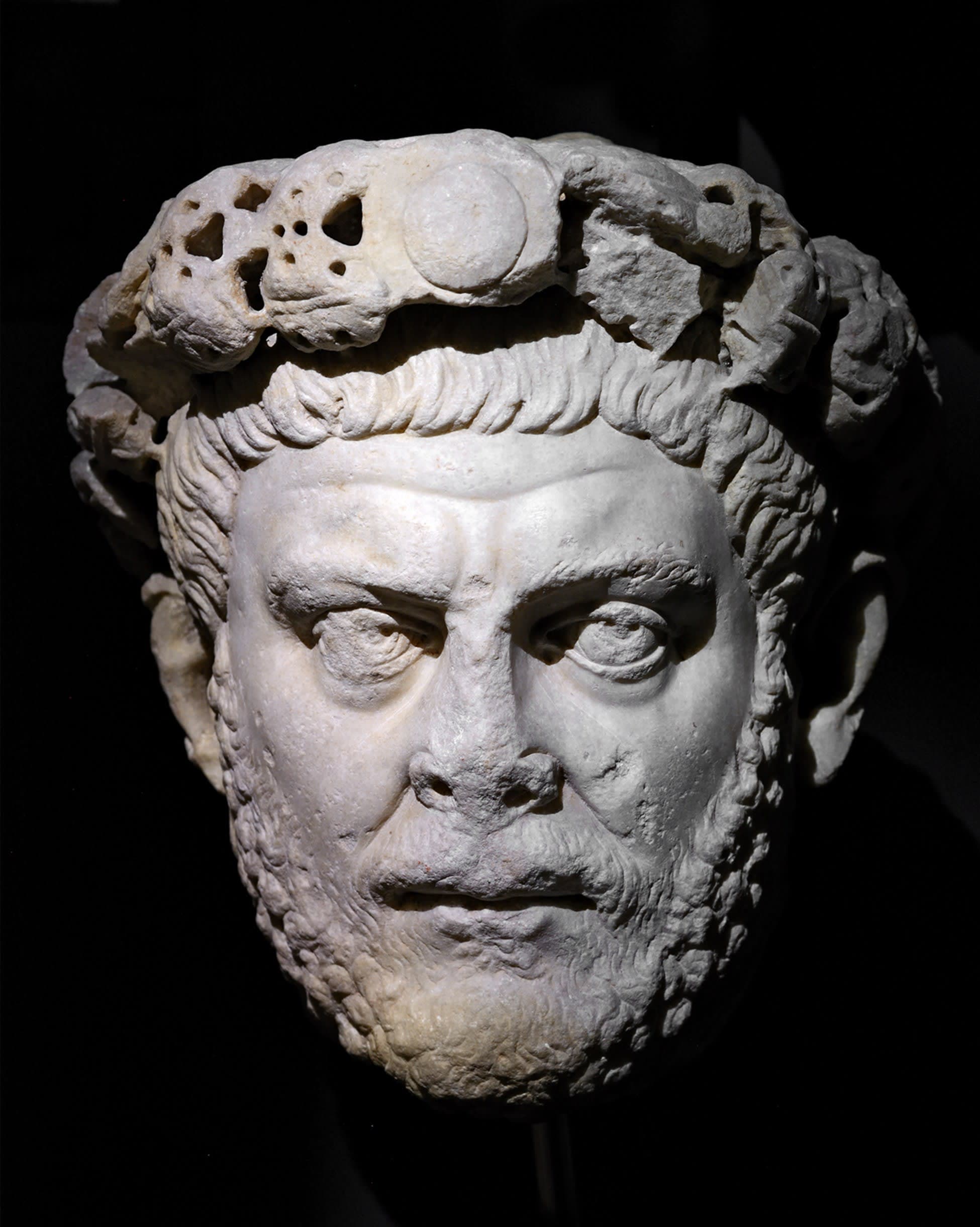

The life of Diocletian is a story of an incredible rise from the very lowest ranks of society. He was born around the year 245 in a place called Diocleia, located near modern-day Shkodër in Montenegro. His birth name was Diocles (or Valerius Diocles), and he came from the lower classes his father was the son of a freedman, which made the future emperor the grandson of a slave.
He began his career as a simple soldier under Emperor Gallienus, but thanks to his diligence and talent, he quickly advanced through the ranks. During the military campaigns that took him from one end of the empire to the other, he thoroughly studied its internal structure and problems. There is a legend that in Gaul a druidess predicted he would become emperor if he killed a boar (in Latin, aper). As we shall see, this prophecy played its role.

Under Emperor Carus, Diocles served as commander of the domestici, the emperor’s personal guard. In 284, Carus suddenly died during a campaign against the Persians. His son and successor Numerian was treacherously murdered by his father-in-law, the praetorian prefect Arrius Aper. When this became known, on September 17, 284, the soldiers proclaimed Diocles emperor, who, fulfilling the old prophecy, immediately and publicly executed Arrius Aper. Upon ascending the throne, Diocles changed his name to the more majestic Diocletian.

The reign of Diocletian marked the beginning of a new era in Roman history, known as the Dominate. He not only strengthened imperial authority but made it completely monarchical: the emperor became the supreme source of all laws and stood above all his subjects. The Senate was deprived of its former influence, and the empire was finally transformed into an absolute monarchy.
His first step was to restore the unity of the state. In the civil war, he defeated Carinus, another son of Emperor Carus. To the astonishment of contemporaries, Diocletian showed extraordinary clemency, refraining from persecuting his enemies. Understanding that it was impossible for one man to rule such a vast empire, he brought to power his loyal friend Maximian. At first, Maximian received the title of Caesar, and after successfully suppressing the peasant revolt of the Bagaudae in Gaul in 285, he was granted the title of Augustus.

While Maximian defended the western frontiers against the Germans, Diocletian dealt with eastern issues, ensuring security in Asia and Europe. He successfully settled relations with Persia and protected the Danube borders from the Sarmatians, restoring control over Dacia and Raetia. During this period both emperors adopted new honorary titles: Diocletian became known as Jovius (of Jupiter), and Maximian as Herculius (of Hercules).
Realizing that even ruling together was still extremely difficult, Diocletian, at a council in Milan in 291, decided to create a new system of government the Tetrarchy (rule of four). He chose two new Caesars: Constantius Chlorus and Galerius Maximian. To strengthen dynastic ties, Constantius married Maximian’s stepdaughter, and Galerius married Diocletian’s daughter.
The empire was divided into spheres of influence: Constantius received Gaul and Britain, Galerius all of Illyria, Maximian Italy, Africa, and Spain, while Diocletian kept the eastern provinces for himself and, in essence, remained the moral head of the entire system. He also took into his care the young Constantine, the son of Constantius, who accompanied him on campaigns in the East.
The formal establishment of the Tetrarchy took place on March 1, 293.
This system proved highly effective in defending the borders. Constantius successfully reclaimed Britain from the usurper Carausius and pacified Gaul. Maximian defended the Rhine frontier against the Germans and subdued the Moors in Africa. Galerius, under Diocletian’s guidance, successfully fought tribes along the lower Danube and then waged war against Persia.
During the Persian campaign, Galerius suffered a defeat, for which he was publicly humiliated by Diocletian, being forced to walk in purple on foot behind the emperor’s chariot. However, in his second campaign, Galerius achieved a crushing victory, forcing the Persians to cede five provinces beyond the Tigris.
In 298, Diocletian went to Egypt to suppress the rebellion of the usurper Achilleus. After an eight-month siege, he captured Alexandria and severely punished the rebels. For better administration, Egypt was divided into three provinces. He also issued a curious edict ordering the burning of all ancient books on alchemy, which was explained by his desire to deprive the Egyptians of a source of wealth.
One of Diocletian’s most controversial decisions was the Great Persecution of Christians, which began in 303. The emperor sought to uphold paganism as the state religion and launched a brutal campaign against the new faith, ordering the closure of churches and the destruction of sacred scriptures. These persecutions led to the emergence of many martyrs.


Having restored peace within the empire and on its borders after twenty years of intense labor, Diocletian finally arrived in Rome. However, his parsimony in organizing celebrations provoked mockery. Soon he left Rome and returned to his residence in Nicomedia, where he fell ill.
At Galerius’s insistence, on May 1, 305, Diocletian performed an unprecedented act—he solemnly abdicated power. Maximian was also forced to abdicate. Galerius and Constantius received the title of Augusti, and the new Caesars became Flavius Severus and Maximinus Daia.
Diocletian spent the rest of his life in seclusion in his homeland, at his estate in Salona, cultivating cabbages. When Maximian and Galerius tried to persuade him to return to power, he replied with the famous phrase:
“If you could see the cabbages I have grown, you would not bother me with your proposals.”
The last years of his life were overshadowed by physical suffering and the disrespectful attitude of the new rulers. The circumstances of his death remain a mystery; according to various sources, he died on December 3, either in 313 or 316. Ultimately, despite all his efforts, his struggle against Christianity proved futile in the very year of his death, Constantine the Great issued an edict granting freedom of religion.
Diocletian left behind not only the colossal ruins of the baths built by Christians but also a legacy that forever changed the Roman Empire, transforming it from a Principate into an absolute monarchy.


