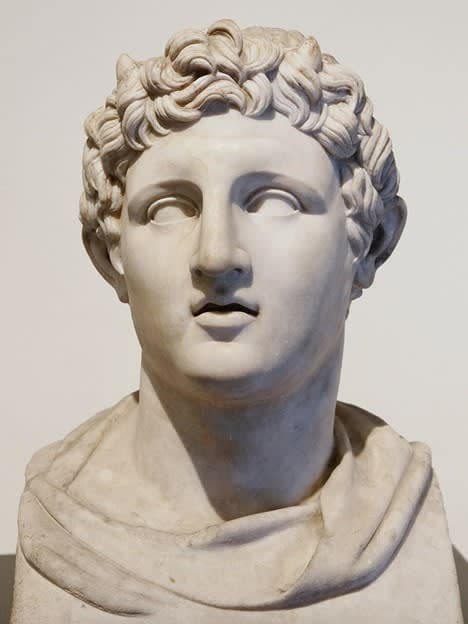

Demetrius was born at the beginning of 336 BC, in the same year that Alexander the Great ascended the Macedonian throne. He was the son of one of the most talented and ambitious commanders of that era — Antigonus Monophthalmus — and the noble aristocrat Stratonice. By an irony of fate, Antigonus had taken Stratonice as his wife after the death of his brother, who was also named Demetrius, and it was in his honor that the firstborn son was named.
Demetrius’s childhood passed in the very heart of Asia Minor — in Celaenae, the capital of Greater Phrygia, where his father ruled as satrap. There the young man received a classical Hellenic education, but his true passion was mechanics. From an early age he showed extraordinary inventiveness and a love of craftsmanship, which would later be embodied in the colossal siege engines that changed the face of ancient warfare.
Demetrius’s political baptism took place in the fire of the Wars of the Diadochi. After Alexander’s death in 323 BC, Antigonus fell out of favor with the regent Perdiccas, and the family was forced to flee to Europe. But soon, after Perdiccas’s death, Antigonus regained his power, and Demetrius, in order to seal an alliance with the governor of Macedonia, Antipater, was married to his daughter Phila. Despite the considerable age difference, this marriage became an important political support for Demetrius.

Demetrius’s military career began under his father’s wing. At the battles of Paraetacene and Gabiene in 317–316 BC, he commanded the elite Companion cavalry, taking part in the defeat of Eumenes of Cardia. But the real challenge awaited him in 312 BC in Coele-Syria.
Left by his father to command the forces in Syria, the young Demetrius decided to give battle to Ptolemy himself, the ruler of Egypt. Ignoring the advice of Alexander’s experienced veterans, Demetrius thirsted for the glory of an independent commander. The Battle of Gaza became a harsh lesson for him. Demetrius counted on the crushing charge of his war elephants, but Ptolemy, an experienced tactician, prepared “minefields” of spikes and caltrops. The elephants were captured, the cavalry fled, and Demetrius lost almost his entire army.


However, he did not lose heart. Soon Demetrius took revenge by making a lightning march and suddenly attacking the camp of the general Cilles at Myus, capturing his army without a battle. This success restored his reputation in the eyes of his father, who ironically remarked that Ptolemy had defeated only “beardless boys.”
In 307 BC, Demetrius undertook one of the most spectacular campaigns of his life. With 250 ships he sailed to Athens to expel Cassander’s Macedonian garrison. Entering Piraeus, he proclaimed the “freedom of the Greeks.” The Athenians greeted him as a savior-god: gilded statues were erected to him, new tribes were created in his honor, and even his image was woven onto the sacred peplos of the goddess Athena. It was then, in Athens, that Demetrius met the philosopher Stilpo and displayed his inclination for dramatic gestures by restoring democracy to the city — even if only formally.
But the world stage demanded new victories. In 306 BC, Demetrius set out for Cyprus to drive Ptolemy from the island. The Battle of Salamis on Cyprus became a triumph of his engineering genius and naval talent. He personally took part in the fighting on his gigantic seven-banked warship. The defeat of the Egyptian fleet was so complete that Antigonus, receiving news of the victory, officially assumed the title of King and proclaimed Demetrius his co-ruler. This was the moment of the highest power of the Antigonid dynasty.


The most famous page in Demetrius’s life was the siege of Rhodes in 305–304 BC. Seeking to punish the island for its alliance with Ptolemy, Demetrius unleashed upon it the full force of his engineering imagination. It was here that the legendary Helepolis, the “City-Taker,” was built — a monstrous siege tower about 40 meters high and weighing 150 tons, moved by 3,400 men.
Despite the use of unprecedented machines, the Rhodians held out heroically, receiving help from Egypt and Macedonia. The siege dragged on for a year. In the end, Demetrius, forced to hurry to the aid of Athens, concluded an honorable peace. The siege machines he left behind were sold by the Rhodians, and with the proceeds they erected the famous Colossus of Rhodes. It was after this campaign that Demetrius received his nickname — Poliorcetes, “the Besieger of Cities” — which he bore with pride, even though Rhodes never fell.

In 301 BC, the coalition of the Diadochi — Seleucus, Lysimachus, and Cassander — decided finally to put an end to Antigonid power. The great Battle of Ipsus became the sunset of Antigonus’s empire. Demetrius commanded the cavalry and made a fatal mistake: carried away in pursuit of the cavalry of Antiochus, the son of Seleucus, he moved too far from the main forces. Seleucus placed a screen of hundreds of war elephants between him and the battlefield, cutting Demetrius off from his father. The 81-year-old Antigonus died under a hail of spears, and his realm was divided.

Demetrius became a “king without a kingdom,” retaining only his fleet and several fortresses. Even Athens, which had once deified him, closed its gates to him. But his energy was inexhaustible. He maneuvered, entered into marriage alliances — giving his daughter Stratonice to his enemy Seleucus — seized and lost Cilicia, Cyprus, and the cities of Phoenicia. In 295 BC he conquered Athens again, this time establishing a harsh oligarchy and garrisons there.
In 294 BC, taking advantage of the civil strife among Cassander’s sons, Demetrius treacherously killed Alexander V and was proclaimed king of Macedonia. He ruled the country for seven years, trying to restore his father’s empire. His court astonished people with its luxury; he wore garments embroidered with gold and built an unprecedented fleet of 500 ships. However, the Macedonians, accustomed to the severity of their kings, were burdened by his arrogance and endless wars.
In 288 BC, the joint offensive of Pyrrhus of Epirus and Lysimachus led to the collapse of his power in Macedonia. His troops deserted to Pyrrhus, and Demetrius was forced to flee, disguised in simple clothing.

His final adventure led him into Asia Minor. Cut off from supplies by the army of Agathocles, the son of Lysimachus, and pursued by hunger and disease, Demetrius wandered through the Taurus Mountains with his dwindling force. In 285 BC, he was forced to surrender to Seleucus.
Demetrius spent the last three years of his life in a golden cage in Syrian Apamea. Seleucus provided him with royal comfort, but Demetrius, deprived of the ability to fight and build, gave himself over to gluttony and drunkenness. He died in 282 BC at the age of 54. His ashes were handed over to his son, Antigonus Gonatas, and solemnly buried in Demetrias.

Demetrius Poliorcetes remained in history as a man of “great vices and great virtues.” He was married five times and had countless mistresses — the most famous of whom was the courtesan Lamia, who lived with him in the Parthenon — yet at the same time he remained a loyal and loving son to his father.
As a commander, he was brilliant in engineering art, but his impulsiveness on the battlefield often betrayed him. Nevertheless, his influence on the Hellenistic age was enormous: he was the first of the Diadochi to mint his portrait on coins as that of a living god, setting the standard for all future monarchs. His son, Antigonus II Gonatas, managed to learn from his father’s mistakes and founded a dynasty that ruled Macedonia for more than a century.


