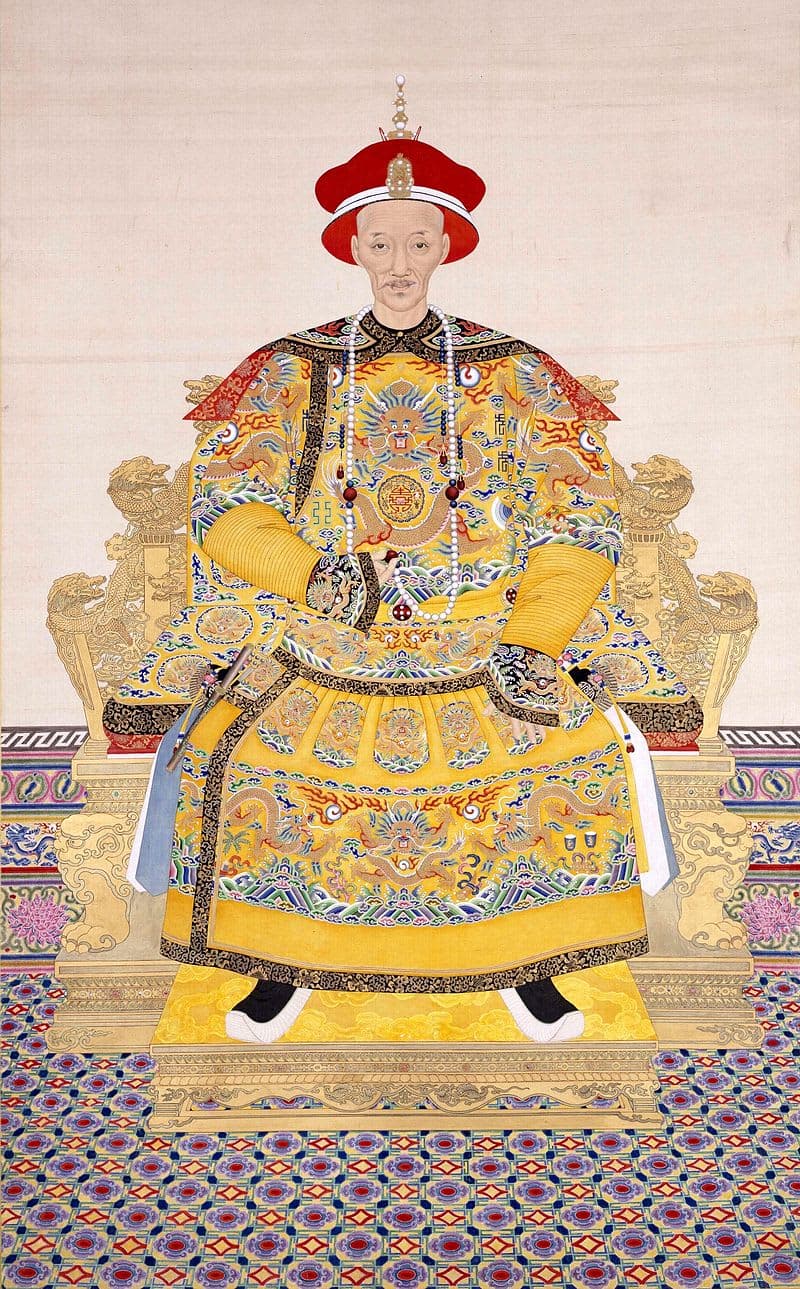

Mianning ascended the throne in September 1820 after the sudden death of his father, Emperor Jiaqing. He adopted the reign title Daoguang (“The Way of Light”). His personal name was later changed to Minning to avoid using the common Chinese character mian in official documents. From the very start of his reign, the Manchu politician Muzhang’a played a decisive role. As head of the Grand Council, he effectively directed the empire’s domestic policy.
By the time Minning came to power, the Qing Empire was already deep in crisis. The Banner estate the foundation of Manchu rule continued to degenerate. Manchu warriors increasingly adopted Chinese lifestyles, abandoning traditional horseback and archery skills in favor of civilian careers. The government tried to counter this decline but failed.
Despite its growing size, the army was losing combat effectiveness, while its maintenance costs kept rising. Expenses for the bloated bureaucracy and imperial court also increased, placing a heavy burden on the treasury. Tax revenues fell as peasant holdings shrank and could no longer pay as before. To avoid financial collapse, the government introduced new taxes and took loans. In 1830, an edict was issued pardoning old tax arrears.


All these problems led to growing social unrest. Across the provinces, uprisings organized by secret societies constantly broke out. On Taiwan, in 1830, the Triad brotherhoods launched a rebellion that lasted over two years and was crushed only with the help of punitive forces from the mainland. In southwestern China, the Yao and other minorities also rose up against heavy taxation and official abuses.
In the early 19th century, Kashgaria faced a severe crisis due to the arbitrariness of Manchu officials and Chinese merchants, which fueled anti-Manchu sentiment. In 1826, Jahangir Khoja, the son of a former ruler of Kashgaria, led a rebellion, calling the Uyghurs to “holy war.” He captured most of the region but failed to win universal support because of religious and ethnic divisions. In 1827, the Qing army suppressed the uprising, and Jahangir was captured and executed. Suppressing the revolt cost the treasury 10 million taels of silver. In 1830, a new rebellion led by Jahangir’s brother Yusuf Khoja was also crushed this time for 8 million taels.

At the same time, the opium crisis was intensifying. Despite the ban, British merchants continued to smuggle massive quantities of opium into China. This caused a huge outflow of silver and destabilized the financial system. Corruption among officials who profited from smuggling worsened the situation.
A faction of reform-minded officials, led by Lin Zexu, demanded firm action against the drug, seeing it as a threat not only to the economy but also to the moral foundations of society. They were opposed by a group advocating legalization of opium trade, dominated by corrupt officials including Muzhang’a who profited enormously from smuggling. Recognizing the danger, the emperor in 1838 appointed Lin Zexu imperial commissioner in the province of Guangdong.
In March 1839, Lin Zexu arrived in Guangzhou and demanded that the British and Americans surrender all their opium. When they refused, he blockaded the foreign factories and confiscated the narcotic stocks, which were then publicly destroyed. In retaliation, Britain seized this as a pretext for war and, in June 1840, dispatched a powerful naval squadron to China’s coast.


The Qing Empire, whose army was technologically backward and poorly trained, could not withstand Britain’s modern weaponry. Chinese forces suffered defeat after defeat. In August 1842, the British reached Nanjing, and on August 29, aboard a British warship, the humiliating Treaty of Nanking was signed.

China was forced to open five ports to British trade Guangzhou, Xiamen, Fuzhou, Ningbo, and Shanghai and to cede Hong Kong to Britain “in perpetuity.” The empire had to pay 21 million dollars in indemnities. China lost its customs autonomy, and import duties could not exceed 5% of a product’s value.
This treaty was the first of the “unequal treaties” imposed on China by Western powers. In 1843, Britain gained extraterritorial rights and most-favored-nation status. Soon after, the United States and France secured their own privileges in 1844, with France also obtaining permission for missionary activity.
After the defeat, Emperor Minning and Muzhang’a pursued a policy of concessions. The influx of foreign capital deepened the empire’s crisis. The outflow of silver caused inflation, and war costs and indemnities became a heavy burden on the population, sparking a fiscal explosion. The number of impoverished peasants and destitute laborers grew rapidly.
The final blow came with natural disasters and widespread famine between 1847 and 1850. Under these conditions, in the southern provinces, a religious sect called the “Society of the Worship of the Heavenly Lord” gained strength. It was founded by a rural schoolteacher, Hong Xiuquan, who would soon lead the Taiping Rebellion.
Emperor Minning died in 1850, succeeded by his fourth son Yizhu, who ruled under the reign title Xianfeng. The reign of Daoguang, which had begun with hopes of renewal, ended in catastrophic defeat and the beginning of a new, even more devastating era in China’s history.


