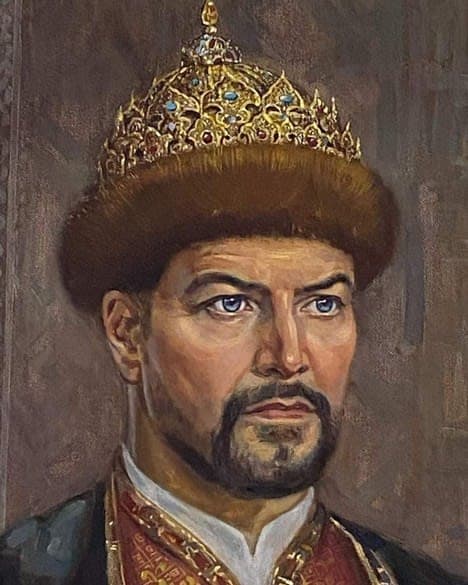
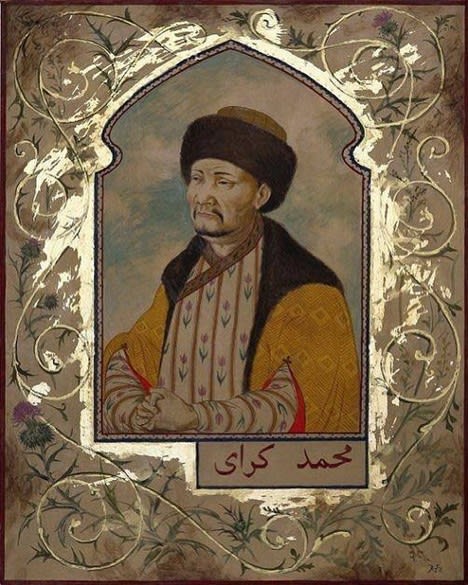
The story of Sahib I Giray’s rise began against the backdrop of a deep dynastic crisis in Kazan. In 1519, after the death of the Kazan khan Muhammad-Amin, who left no direct heirs, a power vacuum emerged in the Volga region. The Crimean khan Mehmed I Giray, who ruled at that time (1515–1523), saw in this a strategic opportunity to expand the influence of his dynasty and began actively promoting his younger brother, Sahib, for the vacant throne. However, the political will of Moscow proved stronger: at the insistence of the Grand Prince, the Qasim khan Shah-Ali was placed on the throne of Kazan in April 1519. His rule, lacking the support of the local nobility and darkened by a pro-Moscow policy, lasted only three years.

The discontent of the Tatar aristocracy resulted in a large-scale conspiracy. In 1521, a delegation of Kazan murzas arrived in Crimea with a request to be given a ruler from the Giray dynasty. In the spring of that same year, Mehmed I Giray sent Sahib to Kazan. In April, when Sahib approached the city walls with a small detachment, a prearranged uprising broke out there. The Russian garrison was destroyed, the Moscow envoy V. Yu. Podzhogin and the merchants were taken into custody, and Shah-Ali fled under Moscow’s protection. Having ascended the throne, Sahib Giray immediately declared war on the Russian state.
The summer of 1521 was marked by a grand joint campaign of Crimean and Kazan forces. Sahib devastated Nizhny Novgorod and Vladimir, after which he joined the army of his elder brother Mehmed near Kolomna. Their united horde advanced to Moscow itself, ravaging the suburbs and capturing a vast number of prisoners, with whom the khans triumphantly returned to their domains in August. Raids continued in the autumn of 1522 as well.
By 1523, relations with Moscow had reached the point of no return. In the spring, Sahib ordered the execution of the captive envoy Podzhogin and all the Russian merchants, which provoked a large-scale retaliatory campaign by Russian forces in August–September of that year. A river flotilla commanded by the deposed Shah-Ali ravaged the banks of the Volga, while the cavalry defeated the Tatars on the Sviyaga River. At the same time, the Muscovites founded the fortress of Vasilsursk, creating a bridgehead for further advance. In October, Sahib Giray attempted to take revenge by besieging Galich, but the city held out.
Realizing the growing threat, Sahib appealed for help to his brother Saadet Giray, asking for artillery and janissaries, but received a refusal. Finding himself isolated, in the spring of 1524 he took a radical step — he recognized himself as a vassal of the Ottoman Empire, hoping for the support of Sultan Suleiman. However, when a 150,000-strong army under Prince Ivan Belsky approached Kazan, no help came from Istanbul. Sahib Giray was forced to flee to Crimea, leaving his 13-year-old nephew Safa Giray on the throne. His first reign in Kazan lasted only three years.
His return to his homeland in 1524 brought Sahib no peace. By order of his brother Saadet Giray, he was thrown into prison in Balaklava. However, already in the autumn of that same year he was released: the khan needed his brother’s experience and authority in the struggle against the pretender to the throne, Islam Giray. In the following years, Sahib twice held the post of kalga-sultan (the second man in the state) — in 1525–1526 and 1528–1530. After participating in a punitive campaign against the Shirin clan in 1531, Sahib Giray left Crimea and moved to Istanbul, which became an important stage in his rapprochement with the Ottoman court.
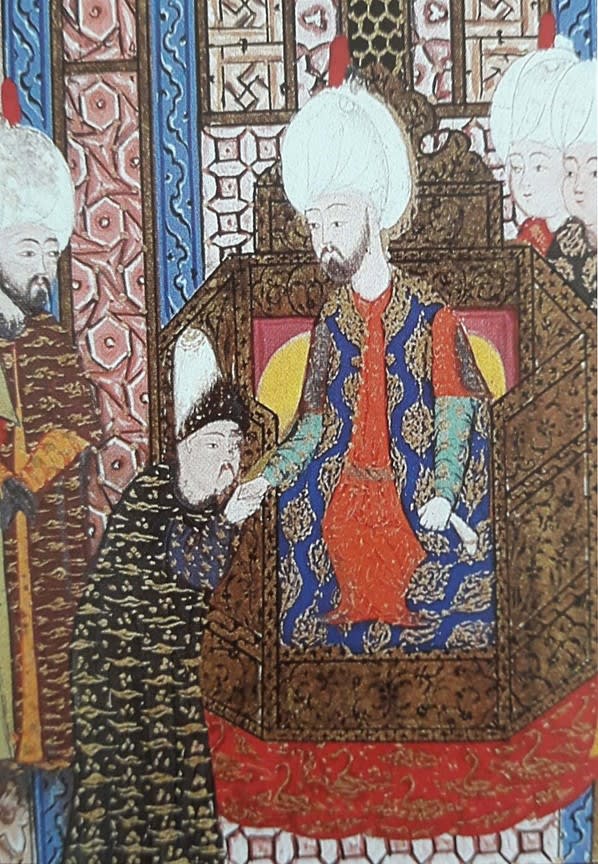
In May 1532, Saadet Giray abdicated the throne. Islam Giray took power in Crimea, but Sultan Suleiman refused to recognize his legitimacy. In the autumn of that same year, the padishah appointed Sahib as the new Crimean khan, presenting him with the symbols of power — a sable cap and a saber. Accompanied by a detachment of janissaries, Sahib I Giray arrived in Crimea, where, after five months of resistance, Islam I Giray was forced to yield the throne in exchange for Ochakov and Perekop.
Sahib I’s rule in Crimea began with a protracted civil war. Islam Giray did not abandon attempts to regain power, launching an uprising in the summer of 1534. The struggle continued until 1537, when Sahib inflicted a crushing defeat on his rebellious nephew near Perekop. Soon afterward, Islam was killed by a hired assassin sent by Baki Bey. In order to finally subdue the unruly nobility, above all the Shirin clan, the khan elevated the Mansur and Sejeut clans, relying on a loyal service aristocracy.
Sahib I Giray went down in history as a great builder and reformer:
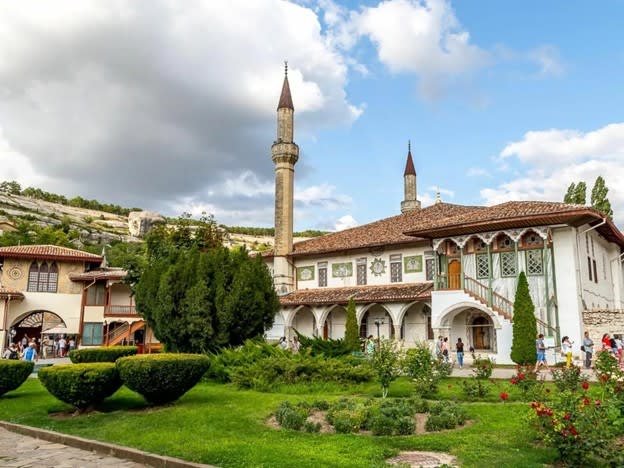
He moved the residence from Salachik to a new location, laying the foundation for the magnificent “Garden Palace.”

The harbor at Gözleve (modern Yevpatoria) was expanded, giving the khanate its own access to the sea without passing through Ottoman territories.
The khan actively compelled the Nogais to adopt a settled way of life, developing agriculture and strengthening the economic base of the state.
Drawing on Ottoman experience, he created a modern army with units of musketeers, field artillery, and the tactic of the wagenburg (a camp of linked wagons).
As a loyal ally of Suleiman the Magnificent, Sahib I took part in numerous campaigns. In 1538, he personally met the sultan during the Moldavian campaign against Petru Rareș, the result of which was the annexation of Budjak and the occupation of Ochakov. In 1539, an expedition followed to the North Caucasus against the Circassians of the Jane tribe. The winter of 1539–1540 was marked by the difficult but successful campaign of his son Emin Giray against Lithuania.
However, the campaign against Moscow in 1541, initiated by the fugitive prince Semyon Belsky, ended in failure. Because of discord within the command and the resolute actions of the Russian voivodes on the Oka, who employed artillery, Sahib Giray did not dare to attempt a crossing and retreated, failing even to take Pronsk.
In the following years, the khan conducted a series of successful campaigns in the Caucasus (1542, 1544) and in the Volga region. In 1545, he captured Astrakhan, expelling Khan Yamgurchi, and in 1546, near Perekop, he literally annihilated a 10,000-strong Nogai army seeking revenge for Astrakhan, using the overwhelming firepower of muskets and cannons.
The decline of the great khan came suddenly in 1551. When Sultan Suleiman ordered him to march against Iran, Sahib Giray refused, citing the poverty and unpreparedness of his army. This aroused suspicion in Istanbul. At the same time, the khan committed a strategic error: he asked for his nephew Devlet Giray to be sent to Crimea (supposedly for dispatch to Kazan), while in reality he merely sought to remove a rival from the sultan’s court.
The sultan, listening to his advisers, decided to change the ruler. Sahib Giray was lured out of Crimea by being sent on yet another war against the Circassians. While the khan was fighting in the mountains of the Caucasus, Devlet Giray landed at Gözleve with janissaries and occupied Bakhchisarai. The Tatar beys immediately went over to the side of the new ruler. Sahib’s son, the kalga Emin Giray, who tried to defend his father’s power, was killed on the Alma River.
When Sahib Giray learned of the coup, he was abandoned by his army. He was taken to the fortress of Taman and imprisoned, where he was soon killed by his own grandnephew Bulyuk Giray. By order of Devlet Giray, all the children and grandchildren of the deposed monarch were mercilessly exterminated. Despite the bloody end, the body of Sahib I was taken to Bakhchisarai and buried with honors in Salachik, in the family dürbe of Khan Hacı Giray. Thus ended the era of one of the brightest and most contradictory rulers of the steppe empire.


