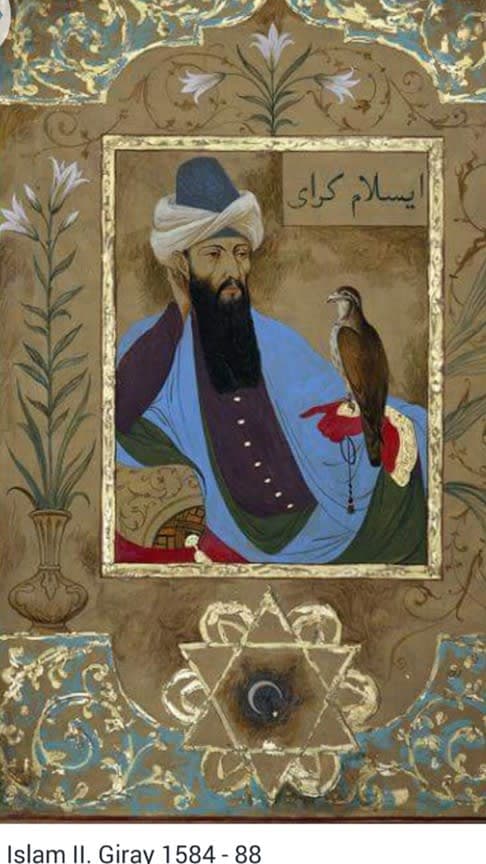

Islam II’s path to power began long before his coronation, yet it unfolded not in the saddle of a warhorse, but in the shadow of the sultan’s court. During the reign of his father, the great Devlet I Giray (1551–1577), the young prince was sent to Istanbul. There he spent more than thirty years as a rehen — an honorable hostage who guaranteed Crimea’s loyalty to the Ottoman sultan.

The years spent in the Ottoman capital left an indelible mark on Islam’s character. In 1574, he made a decision unusual for a representative of the Giray dynasty: he left splendid Istanbul and withdrew to a dervish monastery in Bursa. As a dervish, he devoted himself entirely to meditation, theological debates, and philosophical reflection, for which he later received among the people the nickname “the khan from the dervishes.” He sincerely wished to remain apart from politics, but fate and the will of the padishah decreed otherwise.
His quiet life of prayer ended in the spring of 1584. Islam’s elder brother, the Crimean khan Mehmed II Giray the Stout, had rebelled against the will of Sultan Murad III and laid siege to the Turkish fortress of Kefe. The sultan needed a new ruler whose loyalty would be absolute, and his choice fell upon the “dervish” from Bursa. Islam was summoned to Istanbul and proclaimed the new khan of Crimea.

In May 1584, Islam II Giray landed at Kefe accompanied by a powerful corps of janissaries. The appearance of the sultan’s legitimate appointee caused an immediate split within the Crimean elite. Most of the influential murzas, led by the powerful Ali Bey Shirin, unwilling to quarrel with the Porte, abandoned Mehmed II. Islam’s younger brothers — Alp, Selyamet, and Shakay Mubarak Giray — also went over to the side of the new khan.
The deposed Mehmed II, left with only the support of the loyal Mansur clan, attempted to flee to the Nogai steppe, but he was overtaken near Perekop (Or-Qapi). There, by order of his own brother Alp Giray, the once-powerful ruler was strangled. The road to the throne in Bakhchisarai had been cleared, and Islam II officially took the throne, appointing Alp Giray as kalga and Mubarak as nureddin.
The rule of the “dervish khan” did not bring peace to Crimea. Almost all four years of his reign (1584–1588) passed in a fierce struggle against Saadet Giray, the eldest son of the murdered Mehmed II. Saadet, who had fled to the Nogais, did not reconcile himself to the loss of the throne.

Only three months after his uncle’s enthronement, Saadet Giray invaded Crimea at the head of a 15,000-strong Nogai army. The moment was well chosen: many beys had gathered in Bakhchisarai expecting rewards, and the city was not prepared for a long siege. After seven days of defense, Islam II was forced to flee. He took refuge first in Balaklava, and then under the protection of Turkish guns in Kefe.
Saadet Giray triumphantly occupied the capital and was even officially elevated to the khanate by the beys in ancient Eski Qirim. It seemed that the “dervish’s” power had collapsed, but behind him stood the full might of the Ottoman Empire. Sultan Murad III sent a 4,000-man force of janissaries to his aid. The siege of Kefe, which Saadet maintained for two and a half months, ended in failure.
In the autumn of 1584, the kalga Alp Giray, relying on Turkish artillery, launched a counteroffensive. In the decisive battle in the valley of the Indol River, the Nogai cavalry could not withstand the fire of the janissaries and was defeated. Saadet Giray fled once more. In 1585, he made a second attempt to regain power, but was stopped by the Tatar army before even reaching the peninsula. After this defeat, the claimant brothers scattered: Saadet and Safa went to Kumykia, while Murad Giray departed for Astrakhan, swearing allegiance to the Russian Tsar Fyodor Ioannovich.
Holding the throne solely thanks to Turkish bayonets, Islam II Giray demonstrated unprecedented obedience to Istanbul. He voluntarily renounced part of his sovereignty by introducing the custom according to which, during the Friday prayer (khutba), the name of the Ottoman sultan was mentioned first, and only afterward the name of the Crimean khan. This was a symbolic gesture of the final recognition of vassal dependence.
Despite his peaceful and philosophical cast of mind, Islam II was forced to wage wars. His reign was marked by devastating campaigns:
June 1587: A 40,000-strong horde under the command of Princes Alp and Selyamet invaded the southern Russian lands. Although they did not dare cross the Oka because of the concentration of tsarist forces near Tula, the borderlands were heavily devastated. On the return march, however, Russian voivodes overtook the Tatar raiding detachments, destroying nearly 30,000 men in battle.
The struggle against the Cossacks: Crimea suffered from the audacious raids of the Zaporozhian Cossacks, who in this period managed to attack and plunder even such fortified centers as Akkerman and Gözleve.

The final stage of Islam II Giray’s life also passed in campaigns imposed upon him by external circumstances. In the winter of 1588, the khan, at the head of a Tatar army, marched toward the Polish-Lithuanian borderlands. While awaiting the arrival of Turkish reinforcements, he made his camp in the fortress of Akkerman.
It was there, in March 1588, that the “khan from the dervishes” died. His reign, which had begun as an attempt by the sultan to tame an unruly Crimea, ended in the midst of yet another military campaign. Islam II remained in history as a ruler who might well have preferred prayer beads to the sword, yet was forced to spend his days in endless struggles for чужие interests and for his own survival.


