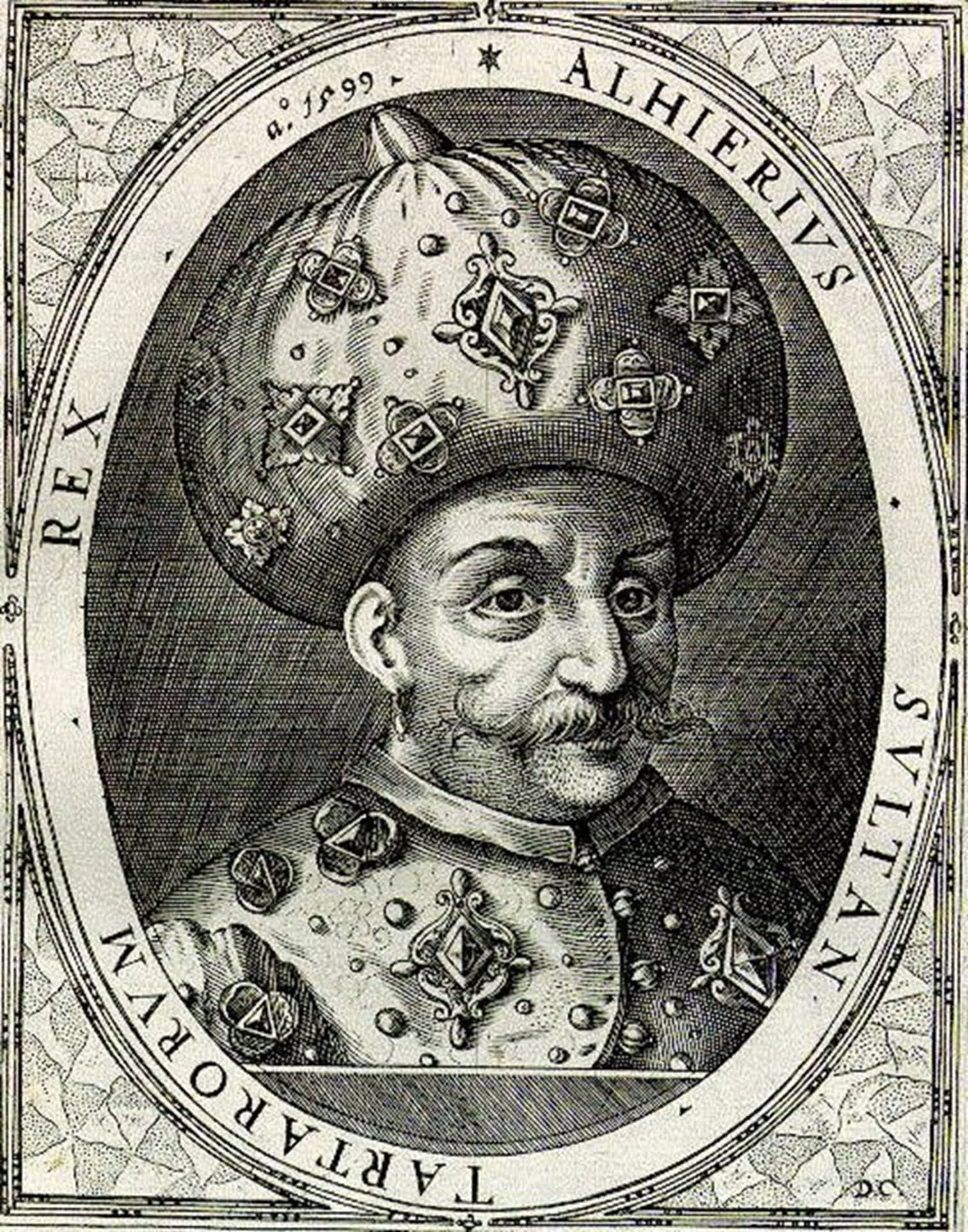

Gazi Giray’s path began under the banners of his father, the great Devlet I Giray. Even as a young prince, he tasted the bitterness of failure during the Astrakhan campaign of 1569, but his true trials awaited him in the east. In 1578, he went to war against the Safavids together with his brothers. This campaign proved tragic for the dynasty: in the battle on the Aksu River, the Crimean cavalry was defeated, and Gazi’s elder brother, the kalga Adil Giray, was taken prisoner and later executed.

Gazi himself proved to be a brilliant commander in 1579, defeating the Qizilbash near Baku and earning the personal gratitude of the Ottoman sultan. However, in the spring of 1581, fortune turned against him: during another campaign, he himself fell into Persian hands. The prince spent seven long years in the famous prison of Alamut. Shah Muhammad Khudabanda, appreciating the talents of his captive, offered him freedom, an army, and the hand of his daughter in exchange for service, but Gazi remained unshaken. In 1587, making a daring escape worthy of an adventure novel, he reached Istanbul via Erzurum, where Sultan Murad III promised him the Crimean throne.

In April 1588, after the death of Islam II, Gazi Giray returned to Crimea as khan. He was greeted by chaos: his brother Alp Giray had already proclaimed himself khan, while other relatives held key fortresses. Gazi II acted with lightning speed and determination. Entering Bakhchisarai on April 27, 1588, he forced his brothers to flee and began a large-scale political reform.
He not only reconciled the feuding bey clans, but also radically strengthened his personal guard, striving for independence from the whims of the aristocracy. To reinforce the dynasty, he brought back his nephew Safa Giray from Astrakhan and appointed him nureddin. Yet family intrigues continued: the kalga Selyamet Giray, fearing Safa’s revenge for the death of his father Mehmed II, fled to Turkey, which forced the khan to appoint his brother Fetih Giray as the new kalga.
One of the most significant events of Gazi II’s first reign was the grand campaign against the Russian Tsardom in the summer of 1591. At the head of a colossal 150,000-strong army, the khan crossed the Oka and advanced toward Moscow. He acted as a strategist of a new type: he forbade plundering on the march so as not to lose momentum.
On July 4, 1591, the horde reached the walls of Moscow. In the area of the present-day Donskoy Monastery, they were met by the Russian army, sheltered behind a gulyay-gorod. Fierce clashes and powerful Russian artillery fire prevented the Tatars from breaking through the defenses. A military ruse proved fatal for the khan: believing false rumors about the approach of a huge force from Novgorod, Gazi II began a hurried retreat on the night of July 6. Russian regiments pursued the demoralized horde all the way to Tula and into the Wild Field. The khan himself was wounded in the arm, but managed to preserve a third of his army. In memory of this event, the Donskoy Monastery was founded in Russia, and annual religious processions were established.


Despite the defeat, Gazi II showed himself to be a subtle diplomat. Already in 1592–1594, he conducted correspondence with Tsar Fyodor Ioannovich, maneuvering between Moscow and Istanbul, and in the end concluded a peace treaty, receiving 10,000 rubles and rich gifts from Russia.

From 1594, Gazi Giray became the “sword of the sultan” in Europe. At the head of an 80,000-strong army, he took part in the siege of Raab in Hungary and captured the castles of Tata and Komorn. However, the khan’s proud temperament led to a quarrel with the Turkish grand vizier Sinan Pasha, after which Gazi withdrew his army on his own initiative.
Intervening in the affairs of Wallachia and Moldavia, the khan narrowly escaped death: in one of the battles he was seriously wounded by a bullet. In 1595, near Țuțora, his 25,000-strong horde faced the Polish hetman Jan Zamoyski. Unable to break the fortified Polish camp, Gazi showed wisdom and entered into peace negotiations, recognizing Ieremia Movilă as the hospodar of Moldavia.

In 1596, intrigues in Istanbul led Sultan Mehmed III temporarily to depose Gazi and appoint his brother Fetih Giray as khan. Gazi II did not accept this: after a storm at sea, he landed at Sinop and began the struggle to regain power. The dispute between the brothers was settled by a sharia court, which ruled in favor of Gazi II.
Having returned to the throne in 1597, Gazi Giray was merciless. Fetih Giray, who attempted to seize Bakhchisarai, was treacherously killed, and with him his entire family and nine sons. The khan’s second reign was marked by new Hungarian campaigns (1598, 1602), during which he captured the fortress of Varad and wintered in Pécs, saving Turkish armies from destruction.
Within the country, the khan continued to suppress conspiracies with an iron hand. In 1601, having learned of plans for a coup, he personally ordered the elimination of nureddin Devlet Giray and the Shirin bey on the very day of Qurban Bayram.
The last years of Gazi II Giray’s life were devoted to strengthening the northern frontiers of the Caucasus. In 1607, he wintered in the fortress of Gazi-Kermen on the Kuban, which he had built himself, bringing the mountain rulers to swear allegiance. But where enemy bullets had failed, the Black Death proved stronger. At the end of 1607, in Temryuk, the 55-year-old khan died of plague.
Gazi II Giray remained in the ages not only as the formidable “Bora,” but also as the great poet Gazayi. His philosophical ghazals and the poems “The Rose and the Nightingale” and “Coffee and Wine” became jewels of Crimean Tatar literature. In his lines, martial valor was paradoxically combined with a deep understanding of the transience of existence:
“Do not trust the splendid attire of fate,
Lions wrestled with fate — where are they now?..”
He was buried in Bakhchisarai, leaving behind a Crimean Khanate at the height of its military and cultural power.


