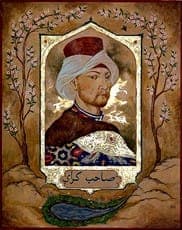

Devlet Giray was the son of Prince Mubarak Giray and the grandson of the great Mengli I Giray; from birth he was drawn into the whirlwind of high politics. His father, Mubarak, lost his life in the distant sands of Egypt while taking part in the campaigns of the Ottoman Sultan Selim Yavuz in 1516–1517. After his father’s death, Devlet found himself in a difficult family situation: his mother successively became the wife of two powerful khans — Mehmed I and Saadet I.
In 1530–1532, during the reign of his uncle Saadet I, the young prince Devlet reached the summit of the hierarchy by taking the post of kalga, the official heir to the throne. However, the wheel of fortune turned: in 1532 Saadet abdicated, and power was seized by Sahib I Giray. Dark times began for Devlet. The new khan, seeing in him a dangerous rival, threw his nephew into prison. After spending several years in captivity, Devlet nevertheless managed to regain his freedom and left Crimea, finding refuge in splendid Istanbul. It was there, at the court of Suleiman the Magnificent, that he displayed remarkable diplomatic talent, gradually winning the absolute trust of the sultan, which predetermined his later rise.

In 1551, the political configuration in the region changed sharply. Sultan Suleiman decided to depose Sahib I and appoint Devlet Giray as the new Crimean khan. His return to his homeland was marked by brutal reprisals: by Devlet’s order, his predecessor Sahib I was killed by his own grandnephew Bulyuk Giray in the fortress of Taman. The bloody purge did not spare the heirs of the old khan either: the kalga-sultan Emin Giray and all the other sons of Sahib were executed.
Yet Bulyuk Giray himself, briefly appointed kalga in gratitude for what he had done, soon fell by Devlet’s own hand. Having secured himself on the throne, the khan named his son Ahmed as heir (and after Ahmed’s death in 1555, another son, Mehmed). Becoming the full sovereign ruler, Devlet I proved himself an outstanding domestic administrator. He managed to do what many of his predecessors had failed to accomplish: he pacified the feuding bey clans and united the country, ensuring Crimea many years of internal stability without civil strife.
The chief goal of all Devlet I’s foreign policy was the restoration of the former greatness of the Tatar world and the recovery of the Khanates of Kazan and Astrakhan, conquered by Ivan IV the Terrible in 1552 and 1556. Devlet devoted his entire life to the struggle against the urusy (“Russians”), becoming Moscow’s most dangerous enemy in the sixteenth century.
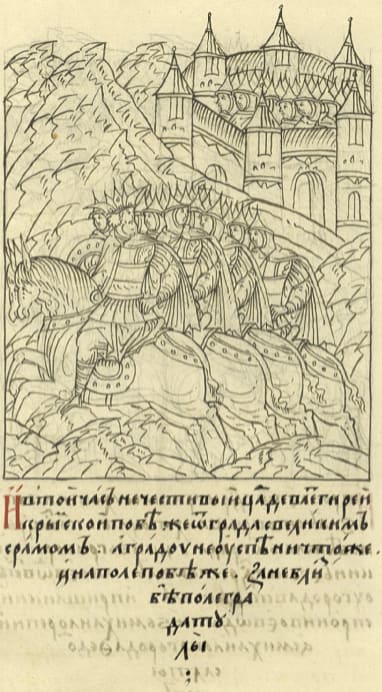
The first serious clash came in the summer of 1552. Trying to save Kazan, the khan led the horde and Turkish janissaries with artillery toward Moscow. But, having learned of Ivan IV’s forces near Kolomna, he suddenly turned toward Tula. On June 21–22, 1552, the walls of Tula shook under the fire of Crimean guns, but the voivode Grigory Temkin-Rostovsky held the defense. The arrival of reinforcements forced Devlet to retreat; in the battle his brother-in-law Kambirdey was killed, and all the Turkish artillery fell into Russian hands.
In 1555, another grand campaign followed, this time with a 60,000-strong army. Having made a deceptive maneuver toward the Circassians, the khan hoped to catch Moscow off guard. However, near the village of Sudbishchi on July 3, 1555, he encountered a 13,000-man detachment under Ivan Sheremetev. Despite their numerical superiority, the Tatars and Turks were unable to break the Russian force. The losses were catastrophic: the khan’s sons Ahmed and Haji were killed. Devlet was forced to withdraw into the steppe.
The second half of the 1550s and the 1560s turned into an endless chain of mutual blows. In 1556–1559, Russian detachments under Dmitry Vishnevetsky and Daniil Adashev carried out daring raids on Perekop, Ochakov, and Kerch. Devlet Giray responded with raids in 1562, 1563, 1564, and 1565, devastating Ryazan, Mtsensk, and Bolkhov.
A special place in his biography belongs to the Astrakhan campaign of 1569, organized jointly with Sultan Selim II. The large-scale plan included the construction of a canal between the Don and the Volga in order to transfer a fleet with artillery. But the engineering project failed: the Turks were unable to dig the canal, and when the army of Kasim Pasha and Devlet Giray reached Astrakhan on September 16, deprived of heavy guns, it did not dare storm the fortified city. The retreat through the waterless steppe turned into a true catastrophe for the Turkish army.
The culmination of Devlet I Giray’s life came in the spring of 1571. Having secured the support of the Ottomans and the Polish-Lithuanian Commonwealth, the khan led a 40,000-strong army against Moscow. Thanks to the betrayal of the Russian defector Kudeyar Tishenkov, who pointed out secret fords across the Zhizdra River, the Crimeans bypassed the defensive lines on the Oka. Ivan the Terrible fled to Rostov, abandoning the capital.
On May 24, 1571, Devlet Giray approached Moscow and ordered the suburbs to be set on fire. A terrible blaze destroyed the city in three hours. Tens of thousands of people perished in the flames and smoke, and more than 150,000 were carried off into slavery. For this success, Devlet received the honorary لقب “Takht Algan” (“He Who Took the Throne”). At the height of his glory, he demanded that Ivan IV return Kazan and Astrakhan. In despair, the Russian tsar was ready to surrender Astrakhan, but the khan, convinced of his final victory, rejected the offer, wishing to subjugate the entire Russian state.


Devlet I Giray’s overconfidence led to the fatal campaign of 1572. Gathering an unprecedented army of 120,000, reinforced by elite janissaries, he marched on Moscow, certain that he was delivering the final blow. However, at the end of July, near the Pakhra River, 50 kilometers from the capital, one of the greatest battles in history unfolded — the Battle of Molodi.
Opposing the enormous horde was a 25,000-man force under Princes Mikhail Vorotynsky and Dmitry Khvorostinin. Using the tactic of the gulyay-gorod and displaying extraordinary heroism, the Russian regiments completely destroyed the khan’s army in a three-day battle (July 30 – August 2). The famous Divey Murza was captured; the khan’s sons Shardan and Haspulad were killed. Out of 120,000 men, only about 10,000 returned to Crimea. This defeat put a permanent end to Crimea’s claims to the Volga region and became the khanate’s last major campaign against Rus’.
The last years of Devlet I’s life were darkened by quarrels between his sons Mehmed and Adil. On June 29, 1577, the great khan died of plague. He was buried in Bakhchisarai, leaving behind the memory of the most formidable ruler of the steppes, whose path stretched from the darkness of a prison cell to the glow of Moscow’s fires and the silence of the Bakhchisarai mausoleums. He was succeeded by his eldest son, Mehmed II Giray.


