
Craterus belonged to the highest aristocracy of Upper Macedonia, coming from an ancient and wealthy family of Orestis. His exact date of birth remains a matter of debate among historians: W. Heckel believes that he was born shortly after 370 BC, while P. Faure places this date closer to 360 BC. He grew up in the family of Alexander and Aristopatra and had a brother named Amphoterus.
Already in his youth, Craterus stood out for his proud character and devotion to Macedonian customs. The late antique historian Diogenes Laertius preserved a tradition about how Craterus, already an influential nobleman, invited the famous Cynic philosopher Diogenes to his home. The sage’s reply became legendary: he would rather lick salt in Athens than indulge in lavish banquets at the court of Craterus. This episode emphasizes that even then Craterus’s name was associated with the highest status and wealth.
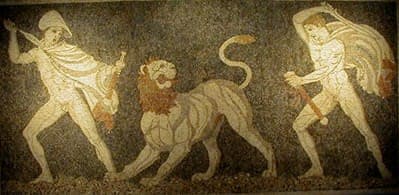
Alexander the Great’s eastern campaign became the arena where Craterus’s talent fully revealed itself. It all began in 334 BC with the Battle of the Granicus, where he led the phalanx of pezhetairoi from Orestis and Lyncestis. His authority grew rapidly: already at the Battle of Issus in 333 BC, all the infantry of the left flank was under his command. Although he was formally subordinate to Parmenion, his role was crucial in holding back the Persian assault. During this same period, a symbolic incident occurred — during a lion hunt near Sidon, Craterus personally saved Alexander’s life, which brought them even closer.


When the army faced the impregnable city of Tyre in 332 BC, Alexander, forced to leave temporarily, entrusted the fate of the siege specifically to Craterus and Perdiccas. Here Craterus showed himself not only as a brave fighter, but also as a tactician. When the Tyrians made a daring sortie, he ordered his troops to make a feigned retreat. As soon as the enemy had moved too far from their walls, Craterus launched a lightning counterattack and drove them back. During the final naval assault on the city, he commanded the left wing of the fleet, putting an end to this long siege.
The Battle of Gaugamela in 331 BC secured his reputation as the “man of the left flank.” While Alexander delivered the decisive blow in the center, Craterus, under Parmenion’s overall command, held back the pressure of Darius III’s superior forces. Soon afterward, he was entrusted for the first time with a fully independent task — the capture of the heights in the lands of the Uxians, which he accomplished brilliantly.
One of Craterus’s most striking tactical maneuvers was the Battle of the Persian Gates. While Alexander bypassed the gorge along secret paths, Craterus remained in the camp, creating the appearance that the entire army was still present. At the agreed trumpet signal, he began a frontal assault, trapping the Persians in a deadly pincer and putting them to flight. After the fall of Persepolis, Alexander trusted Craterus so much that he left him and Parmenion in command of the main army for thirty days while he himself carried out deep raids into the interior of Persis.


In Hyrcania and the lands of the Tapurians on the southern coast of the Caspian Sea, Craterus continued to act as an independent leader, forcing local satraps such as Phradates to surrender. Yet his influence extended not only to the battlefield. Craterus became a key figure in preventing the conspiracy of Philotas. It was he who brought to the king the concubine Antigone, whose testimony proved fatal for the conspirators.
At the military council, Craterus delivered a fiery and effective speech, persuading the hesitant Alexander of the need to eliminate Philotas. Historians note that after the execution of Parmenion, it was Craterus who effectively took his place, becoming commander of all the infantry of the empire. His influence became comparable to that once held by the old companion of Philip II.
In Bactria and Sogdiana, Craterus again and again proved his indispensability. He directed the siege works at Cyropolis, where he was wounded in the heat of the assault. While Alexander pursued the elusive Spitamenes, Craterus secured the rear and suppressed rebellions. His victories over the Massagetae had enormous moral significance: the Scythians, considered invincible warriors, bowed before Macedonian discipline. By the beginning of the Indian campaign in 327 BC, Craterus was no longer merely a general, but the second man in the army.
In India, Craterus was entrusted with the most difficult logistical and strategic tasks. He surrounded cities such as Arigaeum with walls, founded new settlements — Nicaea and Bucephala — and fortified captured capitals. In the great Battle of the Hydaspes against King Porus, Craterus was given an extremely difficult mission: he had to hold the enemy’s attention on the opposite bank of the river while Alexander carried out a concealed crossing. Only when the Indians turned to fight the king did Craterus begin crossing the Hydaspes, completing the rout of the retreating enemy.


However, conflict was brewing within Alexander’s circle. A rivalry arose between Craterus and the king’s favorite, Hephaestion. Alexander said: “Craterus loves the king, but Hephaestion loves Alexander.” Craterus embodied the old Macedonian school — harsh, conservative, contemptuous of Persian silks and prostrations. It was he who represented the interests of the veterans when they asked the king not to risk his life needlessly.

In 324 BC, at Susa, Craterus, following the policy of cultural rapprochement, married Amastris, the niece of Darius III. But soon afterward Alexander decided to send him back to Macedonia. Craterus was to lead 10,000 veterans home and replace the aged Antipater as governor. This journey through Cilicia was deliberately slow. Historians wonder whether this was connected with the commander’s illness — Alexander even wrote letters to his physician Pausanias with advice on treatment — or whether the king himself ordered him not to hurry, fearing political instability.
Alexander’s death in June 323 BC found Craterus in Cilicia. Overnight, all his powers were revised. Under the terms of the Babylonian settlement, he received the title of prostatas, or guardian, of the mentally impaired king Philip III Arrhidaeus — an honorable position, but, given his distance from Babylon, almost meaningless.
Meanwhile, Greece erupted in revolt — the Lamian War began. Antipater found himself under siege, and Craterus, showing nobility, hurried to help his old comrade. He arrived in Macedonia with massive reinforcements. To secure the alliance, Craterus divorced Amastris and married Antipater’s daughter Phila. In the decisive battles of the war, Craterus voluntarily yielded overall command to Antipater, which allowed the Macedonians to win.


But peace did not last long. The empire was being torn apart by the Diadochi. In 321 BC — or 320, according to another version — Craterus marched against Eumenes, a supporter of the regent Perdiccas. Craterus was so popular among the soldiers that his opponent Eumenes did not even dare to deploy Macedonians against him, fearing that they would simply go over to the side of the legendary commander. Instead, detachments of foreign cavalry were thrown against Craterus.
In this final battle near the Hellespont, Craterus fought like a lion, personally striking down many enemies. But fate was inexorable: according to one version, he was struck down by a Thracian; according to another, by a Paphlagonian; according to a third, his horse stumbled, and the commander was trampled in the chaos of battle. When Eumenes found his dying friend on the battlefield, he wept bitterly — thus ended the life of a man whom Macedonian soldiers were ready to obey at the mere sound of his voice. Seven years later, his ashes were handed over to his widow Phila and buried with proper honors.
Craterus left behind a son, also named Craterus, who continued his father’s work and became a prominent statesman in Greece. The “old soldier” himself entered history as the last great defender of the Macedonian spirit in a world that had changed forever.


