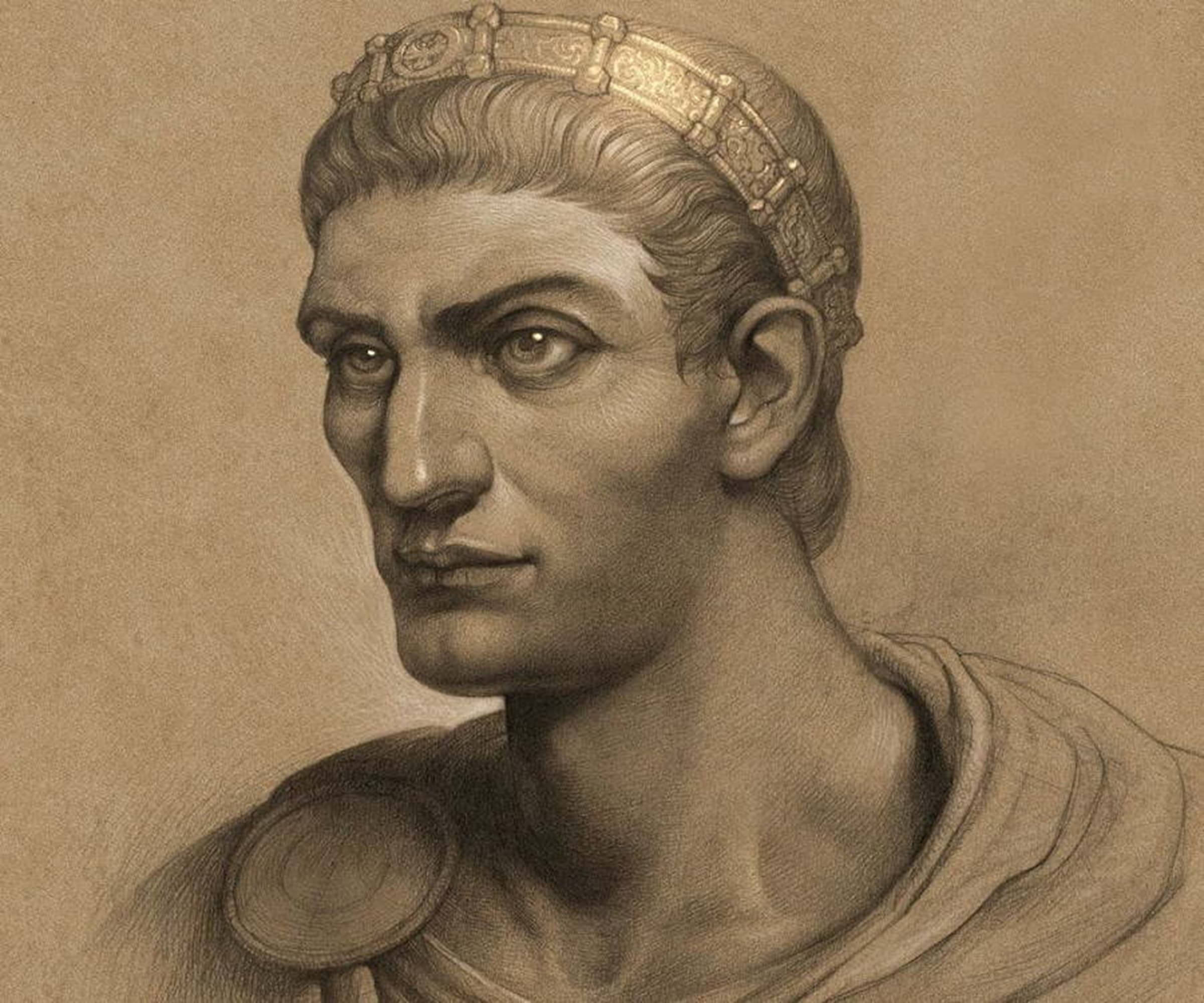

Flavius Valerius Aurelius Constantine was born on February 27, around 272, in the city of Naissus (modern Niš, Serbia), in the province of Upper Moesia. His father was Constantius I Chlorus, the future Caesar, and his mother was Helena, a Christian and the daughter of a humble innkeeper from Bithynia. Despite her modest origins, Helena played a significant role both at her husband’s court and later at her son’s side. Constantius eventually had to leave Helena for a political marriage with Theodora, the stepdaughter of Emperor Maximian Herculius. Constantine thus acquired half-brothers—Dalmatius the Elder, Julius Constantius, Hannibalianus—and sisters: Anastasia, Constantia I, and Eutropia II.
In his youth, Constantine served under Diocletian in Nicomedia, taking part in campaigns in Egypt and Persia and gaining military experience.
In 285, Diocletian established a new system of rule—the Tetrarchy. The empire was divided between two Augusti and two Caesars. In 293, Constantine’s father was honored with the title of Caesar of the West, while Galerius became Caesar of the East. In 305, Diocletian and Maximian abdicated, and Constantius Chlorus became Augustus of the West. However, his health was failing. His co-ruler Galerius sought to consolidate power, fearing that the army might proclaim Constantine as Augustus.
In 306, Constantius died in Britain, in Eboracum (modern York). The soldiers proclaimed Constantine emperor. Galerius had to concede, but he only acknowledged Constantine as Caesar, appointing his own protégé, Flavius Severus, as Augustus.
That same year, 306, an uprising broke out in Rome. The people raised to power Maxentius, the son of former emperor Maximian. Constantine entered into an alliance with him against Severus. Severus besieged Rome but failed. Trapped by Maximian’s trickery, he surrendered and was soon forced to commit suicide.
Galerius himself invaded Italy, but the fortresses of Rome and Ravenna proved impregnable. In 308, Licinius was proclaimed Augustus of the West, and Maximinus II Daza Augustus of the East. Constantine also received the title of Augustus. The empire was now split among five rulers.
Maximian, unwilling to accept his son Maxentius’ power, came in 310 to Constantine at Arelate (Arles). There he spread a rumor of his son-in-law’s death and attempted to usurp power. But the army remained loyal to Constantine. Maximian fled to Massilia (Marseille), but the citizens handed him over. He was allowed to choose his death—he hanged himself.
In 312, Constantine marched his army against Maxentius, whose rule had turned into tyranny. Maxentius relied on the Praetorian Guard and mercenaries, but in open battles he suffered defeats. On October 28, 312, at the Milvian Bridge, Constantine’s forces won a decisive victory: Maxentius drowned in the Tiber, and Constantine displayed his severed head in Rome. In honor of this victory, the Arch of Constantine was erected.
According to legend, before the battle the emperor saw a cross in a dream and heard the words: “By this sign you shall conquer.” He ordered the making of the labarum—a banner bearing the Christian symbol.


After Galerius’ death, two Augusti remained: Licinius and Maximinus II Daza. In 313, Licinius defeated Daza and annexed his lands. In 314, he clashed with Constantine but was defeated and forced to cede Pannonia, Dalmatia, Dacia, Macedonia, and Greece. Ten years later, in 324, in a decisive battle at Adrianople, Licinius was again defeated. His forces were finished off at Chrysopolis. Licinius surrendered under the promise of his life, but was soon killed in Thessalonica. On September 18, 324, Constantine became sole ruler of the Roman Empire.
As sole emperor, Constantine strengthened the administrative apparatus, bound peasants to the land, and increased taxes. The empire was divided into four prefectures, and at court a state council—the consistorium—was established. Between 314 and 324, he carried out a monetary reform that stabilized the economy.
At first Constantine remained a pagan, but after his victory over Maxentius he leaned increasingly toward Christianity. The Edict of Milan in 313 granted freedom of religion. In 321, Christian churches were granted the right to own property. The construction of churches began, sometimes on the sites of demolished pagan temples.
In 325, he convened the Council of Nicaea, which condemned Arianism and established the dogmas of the Catholic Church. The emperor himself declared: “You are bishops of the internal affairs of the Church, and I am bishop of the external affairs.”
In 324, Constantine began building a new capital on the site of ancient Byzantium. On May 11, 330, the city was solemnly inaugurated as the New Rome. But among the people it became known as Constantinople, the name that endured forever.
In 326, tragedy struck within the imperial family: at the instigation of his wife Fausta, Constantine ordered the execution of his eldest son Crispus. Soon afterward, realizing the falsehood, he had Fausta herself killed—she was suffocated in a bath. This episode remains shrouded in mystery, but it was after this, according to Zosimus, that the emperor fully embraced Christianity.
In 332, Constantine defeated the Goths, and in 334 the Sarmatians. He resettled barbarians in Illyria as coloni, binding them to the land—this was the prototype of future serfdom. In 337, the emperor was preparing for a campaign against Persia and intended to be baptized in the Jordan. But illness thwarted his plans.
On May 22, 337, in Nicomedia, Constantine was baptized by the Arian bishop Eusebius of Nicomedia and soon died. He was buried in the Church of the Holy Apostles in Constantinople.


