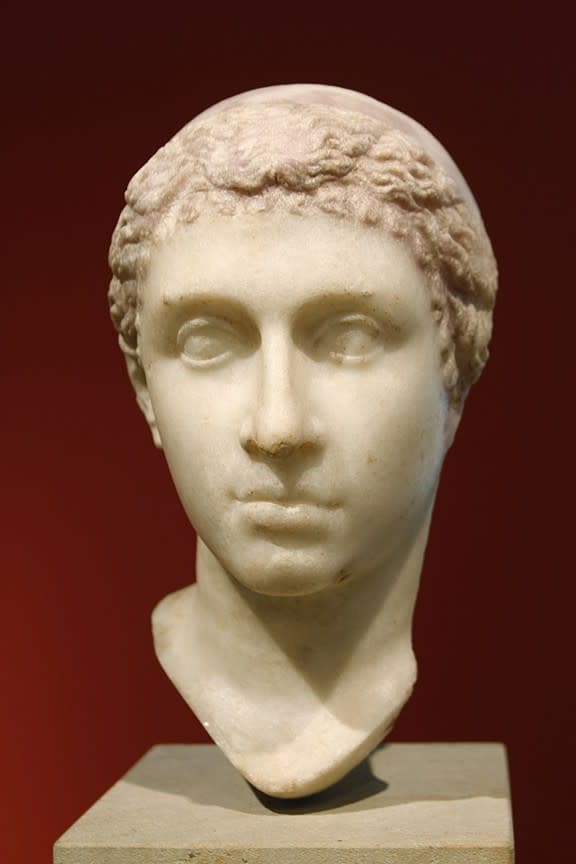

Cleopatra VII Philopator was born in 69 BCE in Alexandria, probably to a concubine of her father, Ptolemy XII Auletes. Her childhood was overshadowed by the political upheavals of 58–55 BCE, when her father was deposed and exiled and her elder sister Berenice IV took the throne. After Ptolemy XII returned to power with Roman help, he brutally eliminated his enemies, including Berenice. This early lesson in ruthless power politics shaped Cleopatra’s later actions.
After her father’s death in 51 BCE, the eighteen-year-old Cleopatra inherited the throne jointly with her younger brother Ptolemy XIII, nine years her junior, whom she formally married according to ancient Egyptian custom. Early in her reign she sidelined her brother-husband, but his advisers, including the eunuch Pothinus, staged a coup and forced her to flee to Syria, where she raised an army.
In 48 BCE, when Gnaeus Pompeius Magnus (Pompey the Great), defeated by Julius Caesar, arrived in Egypt, Ptolemy XIII had him killed, hoping to win Caesar’s favor. Caesar reached Alexandria two days later and was enraged by the deed. He declared himself arbiter in the dispute between Cleopatra and her brother. Understanding that Caesar needed her as a client queen, Cleopatra had herself smuggled into his quarters hidden in a large bundle. She won over the fifty-two-year-old Roman dictator with her wit and charm, and he took her side.


This provoked an uprising by Ptolemy XIII’s supporters. With only about 7,000 soldiers at his disposal, Caesar found himself besieged in Alexandria. Only after reinforcements arrived did he defeat the rebels. In January 47 BCE, Ptolemy XIII, routed in battle, fled and drowned in the Nile. Cleopatra then became sole ruler, with her other younger brother, Ptolemy XIV, appointed co-regent. Soon Cleopatra bore Caesar a son, named Caesarion (Ptolemy Caesar). Although Caesar did not officially acknowledge him as heir, he brought Cleopatra and her brother to Rome, where she lived at his villa on the Tiber. This outraged the Roman aristocracy and became one of the pretexts for conspiracy. After Caesar’s assassination on March 15, 44 BCE, Cleopatra returned to Egypt.

In 41 BCE, after the division of the Roman world, the East fell under the authority of Mark Antony. He summoned Cleopatra to Cilicia to accuse her of aiding Caesar’s killers and to extract funds for his Parthian campaign. Knowing his character well, Cleopatra arrived on a luxurious ship, costumed as the goddess Aphrodite, and captivated him. Thus began their decade-long affair.
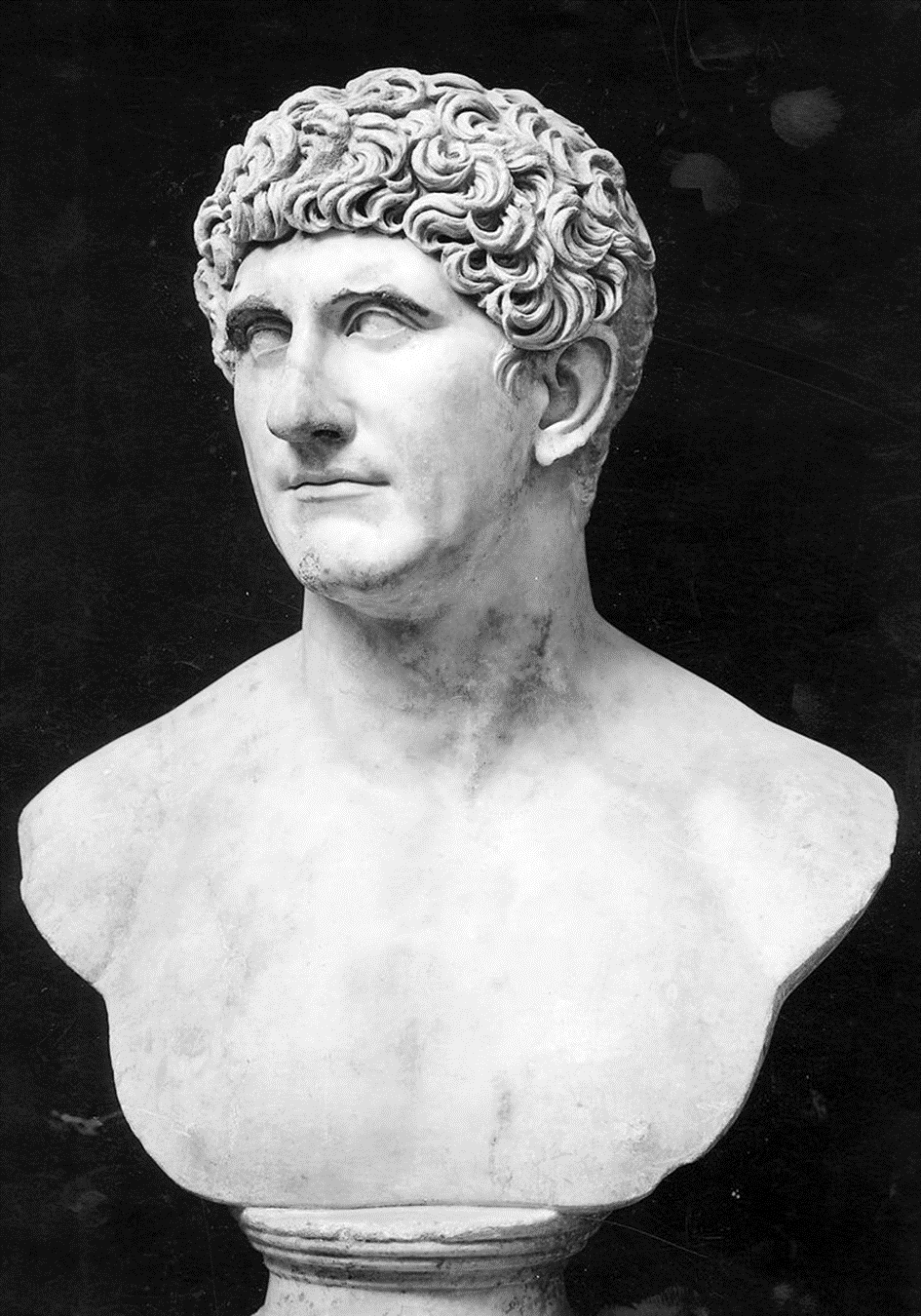
Leaving his army, Antony spent the winter of 41–40 BCE in Alexandria in lavish revelry. Cleopatra bore him three children—twins Alexander Helios and Cleopatra Selene, and later Ptolemy Philadelphus. With Antony’s help, Cleopatra began to restore the Ptolemaic realm, receiving Cyprus, cities in Syria, and other territories. Antony’s conduct, increasingly that of a Hellenistic monarch, provoked indignation in Rome. When civil war erupted in 32 BCE, Octavian (Caesar’s heir) framed it as a war of “the Roman people against the queen of Egypt.”
In 31 BCE, at the Battle of Actium, the fleet of Antony and Cleopatra was decisively defeated. During the fighting Cleopatra, fearing disaster, fled with her ships, and Antony followed her, which shattered his army’s morale.


Antony returned to Egypt and, unable to continue the struggle, gave himself over to festivities. In the spring of 30 BCE Octavian advanced on Egypt. Antony’s remaining forces went over to Octavian. Shut up in her tomb, Cleopatra sent Antony a false report of her death; in despair, he fell on his sword.
Wishing to parade Cleopatra in his Roman triumph, Octavian visited her and spoke words of reassurance before departing; realizing what awaited her, Cleopatra took her own life on August 12, 30 BCE—probably by poison or by the bite of a snake brought to her in a basket of fruit. Octavian had Caesarion executed, and Antony’s children were led in chains in his triumph at Rome, after which they were entrusted to the care of his sister Octavia, Antony’s lawful wife. Egypt was turned into a Roman province, and with Cleopatra VII ended the three-century history of Hellenistic Egypt.



