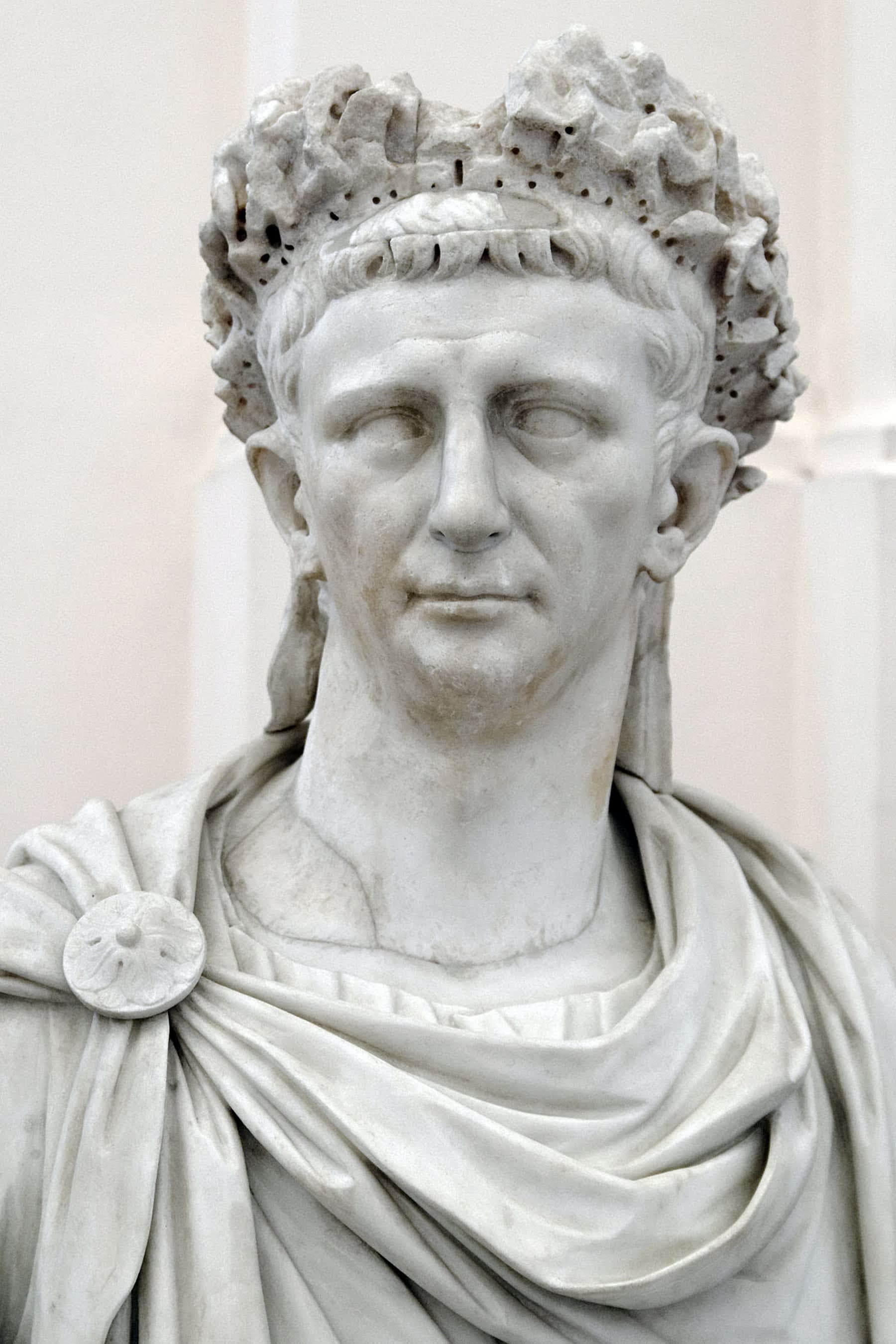

Born to Drusus the Elder and Antonia Minor in 10 BCE at Lugdunum (modern Lyon), Claudius was originally named Tiberius Claudius Drusus. He was the youngest child, and though his family the ancient patrician Claudii held high social standing, he was a weak and sickly boy, which made him the object of his mother’s disdain; she considered him an unfinished product of nature. After his father’s death, Antonia oversaw his upbringing, but her dislike for him was obvious.

Despite physical frailty and insecurity, Claudius possessed a sharp mind. From early childhood he was fascinated by history and scholarship. Under eminent tutors such as Livy, Sulpicius Flavus, and Athenodorus, he began writing his own learned works. Emperor Augustus, who had adopted Claudius’s uncle Tiberius, was skeptical of his grand-nephew’s political prospects but acknowledged his exceptional oratorical and intellectual abilities, as he wrote in letters to Livia.
After Augustus’s death in 14, Claudius named in the will only among third-tier heirs tried to find a place in public life. He was chosen to head an equestrian deputation to the consuls, but Tiberius denied him any office. He was granted consular insignia without the right to perform the duties or sit in the Senate. Seeing little hope, Claudius withdrew from politics to his villa in Campania and devoted himself entirely to study.
Even there his freedom to write was limited. In his History of the Civil Wars, he judged Augustus too severely and praised the republicans and his grandfather Mark Antony too highly. His mother and Livia forced him to abandon the topic. Claudius then turned to safer, more distant periods: a twenty-book History of the Etruscans, accompanied by a glossary of the (by then nearly forgotten) Etruscan language, and an eight-book History of Carthage. None of these works survives; we know them only from scant quotations in Pliny.

Beyond history, Claudius wrote a half-playful manual on dice, a game he loved. He even attempted to reform the Latin alphabet by adding three new characters the so-called “Claudian letters.” These innovations survived only during his reign and were rejected after his death.

During Tiberius’s rule he, like Augustus, considered Claudius a nobody the future emperor remained in the background, spending his time at his villa. His relations with his mother stayed strained, and he seldom visited the Roman house where she lived.
In 11, Claudius married the patrician Plautia Urgulanilla. They had a son, Claudius Drusus, who sadly died in boyhood. Around 26, Claudius divorced Urgulanilla, accusing her of adultery. Shortly afterward she bore a daughter. Claudius first acknowledged the child but a few days later repudiated her, ordering the baby to be laid at her mother’s doorstep.
In 28, Claudius married again Aelia Paetina, the half-sister of the powerful Sejanus. Arranged by Sejanus at Tiberius’s urging, the marriage was, in many historians’ view, largely nominal. In 30 they had a daughter, Claudia Antonia. After Sejanus’s conspiracy was exposed in 31, Claudius, alarmed, divorced Aelia, though his mother Antonia had helped reveal the plot.
Despite the emperor’s contempt, Claudius enjoyed the respect of the Senate and the equestrian order. They rose at his entrance; the senators even proposed enrolling him among the priests of Augustus and granting him consular privileges. Though Tiberius annulled the decree, he recognized Claudius as a member of the imperial family, left him two million sesterces in his will, and singled him out before the army, the Senate, and the people.
In 37, when his nephew Gaius Caligula came to power, Claudius’s life changed abruptly. The new emperor drew his uncle close, made him suffect consul, and often sent him to public festivities in his stead where Claudius was warmly received by the people. Soon Caligula married him to the young and notorious Valeria Messalina, whose name became proverbial; her ravenous appetites and shameless behavior, described by Tacitus and Suetonius, shocked even world-weary Roman society. Around 40 Messalina bore a daughter, Claudia Octavia, and in 41 a son, whom Claudius named Britannicus in honor of a planned campaign to Britain.
Gradually Caligula’s true character showed. He began to terrorize and humiliate Claudius, who could not leave Rome. His uncle’s life constantly hung by a thread. After Lepidus’s conspiracy was uncovered, an enraged Caligula pushed Claudius, fully clothed, into a river. During the German campaign, Caligula forced him to buy a priesthood for 8–10 million sesterces, pledging all his property as security. Claudius was left with only a small house and endured unending courtly humiliations. The constant fear and strain made him appear ill and gaunt.
By 41, Caligula’s madness had become unbearable. He proclaimed himself a god and terrorized the Senate and intimates. That was the last straw: a group of senators and praetorian officers, including Cassius Chaerea, conspired. On the final day of the Palatine Games, they surrounded Caligula and stabbed him to death.
At that moment Claudius, hearing the commotion, panicked and hid in the palace’s sun gallery. A passing soldier named Gratus found him, fell at his feet, and hailed him as emperor. He led the frightened Claudius to fellow praetorians, who unsure what else to do decided to set him against the Senate, which longed to restore the republic.


The Senate met on the Capitoline, but the people, fearing aristocratic domination, demanded a single ruler. The next morning, as the Senate debated power, Chaerea failed to keep the city cohorts from joining the praetorians. Seeing the support, Claudius accepted the guard’s oath and promised each man 15,000 sesterces thus becoming the first emperor to purchase the throne with money. The Senate had little choice but to confirm his powers.
Claudius’s accession was wholly unexpected. He had never been groomed to rule, yet his mastery of history and rhetoric, and his contact with the great minds of his day, unexpectedly made him a wise and strong emperor.
He began his reign by executing Caligula’s assassins. He ordered that the events of those days be consigned to oblivion and he himself strictly observed the rule. He accorded divine honors to his grandmother Livia Drusilla and rehabilitated relatives unjustly persecuted under Caligula.
To avoid dependence on the unreliable nobility and Senate, Claudius created an imperial secretariat divided into four bureaus, placing loyal freedmen at their heads. Tiberius Claudius Narcissus handled correspondence; Marcus Antonius Pallas the treasury; Gaius Julius Callistus scholarly and judicial matters; and Gaius Julius Polybius everything else. This decision quickly consolidated Claudius’s power. These freedmen, enormously powerful and wealthy, advised him on appointing legates and are thought to have suggested the conquest of Britain, which greatly boosted his popularity.
In his early years Claudius maintained the appearance that the Senate remained the chief governing body. He declined many titles, retaining only princeps senatus and tribunician power, and behaved in the curia as “first among equals.” He sat between the consuls rather than on a dais, allowed the Senate to mint its own coinage, and placed two provinces under senatorial administration. These steps earned him respect and popular favor.

Conspiracies and senatorial slowness forced bolder reforms. In 47, as censor with Lucius Vitellius, Claudius revised the senatorial rolls, expelling those who did not meet the property qualification. He replaced them with Italian nobles and for the first time citizens from the Gallic provinces. He also granted patrician status to several Roman families.
In 48, concentrating all power in his secretariat, Claudius sharply curtailed the Senate’s authority, stripping it of control over finance and coinage. Resistance was crushed. During his reign 35 senators and more than 300 equestrians were executed.
Just two years after taking power, Claudius abandoned Tiberius’s conservative foreign policy and planned a major campaign to expand Rome’s borders: the conquest of Britain.
Julius Caesar had attempted the island in the 50s BCE without full subjugation. Augustus and Tiberius were diverted by other troubles. In 40 Caligula staged a comic “invasion,” lining troops on the Channel shore, ordering them to “attack” the sea, and to gather seashells as the spoils of war.
For Claudius, whose position was still precarious, a victorious war was essential. The pretext was the expulsion of Rome’s ally, King Verica, by his own people. Claudius assembled four legions and auxiliaries about 40,000 men under Aulus Plautius; one legion was commanded by the young legate Vespasian, the future emperor.
The Roman army landed at Rutupiae (modern Richborough) and marched inland. They faced the sons of King Togodumnus, Togodumnus and Caratacus. The main battle on the Medway lasted two days, after which the Romans pushed the Britons back to the Thames. Soon Claudius himself arrived and, at Camulodunum (modern Colchester), received the capitulation of eleven British kings. The whole campaign took just sixteen days. Britain was made a province; Claudius was awarded a triumph and the honorific Britannicus, which he declined for himself.


This triumph greatly strengthened his popularity among the people and the army. Through diplomacy he added several client states to the empire: Thrace, Noricum, Pamphylia, Lycia, and Judaea. By 48, at the first census since Augustus, Roman citizens numbered nearly six million about a million more than at Augustus’s death.
Claudius devoted immense attention to the courts. He personally presided over many sessions and did not always stick to the strict letter of the law. To speed proceedings, he lengthened summer and winter court terms and forbade plaintiffs to leave Rome. He raised the minimum age for judges to twenty-five to enhance judicial authority.
He personally intervened in provincial disputes. Early in his reign he settled the conflict between Greeks and Jews in Alexandria, confirming Jewish rights while limiting citizenship for new arrivals. Later he freed Rhodes from Roman control, granting self-government, and exempted Troy from taxes.
He was strict with those who illegally assumed Roman citizenship, but showed prudence in refusing to strip the people of Trento of citizenship mistakenly granted, so as not to cause needless trouble. Claudius issued many edicts on areas from morals to medicine. One famous decree freed slaves abandoned by their masters to die in the temple of Aesculapius if they recovered; masters who denied medical care to a slave could now be charged with murder.
Claudius was active in public works. He built two new aqueducts, the Aqua Claudia and the Anio Novus, with a combined length of more than 96 miles, and restored the old Aqua Virgo, which still supplies Rome including the Trevi Fountain today.
He also improved transport infrastructure. Under him a canal was dug linking the Rhine to the sea, and a road built connecting Germany with Italy. To alleviate grain shortages, Claudius constructed a new harbor Portus 2.5 km north of Ostia. He reduced taxes for grain merchants and granted them privileges, including the possibility of acquiring Roman citizenship.
He undertook a vast attempt to drain Lake Fucine (Fucinus) to expand irrigable land. A tunnel was cut through the hills over eleven years, but at the first opening the tunnel proved too small; the sudden rush of water flooded the surrounding area and swept away spectators who had come to celebrate.


Despite his popularity with the common people, Claudius’s reign was marked by many aristocratic plots, which historians believe were often inspired by his wives. Until 48, Messalina schemed to eliminate anyone who might rival her son Britannicus. Her victims included members of the Julio-Claudian house and their children Julia Livilla, Julia Livia as well as consuls and influential men. The philosopher Seneca, for instance, was banished from Rome.

The most serious revolt was the 42 uprising of Lucius Arruntius Scribonianus, legate-pro-praetor of Dalmatia, who proclaimed the restoration of the republic. It collapsed in four days when his legion refused obedience; Scribonianus was killed.
In 48 Messalina, eager to seize power outright, planned to make her lover Gaius Silius emperor. She was alarmed by the rising influence of Agrippina and Nero. While Claudius was at Ostia, Messalina still married to the emperor publicly went through a wedding ceremony with Silius.
Tiberius Claudius Narcissus, a powerful freedman, informed Claudius. The emperor wavered; fearing he might relent; Narcissus ordered the praetorians to arrest Messalina and Silius. Messalina was seized and confined in the Gardens of Lucullus under the supervision of her mother, Domitia Lepida. Though she disapproved of her daughter’s behavior, Domitia did not abandon her. When it became clear there would be no pardon, Domitia urged her to die with dignity. Messalina could not; an imperial agent thrust in the dagger.
After Messalina’s death it was her rival’s turn. The influential freedman Pallas proposed that Claudius marry Agrippina the Younger Pallas’s lover. Narcissus also supported her candidacy, seeing in her the only counterweight to Britannicus. Beautiful, forceful, and ambitious, Agrippina married Claudius on January 1, 49.
Like Messalina, Agrippina used intrigue to gain full control over the emperor and secure the throne for her son Nero. At her instigation, many nobles were executed or exiled. In 50 Agrippina received the title Augusta, and Claudius adopted Nero. In 51 she secured the praetorian prefecture for her ally Afranius Burrus.
Over time Claudius grew disillusioned with the marriage. He drew Britannicus close again and began preparing him for power alarming Agrippina. She understood Nero’s only chance was to become emperor as soon as possible. On October 13, 54, Claudius died. Most ancient sources claim he was poisoned with mushrooms served by Agrippina, though some historians argue he died naturally of old age.
Immediately after his death, Nero and the Senate deified Claudius. Power passed to Nero, though rumors said Claudius had revised his will in Britannicus’s favor or named them joint rulers. The one man who might have known his secretary Narcissus was killed at once, after burning the emperor’s archives.
Once in power, Nero repealed many of Claudius’s laws as “foolish.” The temple begun in Claudius’s honor was left unfinished, later torn down by Nero to make room for his Golden House. With the rise of the Flavian dynasty eager to present itself as heir to the Julio-Claudians Claudius’s memory was restored. Coins were issued for him and his son Britannicus, and the temple Nero had destroyed was rebuilt.
Gradually, however, Claudius’s memory faded. His books were already lost by the second century, and he himself came to be remembered as a dull-witted emperor.



