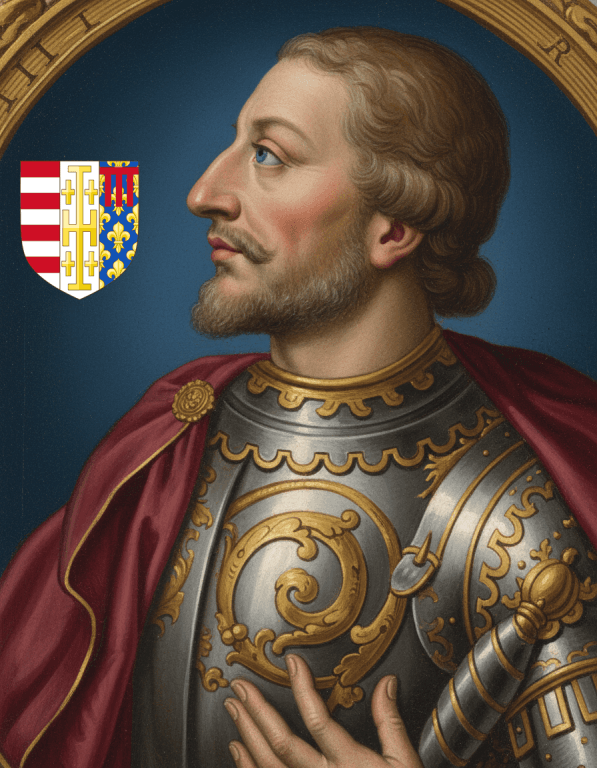

The life of Charles III, King of Naples, is a remarkable story woven from dynastic intrigues, great ambitions, and a merciless struggle for power. Born into a noble family, he was the son of Louis of Durazzo, Count of Gravina (1324–1362), and Margaret Sanseverino. Through his grandfather, John of Gravina, and his great-grandfather, the celebrated King Charles II of Naples, the young prince belonged to the highest ranks of the European aristocracy.
He was a distant cousin of the reigning Queen Joanna I, but their family ties were overshadowed from the very beginning by a profound tragedy. Charles's father had fallen victim to royal displeasure and died in prison, where he had been confined by Joanna's direct orders.
Having endured this loss, Charles found himself in an exceptional historical position: he remained the sole surviving male representative of the powerful Angevin-Sicilian dynasty.

Despite the cruel treatment inflicted upon his father, Charles's relationship with Queen Joanna I was remarkably paradoxical.
Throughout her life, the queen harbored deep romantic feelings for him. However, much to her displeasure and disappointment, Charles did not reciprocate her affection.
Instead, in 1369, he took a decisive dynastic step by marrying Margaret of Durazzo. She was his own first cousin and, in a detail that must have particularly wounded the queen, the daughter of Joanna's younger sister, Maria.
Yet the roots of their irreconcilable disagreements lay in events that had occurred much earlier, in the dark year of 1345.
It was then that Joanna apparently became an accomplice, and possibly even the principal organizer, of the brutal murder of her husband, Prince Andrew of Calabria.
The murdered prince was the brother of Louis I the Great, the powerful King of Hungary, who refused to forgive the bloodshed.
Driven by a desire for revenge, the Hungarian monarch organized two large-scale military campaigns against Naples.
Eventually, overwhelming pressure forced Joanna to capitulate, and it was during these difficult peace negotiations that the future of the young Charles was determined.

In 1365, the Pope himself intervened in the boy's life, requesting that King Louis I of Hungary place Charles under his personal protection.
Thus, at just eleven years of age, Charles left his native Naples and traveled to the Hungarian royal court.
This forced change of surroundings ultimately became the beginning of his extraordinary rise.
The charismatic and talented young prince quickly gained the complete trust and affection not only of the Hungarian king himself, but also of his subjects.
As a mark of exceptional royal favor, Charles was entrusted with the administration of Croatia and Dalmatia, which by that time had become firmly integrated into the Kingdom of Hungary.
From 1371 to 1376, he proudly held the official title of Duke of Croatia and Dalmatia, proving himself a farsighted ruler and winning the loyalty of numerous Croatian feudal lords.
His diplomatic abilities also proved invaluable. When war broke out between Hungary and Venice, Charles served as an important ambassador in 1379.
Charles's defining moment came when a fierce conflict erupted on the Italian Peninsula between Queen Joanna and Pope Urban VI.
In 1381, the pontiff resorted to extreme measures: he officially declared Joanna deposed and solemnly transferred the crown of Naples to Charles.
Having received legitimate grounds for claiming the throne, Charles immediately took action.
At the head of his loyal Croatian army, he marched rapidly toward the Kingdom of Naples.
Near San Germano, he utterly defeated the forces commanded by Joanna's husband, Otto of Brunswick.
Without losing momentum, Charles captured the city and placed the famous fortress of Castel dell'Ovo, where the queen had taken refuge, under a tight siege.
After Otto made one final but unsuccessful attempt to break the siege, Charles captured Joanna and imprisoned her at San Fele.
Soon, disturbing news reached him: the queen's officially designated heir, Louis I of Anjou, had already assembled a powerful military expedition to conquer Naples.
Determined to eliminate this political threat once and for all, Charles made a cold-blooded decision and ordered Joanna to be strangled in her prison cell.
Thus, through bloodshed, he obtained the crown.

However, a period of peaceful rule never followed.
An enormous threat loomed over Naples in the form of the army of Louis I of Anjou.
It consisted of approximately 40,000 well-armed soldiers and was commanded by the experienced military leader Amadeus VI of Savoy.
The invading forces received generous financial support from Antipope Clement VII and the ruler of Milan, Bernabò Visconti.
Charles, by contrast, had only 14,000 troops at his disposal, primarily mercenaries under the command of the renowned condottieri John Hawkwood and Bartolomeo d'Alviano.
Recognizing the overwhelming numerical superiority of his enemy, Charles adopted a brilliant strategy.
He skillfully drew the opposing forces away from the walls of Naples and began systematically exhausting them through a relentless campaign of guerrilla warfare.
The strategy proved successful.
On March 1, 1383, Amadeus VI of Savoy fell seriously ill and died in Molise, after which his demoralized troops abandoned the campaign.

Finding himself in a desperate situation, Louis appealed for assistance to the King of France, who hastily dispatched a fresh army under the command of Enguerrand VII de Coucy.
The French commander acted swiftly: he succeeded in capturing Arezzo and invading the Kingdom of Naples.
However, fortune once again favored Charles.
Halfway to Naples, shocking news arrived: on September 20, 1384, Louis himself had unexpectedly died in Bisceglie.
Despite his military triumphs, the domestic political situation continued to deteriorate.
The relationship between the king and Pope Urban VI was rapidly collapsing, as the pontiff seriously suspected Charles of participating in a conspiracy against him.
In January 1385, the Pope ordered the arrest of six cardinals, one of whom, under brutal torture, testified that the Neapolitan monarch had indeed been their accomplice.
Enraged, Urban immediately excommunicated Charles and his wife and imposed a strict interdict upon the entire kingdom.
Charles responded with force.
He dispatched an army under the command of Alberico da Barbiano to besiege the papal residence at Nocera.
The exhausting siege continued for six long months until Urban was rescued by two Neapolitan barons, Raimondello Orsini and Tommaso di Sanseverino, who, as it turned out, were secret supporters of the late Louis I of Anjou.
While the liberated Pope sought refuge in Genoa, Charles's ambitions turned far to the east.
In 1385, he left Naples to return to Hungary.
There, he had been repeatedly invited by the political opponents of Elizabeth of Bosnia, widow of the deceased Louis I the Great.
As the senior surviving male member of the great Angevin dynasty, and relying on the loyal support of Croatian and Dalmatian barons, Charles triumphantly ascended the Hungarian throne.
However, his reign in Hungary proved tragically brief.
The dowager queen, Elizabeth of Bosnia, refused to accept the loss of power and organized a treacherous conspiracy.
On February 7, 1386, Charles was mortally wounded in an assassination attempt.
After suffering from his injuries for several weeks, he died at Visegrád on February 24.
The remains of Charles III were buried in Belgrade.
His historical legacy remained a subject of controversy and admiration among his contemporaries. His image, seated upon the Hungarian throne, would later appear in a famous woodcut from the 1488 Augsburg edition of János Thuróczy's Chronica Hungarorum (Chronicle of the Hungarians).
Charles's realm was divided.
In Naples, he was succeeded by his son Ladislaus, symbolically named in honor of the knightly King Saint Ladislaus I of Hungary.
In Hungary itself, real authority passed to the regents acting on behalf of the young Mary, daughter of Elizabeth of Bosnia.
Nevertheless, his father's blood and ambitions lived on in Ladislaus. In the years that followed, he would make desperate attempts to reclaim the Hungarian crown by force, continuing the lifelong struggle of Charles III.


