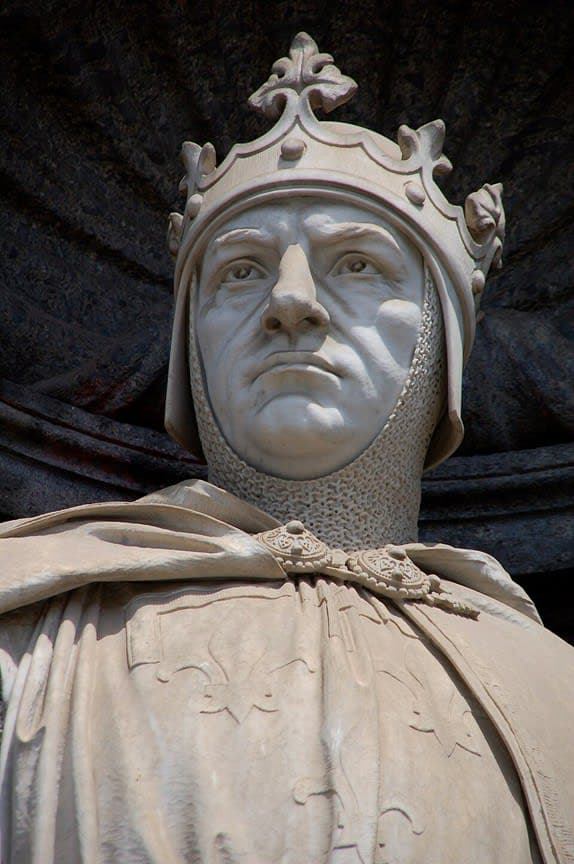

Charles I of Anjou went down in European history as one of the most ambitious, ruthless, and powerful rulers of the 13th century. He was born in late 1226 or early 1227, just a few months after the death of his father, King Louis VIII the Lion of France. His mother was the renowned Blanche of Castile, daughter of King Alfonso VIII of Castile. Having assumed the burden of the regency for the young King Louis IX, later known as Saint Louis, Blanche was forced to wage a relentless struggle against the rebellious French aristocracy. Under these conditions of intense political conflict, she had little time to devote to raising her youngest son.
Charles grew up largely neglected by the royal court, which fostered his early independence and accustomed him to relying entirely on his own abilities. Nature endowed him with an imposing appearance: he was tall and strongly built, with a dark olive complexion and a majestic, truly regal bearing. At the same time, Charles received an excellent education by the standards of his age, developed a genuine appreciation for poetry and the fine arts, and demonstrated deep religious devotion, sometimes bordering on fanaticism, a trait he shared with his elder brother Louis.
A brave and valiant knight on the battlefield, Charles displayed remarkable prudence, restraint, determination, and political insight. However, these undeniable virtues were overshadowed by his boundless ambition, greed, and uncompromising cruelty toward his enemies.

According to the will of Louis VIII, the lands of the royal domain were to be inherited by his four eldest sons, while the younger sons were destined for ecclesiastical careers. However, the premature deaths of his brothers John and Philip by 1232 changed these plans, leaving exactly four surviving sons of the French king. Consequently, it was decided that Charles would receive the share originally intended for the third son, John. He inherited the wealthy counties of Anjou and Maine, together with all their dependent feudal territories, including Touraine. In 1246, Charles was solemnly knighted at Melun and officially took possession of his French appanages.
That same year, 1246, the strategic brilliance of his mother, Blanche of Castile, secured Charles a marriage to Beatrice of Provence, the youngest daughter of Raymond Berengar V, Count of Provence and Forcalquier. This union immediately transformed the youngest prince into one of the most influential magnates of Southern Europe, but it also laid the foundations for decades of dynastic disputes.
Beatrice's three elder sisters were already connected to European thrones: Margaret had married King Louis IX of France in 1234, Eleanor had married King Henry III of England in 1236, and Sanchia had married Richard of Cornwall, the English king's younger brother and future King of Germany, in 1243.
Having no sons, Raymond Berengar V was expected under feudal law to divide his lands among all his daughters. However, believing that his elder daughters had already received enormous dowries and wishing to preserve the integrity of his possessions, the count bequeathed Provence and Forcalquier exclusively to Beatrice.
Since the promised dowries of the elder sisters had never been paid in full, they considered themselves unfairly treated. From that moment onward, Margaret of Provence, Queen of France, developed a deep hatred for Charles of Anjou. The situation worsened when Charles quarreled with his mother-in-law, the dowager countess Beatrice of Savoy, who demanded the County of Forcalquier as her widow's portion.

At that time, the County of Provence was a vassal territory of the Holy Roman Empire, forming part of the ancient Kingdom of Burgundy, also known as the Kingdom of Arles. Displaying considerable arrogance, Charles of Anjou categorically refused to swear fealty to Emperor Frederick II of the Hohenstaufen dynasty. Preoccupied with internal disturbances and warfare in Italy, the emperor chose not to enforce his feudal rights through military intervention.
Previous counts of Provence had traditionally granted extensive autonomy to local towns and nobles, but Charles had no intention of tolerating any limitations on his authority. Upon arriving in Provence, he brought with him a large entourage of French lawyers and accountants, who immediately began a comprehensive review of comital rights, taxes, and privileges.
This provoked fierce resentment among the local aristocracy and eventually led to a large-scale uprising headed by Barral des Baux and Boniface de Castellane. The rebellious nobility was joined by Beatrice of Savoy and the major commercial and manufacturing centers of Marseille, Arles, and Avignon, which seriously feared for their independence.
When Charles was forced to leave Provence temporarily in 1247 to formally assume control of Anjou and Maine, these cities established a powerful defensive alliance under the leadership of Barral des Baux.

In 1248, Charles of Anjou joined his royal brother Louis IX and his wife Beatrice in the Seventh Crusade to Egypt. Before departing, he reached a temporary diplomatic compromise with his mother-in-law, ceding the disputed County of Forcalquier to her.
During the fighting along the Nile, Charles distinguished himself as a fearless and capable warrior. However, reports of a growing rebellion in his homeland forced him to interrupt his participation in the crusade.
In 1250, Louis IX, who had decided to remain in the Holy Land, allowed Charles and another brother, Alphonse of Poitiers, to return to France with an important message for their mother, Queen Blanche.
Returning to his territories in October 1250, Charles combined harsh military pressure with skillful diplomacy. By August 1252, he had succeeded in bringing the rebellious cities completely under his control. Showing unexpected generosity toward the leaders of the uprising, Charles transformed Barral des Baux into a loyal ally, while Marseille, Arles, and Avignon were compelled to formally recognize him as their overlord.

In November 1252, Blanche of Castile died. Charles hastened to Paris, where he and Alphonse of Poitiers assumed the regency of France during the king's absence.
It was during this period that Pope Alexander IV, seeking a counterweight to the Hohenstaufen dynasty, first offered Charles the crown of the Kingdom of Sicily.
Alphonse of Poitiers strongly opposed the venture, while Louis IX, who soon returned from the Holy Land, explicitly forbade his brother from accepting the papal proposal.

Disappointed, Charles redirected his immense energy toward the dynastic conflict raging in Flanders and Hainaut.
Countess Margaret of Flanders, engaged in a bitter struggle against her own son, John of Avesnes, offered Charles of Anjou the County of Hainaut and the regency of Flanders in exchange for military assistance.
Charles immediately marched his troops into the region, but Louis IX returned to France in 1254. Angered by his brother's independent actions, the king summoned Charles to Paris and demanded that he immediately abandon his claims to Hainaut.
As compensation for the expenses he had incurred, Margaret of Flanders paid Charles an enormous sum of money. In 1256, King Louis awarded the disputed County of Hainaut to John of Avesnes.
While Charles was occupied with affairs in the north, another noble uprising erupted in Provence, led by Boniface de Castellane and the tireless Beatrice of Savoy.
Returning south, Charles adopted a strategy of defeating his opponents individually. Through the mediation of the French king, Beatrice of Savoy finally renounced her claims to Forcalquier in November 1256 in exchange for a substantial payment and a lifelong pension, both of which Louis IX undertook to provide.
That same year, Charles suppressed Marseille's resistance with an iron hand.
To prevent further rebellions, he centralized the administration by establishing a system of appointed governors known as comital viguiers: in Arles and Avignon in 1251, Tarascon in 1256, and Marseille in 1257.
With Provence pacified, Charles began rapidly expanding into neighboring territories.
In 1257, he purchased several important lordships in the Alps from the Dauphin of Viennois and acquired the rights of regency over the Kingdom of Arles from Raymond des Baux, Prince of Orange.
In 1258, the influential Count of Ventimiglia acknowledged Charles as his overlord.
Expansion continued into southern Piedmont, where Charles established suzerainty over the towns of Cuneo, Alba, and Cherasco in 1259. In 1260, he brought the lordships of Mondovì, Ceva, and Biandrate in Saluzzo under his authority.
In early 1262, taking advantage of another absence of Charles, Boniface de Castellane launched a new rebellion with the support of the powerful Republic of Genoa and the sons of King James I the Conqueror of Aragon.
Barral des Baux, whom Charles had left as his lieutenant, demonstrated loyalty to his overlord and managed to withstand the rebels' offensive, despite the participation of his own cousin, Hugh des Baux, in the uprising.
Charles of Anjou returned urgently and made territorial concessions to the Genoese, surrendering coastal lands to them. He then isolated Boniface de Castellane and Hugh des Baux and forced them into exile.
Through the mediation of the King of Aragon, Charles concluded a new agreement with Marseille.
Provence was finally pacified and remained a submissive source of enormous revenues until the very end of Charles's reign, financing all his subsequent campaigns of conquest.

For decades, the Papacy had waged an uncompromising struggle aimed at destroying the Hohenstaufen dynasty.
In 1258, Manfred, the illegitimate son of Emperor Frederick II, proclaimed himself King of Sicily. The Holy See desperately sought a secular leader capable of defeating Manfred, and Charles of Anjou once again emerged as a candidate.
In 1262, Pope Urban IV resumed secret negotiations with the French court.
This time, in May 1263, Louis IX, increasingly weary of Hohenstaufen expansion in Italy, officially permitted his brother to conclude an agreement with Rome.
The treaty was finalized in June.
The Pope imposed extremely strict restrictions on Charles: he was forbidden from interfering in Church affairs, required never to claim the title of Holy Roman Emperor, and prohibited from holding any offices in the Papal States or Northern Italy.

Nevertheless, in the autumn of 1263, the citizens of Rome elected Charles Senator of Rome, directly violating the agreement with the Pope.
A lengthy round of negotiations and mutual concessions followed, during which Charles agreed to temporarily renounce the senatorship in order to preserve the alliance.
Urban IV died on October 2, 1264, but his successor, Clement IV, elected on February 5, 1265, continued the same policy and officially summoned the French prince to Italy.
By this time, Charles had already established a network of alliances with the Lombard Guelphs.
On May 10, 1265, he departed Marseille with a small squadron, skillfully evaded the combined Sicilian-Pisan fleet, and triumphantly arrived in Rome on May 23, taking up residence in the Lateran Palace.
On June 21, he was once again granted the insignia of senatorial office, having solemnly promised the Pope that he would resign immediately after conquering Sicily.
On June 28, 1265, Charles of Anjou was officially proclaimed King of Sicily.

Manfred mobilized his army and advanced toward Rome, but he did not dare assault Charles's fortified camp near Tivoli.
Following a series of minor skirmishes, the Sicilian king retreated, immediately undermining his authority in the March of Ancona and Tuscany.
During the winter, Charles raised enormous financial resources through papal channels.
The heavily armored knightly army he had assembled in France departed Lyon in October 1265 and entered Rome in January 1266.
On January 6, Charles and his wife Beatrice were solemnly crowned with the golden crowns of the Kingdom of Sicily in St. Peter's Basilica.
On January 20, 1266, the French army began its advance southward.
The decisive confrontation took place on February 26 at the famous Battle of Benevento.
The French knights completely defeated the Sicilian forces. King Manfred himself, realizing that defeat was inevitable, plunged into the thick of battle and was killed.
On March 7, Charles of Anjou made his ceremonial entry into Naples, which from that moment became the new capital of his kingdom.
Manfred's family, including his wife Helena of Epirus and their young children, were captured and imprisoned in the grim castle of Nocera, where Queen Helena soon died.
Only Manfred's daughter Beatrice regained her freedom in 1284, after many years of imprisonment.
Initially, Charles demonstrated political wisdom by declaring a general amnesty for supporters of the former dynasty.
However, his rule quickly disappointed the local population.
Needing enormous sums to repay his debts to the Pope and maintain his mercenary forces, Charles introduced extraordinarily high taxes, collected with ruthless efficiency.
In May 1266, he fulfilled his promise to the Pope and resigned as Senator of Rome. In June 1267, the position was assumed by Henry of Castile, brother of King Alfonso X the Wise of Castile.
In gratitude, Clement IV granted Charles freedom of action in Northern and Central Italy.
By the end of 1266, all of Lombardy had fallen under Angevin influence.
In 1267, Charles's troops approached Florence, provoking the flight of the ruling Ghibellines and the triumph of the radical Guelph faction.
Charles of Anjou was elected podestà of Florence, retaining the position for thirteen years and exercising complete control over the republic's foreign policy.
At the same time, the Pope appointed him Vicar General of Tuscany, from which position Charles launched a systematic offensive against the Ghibelline communes.
During the siege of Poggibonsi in July 1267, Charles's devoted wife, Queen Beatrice of Provence, died in Nocera.

The principal threat to Charles of Anjou's power came from Germany.
There, in Bavaria, the young Conradin was growing up. He was the son of the late Emperor Conrad IV and the legitimate grandson of Frederick II.
The Swabian nobility recognized him as their duke, while the barons of the Kingdom of Jerusalem proclaimed him their monarch in absentia.
Numerous Italian Ghibelline exiles gathered at his court.
Alarmed, Pope Clement IV issued a papal bull threatening excommunication to anyone who supported the claimant.
Nevertheless, in the autumn of 1267, a powerful uprising in favor of the Hohenstaufen dynasty erupted in Sicily, while Conradin himself crossed the Alps into Italy at the head of a formidable army.
Unexpectedly, Henry of Castile, Senator of Rome, also defected to the young claimant's side. He harbored resentment toward Charles for refusing to grant him landed estates in the conquered Kingdom of Sicily.

Charles, deeply involved in sieges of Tuscan towns, was unable to march to the Pope's assistance until May 1268.
In Viterbo, he met Clement IV, accepted the position of imperial lieutenant in Lombardy, and advanced toward Lucera, where rebellious Saracens had fortified themselves.
Meanwhile, on March 24, 1268, Conradin made a triumphant entry into Rome, receiving an enthusiastic welcome from its citizens.
On August 14, having considerably strengthened his forces with Italian Ghibellines, Conradin departed Rome to conquer Naples.
Upon receiving this news, Charles immediately lifted the siege of Lucera and marched rapidly to intercept his enemy.
The decisive battle that determined the fate of Italy took place on August 23, 1268, at Tagliacozzo.
Thanks to a brilliant tactical maneuver by Charles of Anjou and his marshal, Erard de Siry, who had kept an elite detachment of heavy cavalry concealed in ambush, Conradin's army, already celebrating what it believed to be a victory, was suddenly attacked and completely routed.
The young Conradin fled the battlefield with his inseparable friend, Frederick of Baden.
They reached the small seaport of Astura, hoping to sail to Sicily, but were captured by a local feudal lord, identified, and handed over to Charles of Anjou.
On October 29, 1268, Conradin and Frederick of Baden were publicly beheaded in the marketplace of Naples.
The execution of the last legitimate descendant of the great House of Hohenstaufen sent shock waves throughout Christian Europe.
Having crushed Conradin, Charles completed the subjugation of Tuscany.
On June 17, 1269, at the Battle of Colle di Val d'Elsa, the combined Florentine and French forces dealt a devastating defeat to the armies of the Ghibelline communes led by Siena.
In Siena, Pisa, and other Tuscan towns, puppet Guelph governments came to power, entirely controlled by Naples.
Having established dominion over Southern Italy, become the supreme protector of the Guelphs of Lombardy and Tuscany, and retained possession of Anjou, Maine, and Provence, Charles of Anjou emerged as the most powerful and influential monarch in Europe.
Shortly after Conradin's execution, Charles married for a second time, choosing Margaret of Burgundy in an effort to strengthen his position in northern France.
As her dowry, she brought him one-third of the wealthy counties of Tonnerre, Nevers, and Auxerre, as well as several smaller lordships, including Montmirail, Alluyes, Thorigny, and Brugny.
The couple's only daughter died in infancy, and after Margaret's death, these lands reverted to her Burgundian relatives.

On November 28, 1268, Pope Clement IV died.
The Papal Curia entered the longest conclave in its history, which continued until the autumn of 1271.
In the absence of a legitimate pontiff, Charles of Anjou became the undisputed master of Italy.
The Romans once again elected him senator, and he unilaterally assumed the authority to appoint imperial governors throughout the Italian Peninsula.
In the spring of 1270, Charles suppressed the prolonged rebellion on the island of Sicily with extreme brutality.
All previous grants of land made by Frederick II and his successors after their excommunication from the Church were declared invalid.
Charles confiscated these vast estates and distributed them among his French and Provençal knights.
From an administrative perspective, his reign was remarkably efficient: strict order and the rule of law were established throughout the kingdom.
However, this system depended on terror and the execution of opposition leaders.
All major administrative, military, and judicial positions were occupied by newcomers from France and Provence.
Charles systematically dismantled the former centralized bureaucratic system of the Kingdom of Sicily, established by the Norman kings of the Hauteville dynasty and perfected by Frederick II, replacing it with the traditional French model of feudal society.
Through extensive grants of land, Charles bestowed exceptionally broad immunities and privileges upon the new French barons.
He significantly restricted the Crown's rights to escheated fiefs, greatly expanding the number of relatives eligible to inherit a vassal's estate.
The requirement for nobles to obtain royal permission before marriage was abolished, while the amount of feudal relief—the payment owed to the king upon inheriting a fief—was strictly limited.
All these concessions to the knightly class came at the expense of the severe fiscal oppression imposed on the common population, provoking widespread, though often suppressed, resentment among Italians and Sicilians.
As a sovereign ruler, Charles also devoted considerable attention to monetary reform.
In 1278, he personally oversaw a project to develop a new royal coinage, inviting the finest craftsmen from the mints of Brindisi and Messina.
Two types of coins were issued: gold coins known as saluto d'oro and silver coins known as saluto d'argento.
The minting process was supervised by experienced Florentine mint masters Francesco Formichi and Giovanni Fortino.
The production of these elegant coins was subsequently continued by his son Charles II and his grandson Robert. In numismatic history, they became widely known as carlini.
The gold carlino of Charles I

The principal ambition of Charles of Anjou's foreign policy was the destruction of the restored Byzantine Empire, the conquest of Constantinople, and the restoration of the Latin Empire.
To achieve this objective, in May 1267, through papal mediation, Charles signed the famous TREATY OF VITERBO with the exiled Latin Emperor Baldwin II of Courtenay.
Baldwin transferred to Charles supreme suzerainty over the Principality of Achaea, most of the islands of the Aegean Sea, Epirus, and Corfu.
The alliance was reinforced by the betrothal of Baldwin's son, Philip of Courtenay, to Charles's daughter, Beatrice of Anjou.
The agreement stipulated that if Philip died without children, all rights to the throne of Constantinople would pass to Charles and his heirs.
At the same time, Charles brought William II of Villehardouin, Prince of Achaea, under his authority. William desperately needed a powerful protector.
Expanding his network of alliances throughout the Balkans, Charles concluded an agreement with King Béla IV of Hungary.
He arranged the marriage of his daughter Isabella to the Hungarian prince Ladislaus, the future King Ladislaus IV, and the marriage of the Hungarian princess Mary to his own son and heir, the future Charles II.
This dynastic arrangement would eventually bring the Angevin dynasty to the Hungarian throne.
Following his triumph at Tagliacozzo, Charles compelled William of Villehardouin to marry his eldest daughter and heiress, Isabella, to Charles's second son, Philip of Anjou.
The agreement stipulated that if the marriage remained childless, the rights to the Principality of Achaea would pass to the House of Anjou, which eventually occurred following the wedding in 1271.

The large-scale campaign against Byzantium, planned for 1268, was disrupted by Conradin's invasion.
No sooner had Charles restored his military strength than his elder brother Louis IX announced the beginning of the Eighth Crusade and demanded Charles's personal participation.
Charles did not dare refuse, but he demonstrated considerable tactical cunning: he persuaded his brother to direct the crusader offensive against Tunis.
The Emir of Tunis, Muhammad I al-Mustansir, had actively supported Manfred and Conradin financially and had provided refuge to exiled Italian Ghibellines.
In the summer of 1270, the crusaders landed in Africa and occupied the ruins of ancient Carthage.
However, disastrous delays caused a devastating epidemic of dysentery or plague to break out in the crusader camp.
First, the young Prince John Tristan died, followed on August 25, 1270, by King Louis IX himself.
Charles of Anjou's fleet arrived off the African coast just a few hours after his brother's death.
Charles immediately seized the initiative, defeated the Tunisian army in two fierce battles, and forced the emir to sign an extremely favorable peace treaty on October 30, requiring the payment of an enormous tribute to Naples.
However, the expedition suffered a catastrophe on its return journey.
The epidemic continued to devastate the ranks of the knights, claiming the life of King Theobald II of Navarre, while a terrible storm at sea sank most of Charles's ships.
The death of Louis IX was a devastating blow to the Sicilian king.
Although Louis had frequently restrained his brother's aggressive ambitions, he had also remained his most reliable protector.
The French throne passed to the weak-willed Philip III, who was under the influence of his mother, Margaret of Provence, whose bitter hatred of Charles remained unchanged.
Nevertheless, Charles attempted to extract the greatest possible benefit from the tragedy.
He proposed burying his brother's remains in the Kingdom of Sicily, which would have greatly enhanced the prestige of the House of Anjou in view of Louis's anticipated canonization.
The new French king, Philip III, insisted that his father be buried in the royal necropolis of Saint-Denis.
Eventually, the two sides reached a compromise: the flesh and internal organs of Louis IX were buried in Monreale Cathedral near Palermo, while his bones were transported to France.
Years later, in 1282, Charles personally provided extensive testimony to Cardinal Benedetto Caetani, the future Pope Boniface VIII, during the official proceedings for the canonization of Louis IX.

Freed from his crusading obligations, Charles returned to his eastern ambitions.
Pope Gregory X, elected in 1271, strictly prohibited him from attacking Constantinople, hoping instead to establish a union between the Roman Catholic and Greek Churches.
Charles obeyed, but redirected his activities toward the Balkan coast.
After capturing the city of Durazzo and extensive coastal territories from the Despots of Epirus, he officially proclaimed himself King of Albania in February 1272.
On October 15, 1273, the magnificent wedding of Philip of Courtenay and Beatrice of Sicily was celebrated.
A few days later, the elderly Emperor Baldwin II died, and the title of Latin Emperor of Constantinople formally passed to Charles's son-in-law.
In response, Byzantine Emperor Michael VIII Palaiologos launched a brilliant diplomatic campaign.
He established alliances with the Bulgarian Empire, Hungary, the powerful Golden Horde commander Nogai, and the Republic of Genoa.
In 1274, at the Second Council of Lyon, he officially declared his acceptance of ecclesiastical union with Rome, thereby depriving Charles of any legitimate pretext for war.
In 1275, Pope Gregory X secured a treaty of friendship between Charles of Anjou and the newly elected German king, Rudolf I of Habsburg.
The alliance was strengthened by the betrothal of Charles's eldest grandson, Charles Martel, to Rudolf's daughter, Clementia of Habsburg.
Rudolf formally renounced all imperial claims to Romagna and the March of Ancona.
Soon afterward, on January 10, 1276, Pope Gregory X died.

Since November 1272, Charles had been fighting an exhausting war against Genoa, which by 1275 had developed into a major confrontation with the revived Ghibelline League.
The military campaign in Piedmont proved disastrous for Charles.
By the summer of 1276, he had lost almost all his strongholds in the region, retaining only three small towns: Cuneo, Cherasco, and Savigliano.
On June 22, 1276, a peace agreement was signed through the mediation of Pope Innocent V.
The next pontiff, John XXI, was also favorably disposed toward Charles.
However, the situation changed dramatically when Nicholas III ascended the papal throne on November 25, 1277.

The new Pope pursued an independent policy and, on May 24, 1278, forced Charles to permanently relinquish his position as Senator of Rome.
Nicholas III also attempted to resolve the dangerous dispute between Charles and Rudolf of Habsburg over the County of Provence.
Margaret of Provence, widow of Louis IX, appealed to Rudolf, with the support of King Edward I of England, asking him to grant her Provence, which nominally remained part of the Empire.
In the summer of 1278, a tripartite alliance was formed.
Rudolf's eldest son, Hartmann, was to marry a daughter of Edward I and, following his father's coronation, receive the title of King of the Romans and authority over the Kingdom of Arles, including Provence.
In August 1278, Rudolf of Habsburg decisively defeated King Ottokar II of Bohemia at the Battle on the Marchfeld, freeing him to undertake a campaign in Italy.
Only in May 1280 did Nicholas III succeed in reconciling the opposing parties.
Charles renounced his position as imperial lieutenant in Tuscany, but in exchange secured an agreement under which the Kingdom of Arles would eventually pass to his grandson Charles Martel following his marriage to Clementia of Habsburg.

In 1278, William II of Villehardouin, Prince of Achaea, died.
Under the terms of the earlier agreement, the principality passed to Charles's son Philip and his wife Isabella, although Charles himself assumed effective control over the Morea.
On August 22, 1280, Pope Nicholas III died.
Charles of Anjou intervened openly and aggressively in the prolonged papal election, and on February 22, 1281, his devoted friend ascended the papal throne as Martin IV.
Charles was immediately restored to the position of Senator of Rome.
However, his attempt to use papal support to regain his position in Piedmont failed.
In May 1281, his troops were decisively defeated by the Marquess of Saluzzo at the Battle of Borgo San Dalmazzo, after which Angevin control over Lombardy was permanently lost.

Nevertheless, under direct pressure from Charles, Pope Martin IV officially terminated all negotiations with Byzantium and declared the ecclesiastical union dissolved.
At last, Charles had a free hand to launch an assault on Constantinople.
As early as 1280, his Balkan army had captured Butrint and laid siege to the strategically important Byzantine fortress of Berat.
However, in 1281, regular Byzantine forces arriving in the region inflicted a severe defeat on the French, restoring Michael VIII's control over inland Albania and Northern Epirus.
Charles retained only the coastal towns.
That same year, Charles signed the famous TREATY OF ORVIETO with the Republic of Venice and the titular Emperor Philip of Courtenay.
This agreement, officially blessed by the Pope, contained a detailed plan for a naval expedition, the reconquest of Constantinople, and the forcible submission of the Orthodox Church to Rome.
The departure of a magnificent armada was scheduled for the spring of 1282.
In early 1282, Charles of Anjou stood at the height of his power, effectively serving as the arbiter of European politics.
However, he had underestimated his enemies.
Numerous Sicilian exiles and supporters of the Hohenstaufen dynasty had found a secure refuge at the court of King Peter III of Aragon.
Peter was married to Constance, daughter of the slain Manfred and the only legitimate heiress of the defeated German dynasty.
The Sicilian underground movement united around a brilliant conspirator, Count Giovanni Procida.
He secretly visited Constantinople, Rome, and Zaragoza, bringing together the various elements of a vast anti-French conspiracy.
Byzantine Emperor Michael VIII Palaiologos generously financed preparations for the Aragonese war fleet, determined to avert the deadly threat to Constantinople at any cost.
On Sicily itself, growing resentment was approaching a breaking point.
The population had been exhausted by unbearable taxation, the brutality of French garrisons, and the arrogance of the new nobility.
The explosion came earlier than the conspirators had planned.
On Easter, March 29, 1282, a quarrel broke out between French soldiers and local residents near the Church of the Holy Spirit outside Palermo.
It immediately escalated into a bloody massacre.
In a single day, approximately two thousand French people were mercilessly killed in Palermo.
This event became known forever in history as the Sicilian Vespers.
The flames of rebellion rapidly spread across the entire island.
On April 28, an uprising erupted in Messina, Charles's principal naval base, where his fleet, prepared for the Byzantine expedition, was stationed alongside a powerful garrison commanded by Herbert of Orléans.
The French soldiers took refuge in the city's citadel, but their magnificent fleet was burned in the harbor.
Herbert of Orléans eventually surrendered on the condition that his troops would be allowed to leave the island unharmed.


To suppress the rebellion, Charles of Anjou mobilized all his immense resources.
In June 1282, he transported his army across the Strait of Messina, and in August he laid siege to Messina from both land and sea.
Realizing that they could not withstand the assault of regular French troops alone, the leaders of the Sicilian rebels sent envoys to Peter of Aragon, whose fleet was already stationed off the African coast.
Peter III immediately accepted both their proposal and the Sicilian crown.
On August 30, 1282, the Aragonese army landed at Trapani.
The Sicilians enthusiastically welcomed the newcomers as liberators, and on September 4, Peter III was officially proclaimed King of Sicily in Palermo.
Thus began the era of the prolonged Wars of the Sicilian Vespers, which would draw in the leading powers of Europe.

During September and October 1282, the Aragonese king consolidated his success.
On October 2, he made a triumphant entry into Messina.
Charles of Anjou was forced to hastily lift the siege of the city and evacuate his demoralized troops to the mainland portion of the kingdom.
On October 14, 1282, in a major naval engagement near Nicotera, the Aragonese fleet under the command of the brilliant admiral Roger of Lauria completely defeated the Neapolitan ships.
Sicily and the surrounding sea routes came under the absolute control of Aragon.
Over the following months, Roger of Lauria repeatedly destroyed isolated Guelph squadrons.
By February 1283, Peter III had occupied a significant portion of the Calabrian coastline, effectively cutting off Charles's army stationed at Reggio from the rest of the mainland.

During the winter, the situation was further aggravated by a major Ghibelline uprising in Perugia, which resulted in most of Umbria escaping Angevin control.
Rebellions also erupted in other cities of Northern Italy, tying down the forces of Charles's allies, although the northern Ghibellines were unable to provide any substantial military assistance to Peter of Aragon.
Charles's principal and most loyal ally remained his nephew, King Philip III the Bold of France.
At his uncle's first request, Philip sent powerful detachments to Italy under the command of his brother Peter, Count of Alençon, and his cousin Robert II, Count of Artois.
However, because of the enormous distance, this assistance was largely limited to the dispatch of mercenary contingents.
Pope Martin IV gave Charles his unconditional support.
He imposed an interdict on rebellious Sicily and, on November 18, 1282, officially excommunicated King Peter III of Aragon.
At the end of 1282, seeking to end the bloodshed and settle the dispute through personal courage, Charles of Anjou challenged Peter of Aragon to a judicial duel.
According to the agreement, the two bitter rivals, each accompanied by one hundred of their finest knights, were to meet on June 1, 1283, in Bordeaux, which was under the jurisdiction of King Edward I of England.
However, the duel, eagerly anticipated throughout Europe, never took place because of mutual diplomatic accusations and the failure of the kings to appear.
To raise funds for the construction of a new fleet and the recruitment of fresh troops, Charles I of Anjou left Southern Italy in early 1283 and traveled to Paris for personal negotiations with Philip III, subsequently visiting Provence.
He left his eldest son and heir, Charles of Salerno, as governor of Naples with unlimited powers, issuing a corresponding decree on January 12, 1283.
King Peter III was also forced to return to Aragon, where the local nobility had risen in rebellion against royal absolutism.
He entrusted command of the Aragonese forces in Italy to his son James.

The papal excommunication had turned Peter III into an outcast, and his own brother, King James II of Majorca, was quick to take advantage of the situation.
In 1283, James betrayed his brother, recognized King Philip III of France as his overlord for the County of Montpellier, and opened the mountain passes through Roussillon to the French army and fleet.
In May 1284, Pope Martin IV declared Peter III formally deposed and transferred the vacant Aragonese crown to Charles of Valois, the younger son of Philip III of France.
A Crusade against Aragon was officially proclaimed.
In Southern Italy, Charles of Salerno and Robert II of Artois were conducting a difficult defensive war against the Aragonese in Calabria and the local Ghibellines.
At the end of May 1284, Charles I of Anjou sailed south with a fleet newly constructed in Provence.
But he was too late.
In June 1284, Admiral Roger of Lauria executed a daring maneuver.
He approached Naples and pretended to retreat in panic.
The young and impatient Prince Charles of Salerno, unaware that his father's fleet was already approaching, led the Neapolitan ships out of the harbor of Salerno and gave chase.
In the naval battle that followed in the Bay of Naples, the French fleet was completely destroyed, and the heir to the throne, Charles of Salerno himself, was captured by the Sicilians.
An enraged crowd in Sicily demanded the prince's immediate execution in revenge for Conradin.
Only the personal intervention of Queen Constance of Hohenstaufen saved his life.
On June 6, 1284, the fleet of Charles I of Anjou anchored at Gaeta, where the elderly king learned of the terrible catastrophe and his son's capture.
He immediately traveled to Naples, where disturbances had already broken out.
The papal legate present in the city managed to restrain the aristocratic opposition, and Charles completed the restoration of order with an iron hand.
The loss of his son did not break his indomitable will.
He arrogantly wrote to the Pope that the loss of one man was regrettable, but that he had numerous grandsons growing up who could inherit the throne.
The royal treasury had been completely exhausted, but Charles managed to borrow money and pay his mercenaries.
On June 24, 1284, his land army embarked on its final campaign.
He succeeded in blockading Reggio by land and sea, but the elusive Roger of Lauria once again outwitted the Angevins.
His ships escaped the trap and began launching devastating attacks against the French rear positions and supply lines.
On August 3, 1284, Charles was forced to lift the siege and retreat northward, postponing the campaign until the following spring.

A major offensive was planned for the spring of 1285.
Philip III, at the head of a vast French army, was to invade Aragon, while Charles himself intended to personally command an amphibious assault on Sicily.
However, the enormous physical and psychological strain had severely undermined the elderly monarch's health.
In late December 1284, he became gravely ill, and on January 7, 1285, he died in Foggia.
His body was transported to France and buried with royal honors in the ancestral burial place of the French monarchs at the Abbey of Saint-Denis.

At the time of Charles I's death in January 1285, the vast state he had created included the entire extensive mainland portion of the Kingdom of Sicily, which would later become the independent Kingdom of Naples, along with his wealthy French possessions of Anjou, Maine, Touraine, and Tonnerre, and the imperial territories of Provence and Forcalquier.
In the east, his authority extended over Corfu, several islands in the Aegean Sea, and the Duchy of Durazzo in Albania.
His successor, Charles II, who regained his freedom in 1288, managed to preserve only part of this enormous inheritance.
He was eventually forced to abandon Sicily permanently, as all his attempts to reconquer the island ended in complete failure.
After the death of the dynasty's founder, the County of Tonnerre remained in the possession of his widow, Margaret of Burgundy.
Under the terms of the Treaty of Senlis, Charles II was compelled to surrender Anjou, Maine, and Touraine as the dowry of his daughter Margaret of Anjou and Maine, who married Charles of Valois.
Nevertheless, Provence, Forcalquier, and the Albanian Duchy of Durazzo remained under the authority of the House of Anjou.
Over the following centuries, numerous descendants of Charles I of Anjou occupied the thrones of various European states, until the dynastic branch he had founded finally became extinct in 1435 with the death of the childless Queen Joanna II of Naples.


