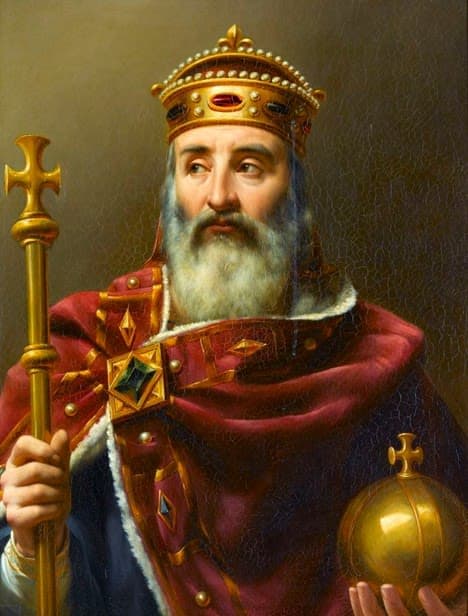

Charlemagne, the eldest son of Pepin the Short, became one of the most remarkable rulers of the European Middle Ages. Although the exact date and place of his birth are unknown, most historians favor 747 or 748. In 754, to strengthen the legitimacy of their dynasty, he and his younger brother Carloman were anointed by Pope Stephen II. After their father’s death they divided the Frankish realm, but relations between them quickly grew tense.

In 771 Carloman died suddenly, and Charles seized his brother’s lands, becoming sole ruler of the Franks. From this moment began the era of his great campaigns to expand and consolidate the Frankish state.
Charlemagne’s reign was a near-continuous series of military operations that ultimately forged a vast empire. The longest and bloodiest war was the struggle against the pagan Saxons, which lasted 33 years. Charles invaded Saxony and destroyed its sacred sites, but the Saxons, led by Widukind, offered stubborn resistance.
Charles used harsh measures to subdue the Saxons, including mass executions in 782, and finally prevailed through forced Christianization. In 785 Widukind submitted, was baptized, and swore fealty to Charles.


In 773 Pope Adrian I appealed to Charles for help against the Lombard king Desiderius. The Frankish army crossed the Alps and besieged Pavia. In 774 Desiderius surrendered, and Charles assumed the title “King of the Franks and Lombards.” This united Gaul and Italy under one crown, greatly increasing Frankish power and influence.

In 778 Charles undertook an expedition into Spain at the request of the Muslim governor of Zaragoza. The campaign failed. On the return, in the Roncevaux Pass, his rearguard was destroyed by the Basques; the fallen hero Roland later became the protagonist of the epic The Song of Roland.
From 791 to 803 Charles waged a hard war against the nomadic Avars. In 796 his son Pippin captured the khagan’s “capital,” the great fortified camp (the Ring), taking immense booty. The Avars ceased to exist as a people, and their lands formed part of what would become Austria. Charles also campaigned successfully against Slavic tribes, protecting allies and pushing the frontier eastward.
In 800 Charles traveled to Rome to resolve a conflict between Pope Leo III and the Roman nobility. On 25 December 800, during Christmas Mass, the pope unexpectedly placed the imperial crown on Charles’s head. Though it angered Byzantium, the act made Charles emperor of the West—the symbolic heir of the Roman Empire.


Charlemagne enacted significant reforms. He divided the empire into counties and marches governed by counts and margraves appointed by him. He standardized the currency, introducing a silver monometallic system (the livre and denier), and promoted uniformity of weights and measures.

He fostered learning and the arts, creating a “Palatine Academy” at court where his children and courtiers were educated. Surrounding himself with scholars such as Alcuin, he promoted education among the clergy. Under Charles began the “Carolingian Renaissance,” a cultural revival in Western Europe after the fall of the Western Roman Empire and the “Dark Ages.”

Charlemagne also intervened actively in church affairs, appointing bishops and abbots and standardizing the liturgy. He saw himself as the church’s defender and protector.
Shortly before his death, in 813, Charles made his only surviving son, Louis, co-ruler and heir. He died in Aachen on 28 January 814.
Charlemagne left behind a vast empire which, despite later partition, profoundly shaped medieval Europe. His reign ushered in the Carolingian Renaissance, long influencing the continent’s cultural and political development. In the 12th century he was canonized by Antipope Paschal III and is still venerated in Aachen as the city’s patron saint.



