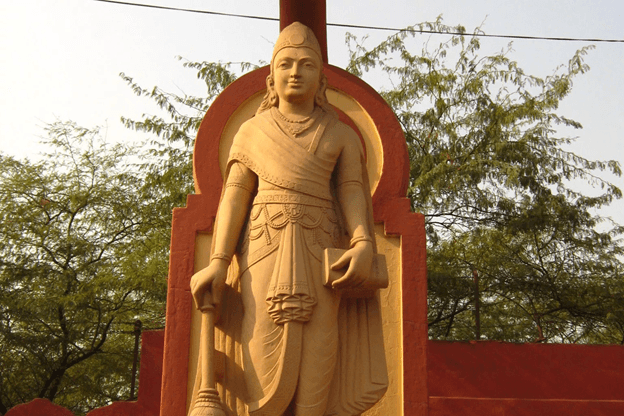

Chandragupta Maurya, the first emperor of the Maurya dynasty, was born around 340 BCE. His origins remain a matter of debate: some sources say he was an illegitimate son of a prince, others that he belonged to a noble kshatriya clan. All agree, however, that his path to power was long and arduous.
From a young age Chandragupta studied at Taxila, where he met his mentor Chanakya. Together they devised a plan to overthrow the ruling Nanda dynasty in Magadha and to expel the Greek garrisons left by Alexander the Great during his Indian campaign. Chandragupta assembled a vast army, recruiting warriors from various regions. According to Plutarch, he even met Alexander while the latter was still alive, attempting unsuccessfully to persuade him to act against the Nandas.
After the main Macedonian forces withdrew from India and Alexander died in 323 BCE, Chandragupta took advantage of the satraps’ infighting. By 317 BCE he had become the de facto ruler of the Punjab, and then, having secured support, began a determined struggle for the Magadhan throne. In the end he overthrew the Nandas and was crowned.


Once in power and at the head of a great army, Chandragupta embarked on a sweeping expansion. He brought all of northern India under his rule, creating an empire from the Bay of Bengal to the Arabian Sea, and then moved into the central part of the subcontinent.
A key moment of his reign was the confrontation with Seleucus I Nicator, one of Alexander’s former generals, who sought to reclaim the Indian territories. After a short war they concluded a peace treaty by which Chandragupta gave Seleucus 500 war elephants in exchange for important territories—Paropamisadae, Arachosia, and Gedrosia. Seleucus, for his part, sent his envoy Megasthenes to Chandragupta’s court; Megasthenes left a detailed description of the Indian state in his work Indica.
Under the guidance of Chanakya (often identified with the author of the famous treatise Arthashastra), Chandragupta enacted a series of reforms that created a strong centralized administration. His rule was marked by economic and cultural growth, as well as a strengthening of Buddhism and Jainism.
According to Jain sources, at the end of his life Chandragupta abdicated and became an ascetic. He is said to have voluntarily fasted to death in a cave at Shravanabelagola, where a temple in his honor still stands. He was succeeded by his son Bindusara and then by his grandson Ashoka, who became one of the most renowned rulers in Indian history.


