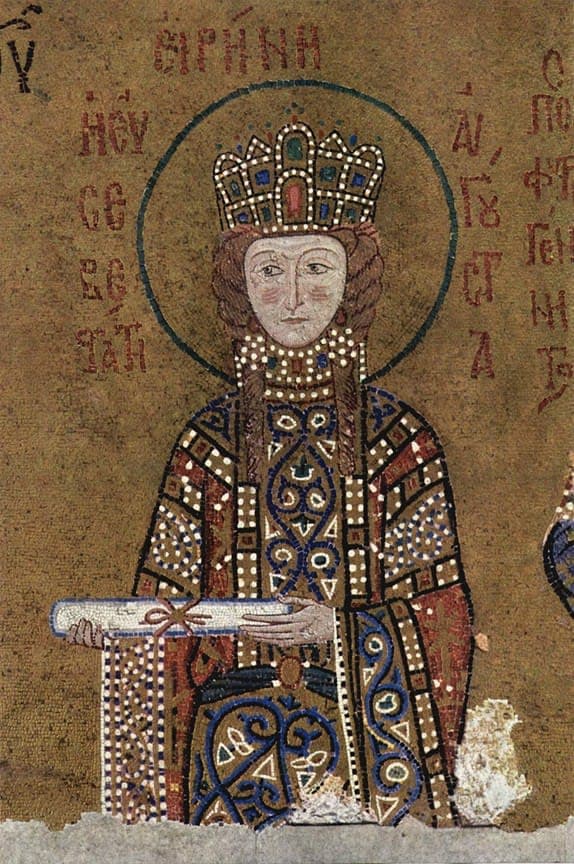
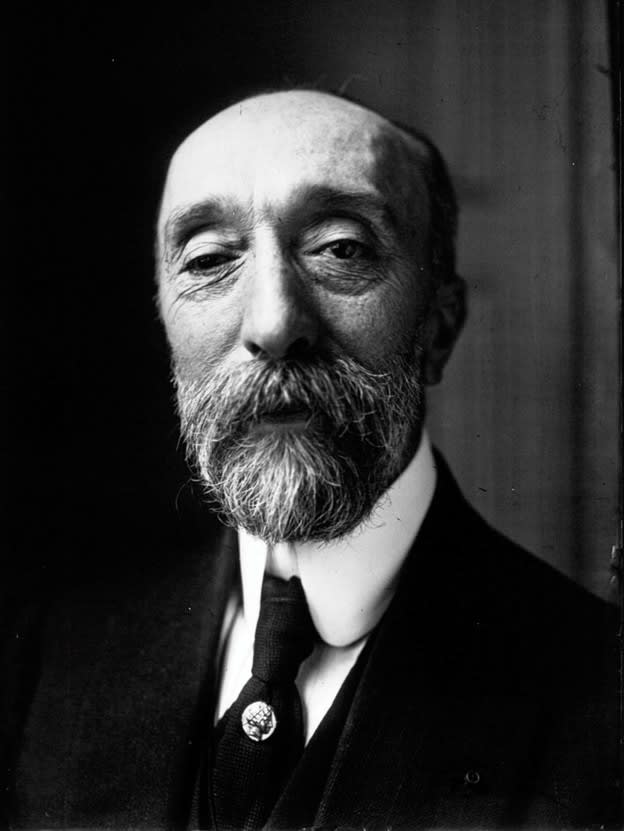
Her path began around 752 in provincial Athens. Orphaned at an early age, she was raised in the household of her uncle, the influential patrician Constantine Sarantapechos, who apparently held the post of strategos. Although Irene came from a noble Greek family, historians, including Charles Diehl, agree that it was her exceptional beauty, and not political calculation alone, that drew the attention of the Byzantine basileus. There was also an opinion that marriage to a Greek woman might strengthen the Isaurian dynasty within the state by reconciling it with the Greek provinces of the empire.

The decisive turn came in 768, when Emperor Constantine V chose Irene as the wife of his heir, Leo. The chronicle of Theophanes describes this triumphant arrival in detail: on September 1 Irene sailed from Athens, and her flotilla, adorned with precious silk fabrics, arrived in Constantinople to the acclamations of the noblest citizens. The betrothal took place on September 3, and on December 17, 768, in the chapel of Saint Stephen, she was crowned, becoming the wife of the future Leo IV. Yet this marriage demanded the greatest powers of acting from Irene: as a secret supporter of icons, she was forced to swear to Constantine V that she would never recognize icons, concealing her true beliefs in the very heart of the iconoclast court. In this marriage, on January 14, 771, her only son Constantine was born, destined to become the last representative of his dynasty.

After the death of Constantine V in 775, Leo IV ascended the throne, and Irene’s influence began to grow. She skillfully persuaded her husband to soften the persecution of icon-venerators, which at first won the emperor the love of the people and the monastic community. The high point of her success as mother and wife came in 776, when, at Easter and under pressure from the crowd, Leo crowned the young Constantine in the Hippodrome of Constantinople. Irene took part in this solemn procession as a full-fledged empress, with pages bearing scepters before her. Yet the domestic harmony did not last long: in 780 Leo discovered icons hidden under his wife’s pillow. The emperor’s anger was terrible, and Irene fell into deep disgrace. She was saved from complete ruin only by her husband’s sudden death on September 8, 780. Legend says that Leo died of “carbuncles” after wearing a crown stolen from a church, though many contemporaries and historians had solid grounds for suspecting that the empress hastened his end with poison.
Having become regent for her nine-year-old son, Irene immediately faced opposition. Just forty days after Leo’s death, the iconoclast party attempted to place his brother Nikephoros on the throne. Irene acted decisively: the plot was crushed, and her husband’s brothers were forcibly tonsured as monks. To humiliate them completely, on December 25, 780, she compelled them to serve publicly in Hagia Sophia. Having secured her rear, she began the gradual restoration of icon veneration. In 781 peace was concluded with the Arabs, and in 782 a Slavic revolt in Greece was suppressed. Seeking an alliance with the West, Irene in 783 betrothed her son to Rotrude, the daughter of Charlemagne, assigning the eunuch Elissaios to teach her Greek.
The principal work of her life was the Seventh Ecumenical Council. After the death of Patriarch Paul in 784, Irene advanced her secretary Tarasios to that office. On December 25, 784, he was installed as patriarch, and preparations for the Council began. Irene appealed to Pope Adrian I, who in 785 sent his legates, calling Irene and her son “a new Constantine and Helen.” The first attempt to hold the Council, on August 7, 786, in Constantinople, failed: armed iconoclast soldiers burst into the Church of the Holy Apostles, threatening the bishops with death. Irene withdrew, but only in order to strike more precisely. Under the pretext of war with the Arabs, she removed the troops loyal to iconoclasm from the capital, disbanded them, and replaced them with a new guard.
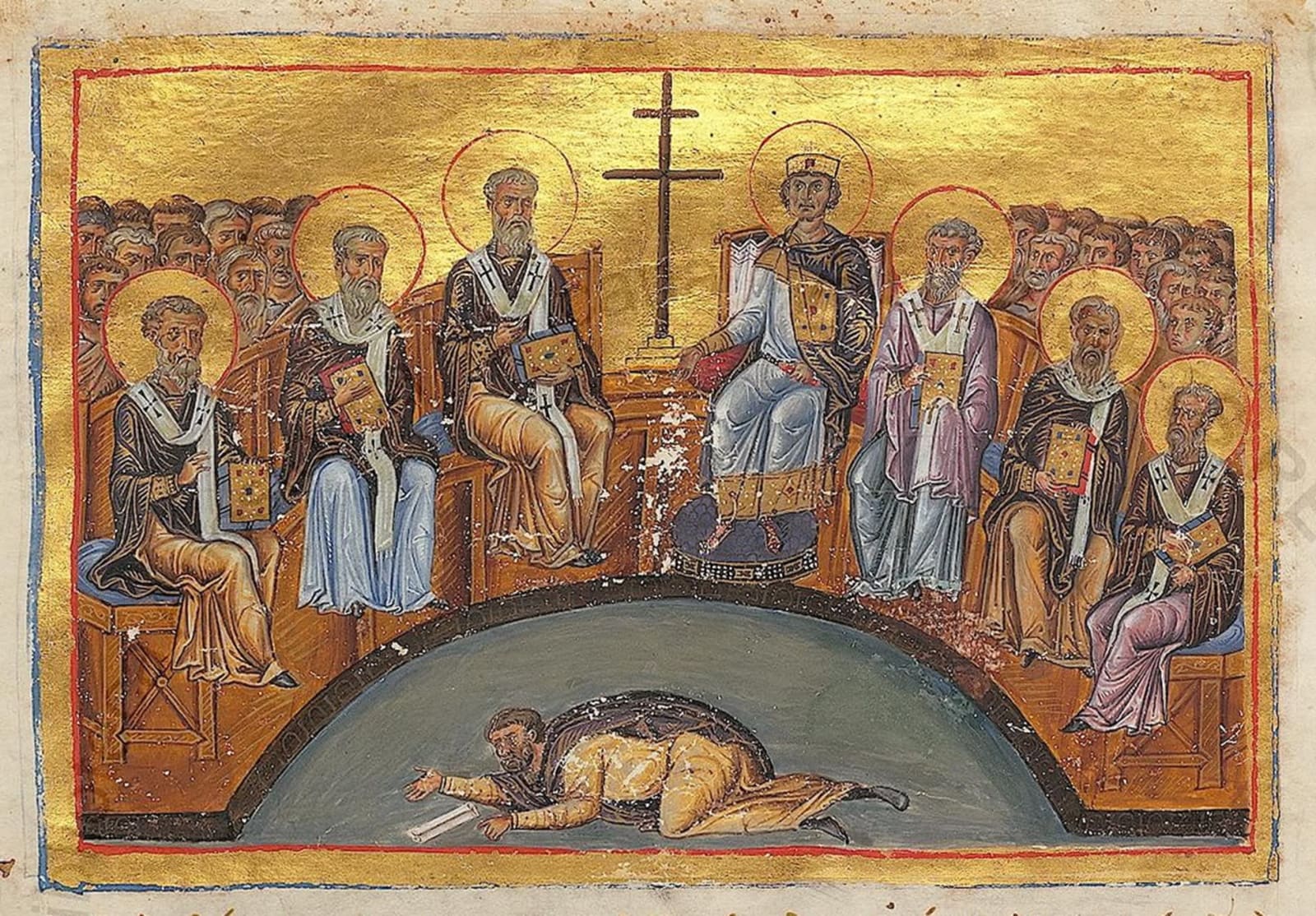

In 787, the true Seventh Ecumenical Council opened at Nicaea. Irene did not personally attend the sessions, but her will guided every decision. On October 23, 787, at the final session in Constantinople and in her presence, the horos restoring the veneration of icons was adopted. This was her triumph. However, as Constantine VI grew older, conflict ripened within the family. Irene had no intention of surrendering power. In 788 she broke off her son’s betrothal to the Frankish princess and forced him to marry Maria of Amnia, whom she had chosen at the first “bride show” in history. In 789 Constantine tried to overthrow his mother, but the conspiracy was uncovered: the emperor was subjected to corporal punishment and placed under house arrest, like a wayward child.

Irene’s attempt in 790 to compel the army to swear loyalty to her as sole ruler led to the revolt of the Armenian legion. Constantine was proclaimed sole emperor, and Irene was removed to the palace of Eleutherios. But already in 792, after her son’s military failures, she returned to the palace and received the title of Augusta. From that moment began her five-year campaign to discredit her own child. She encouraged his cruelty — the blinding of his uncles and of the general Alexios Mosele — as well as his affair with Theodote. When in 795 Constantine forcibly sent his wife Maria to a monastery and married his mistress, the Church rose against him. Irene skillfully exploited that anger.
The denouement came on June 17, 797. The conspirators moved against Constantine, and although he attempted to flee, Irene’s threats forced her supporters to carry the matter through to the end. On August 15, 797, the emperor was seized, and in the very Porphyry Chamber where he had been born, his eyes were mercilessly gouged out by order of his mother. Irene became the first woman in history officially to assume the title “Autokrator of the Romans.” In the West, this was perceived as a vacancy of the throne, which allowed Pope Leo III, on December 25, 800, to crown Charlemagne emperor, calling Byzantium a “woman’s empire.”

Irene’s rule as sole sovereign was marked by enormous spending on monasteries and by a populist reduction of taxes, which made her popular among the poor but emptied the treasury. Inside the court, a struggle raged between her favorites Staurakios and Aetios. When in 802 ambassadors of Charlemagne arrived in Constantinople with a proposal of marriage to unite East and West, Irene was not opposed. Yet this became the last straw for the Byzantine aristocracy. On October 31, 802, the logothete Nikephoros carried out a coup. Surrounded by troops in the palace of Eleutherios, Irene preserved her dignity and merely reminded the usurper that she had once spared his life.
She was exiled first to the Princes’ Islands and then to the island of Lesbos. There the great and terrible empress spent her final days, according to legend mourning her sins and watering with tears a tree planted in memory of her son. On August 9, 803, Irene died. Despite the murder of her own child, the Orthodox Church canonized her for restoring the veneration of icons, fixing for her the image of a “new Helen,” in whose fate sanctity and crime were intertwined in an incomprehensible way.


