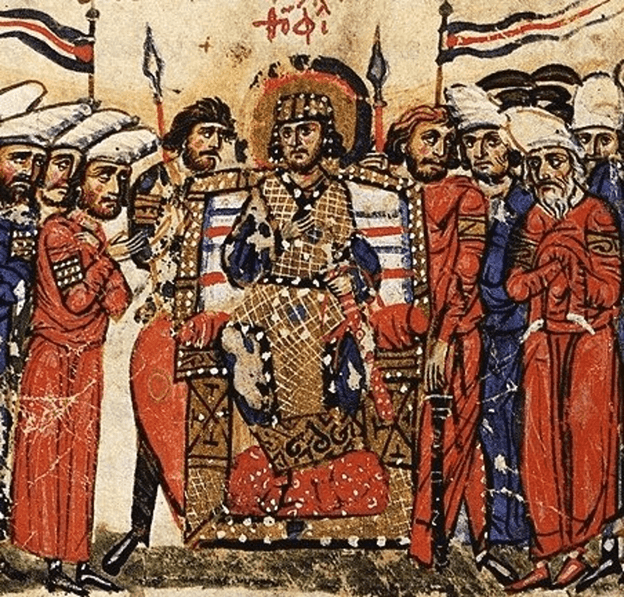

The reign of Emperor Theophilos was a vivid, contradictory, and tragic era in Byzantine history, marked by the last powerful surge of iconoclasm, the flourishing of eastern-inspired art, and a devastating clash with the Arab Caliphate. The son of Michael II the Stammerer and his first wife Thekla, Theophilos had already been proclaimed co-emperor alongside his father in 821, and after his father’s death in 829 he assumed the full burden of sole rule.

His accession took place in an atmosphere of relative prosperity: the treasury was full, the population did not suffer want, and external threats seemed manageable. Yet beneath this calm lay a complex and passionate nature, for Theophilos, having received a brilliant education under the guidance of the outstanding scholar and future patriarch John the Grammarian, combined a love of learning, a refined aesthetic taste, and an attachment to justice that at times bordered on cruelty.
One of Theophilos’s first and most symbolic acts was his demand that the Senate execute the murderers of Emperor Leo V the Armenian. Although these men had effectively raised his own father to the throne, Theophilos believed that regicide could never be justified. His second step was to remove from the palace his stepmother Euphrosyne, the daughter of Constantine VI, whom his father had once taken from a monastery.
Theophilos entered popular legend as a “just king,” accessible to the complaints of ordinary subjects. He liked to disguise himself and wander incognito through Constantinople, learning the needs of the people. His severity was impartial:
He ordered Petronas, his wife Theodora’s brother, to be publicly flogged because, in building his house, he had infringed upon the rights of a neighboring woman.
Seeing in the harbor a rich merchant ship belonging to the empress, he ordered its entire cargo to be burned in the square, declaring that it was not fitting for emperors to engage in trade and take bread away from merchants.
The emperor was passionately devoted to architecture and art. Under the influence of John the Grammarian and Leo the Mathematician, he transformed the Great Palace into a wonder of the world. During his reign magnificent structures were erected: the fountain of the Phiale, the porticoes of the Mysteria and the Sigma, as well as the suburban palace of Bryas, built in an Arab style. Theophilos personally composed hymns and directed the church choir in Hagia Sophia, displaying a deep love for music and liturgical art.


Despite his personal piety and his marriage to Theodora — whom he chose in 821 at a bride-show after being unsettled by the bold answer of another candidate, Kassia — Theophilos was a convinced iconoclast. In 832 he issued an edict officially forbidding the veneration of icons, provoking a new wave of persecution.

Yet his iconoclasm was more disciplinary and political than purely theological. As modern scholars note, he punished not so much for doctrine as for disobedience to imperial authority. Icons often remained in churches, but were hung high up, out of reach for kissing. The influence of Empress Theodora and John the Grammarian often softened his anger, and it was precisely thanks to his wife’s love that Theophilos’s name was not anathematized after the restoration of icon veneration in 843.
On the international stage, Theophilos pursued an active diplomacy, maintaining ties with Louis the Pious, Lothair, and the emir of Córdoba, Abd al-Rahman II.

Around 834–837, Byzantine engineers under Petronas Kamateros helped the Khazars build the brick fortress of Sarkel (“White House”) on the Don, in order to defend against the Pechenegs. At the same time, the new theme of Cherson was established in Crimea, strengthening the empire’s influence in the Black Sea region.
A major stroke of fortune for Theophilos was his alliance with Persian refugees, the Khurramites, who had fled from the caliph. Several thousand Persians under the talented commander Theophobos — who became the emperor’s son-in-law — formed elite units within the Byzantine army.
The greatest trial of Theophilos’s reign was the wars with the Abbasid Caliphate. In the early 830s, Caliph al-Ma'mun launched a series of invasions into Cappadocia, capturing the strategic fortresses of Tyana and Loulon. In 833, Theophilos was forced to sue for peace, paying an enormous tribute.
The fatal new turn in the war came in 838. Encouraged by letters from the rebel Persian Babak, Theophilos invaded Arab lands and captured Zapetra, the birthplace of Caliph al-Mu'tasim. The caliph’s revenge was terrible. In the Battle of Anzen in July 838, the Byzantine army was defeated, and Theophilos himself barely escaped capture.
The climax came with the siege and destruction of Amorium, the ancestral seat of the imperial dynasty. The city fell because of treachery, thousands of its inhabitants were killed, and forty-two high-ranking commanders — known as the “42 Martyrs of Amorium” — were taken into captivity and later executed for refusing to accept Islam.


“Babak thought that if the king of the Romans marched out, he would ease his own position... al-Mu'tasim would be forced to send troops to fight the Romans.” — Ibn al-Athir
The destruction of Amorium became for Theophilos not only a military defeat, but also a deep personal blow. His health began to deteriorate rapidly. Illness — probably dysentery or kidney disease — sapped the emperor’s strength over the course of four years.
Sensing the approach of death, Theophilos committed one final cruel act: fearing for the throne of his young son Michael III, he ordered the execution of his loyal associate Theophobos, seeing in him a potential usurper. Tradition says that before his death he was at last reconciled with Orthodoxy by kissing an icon brought to him by Theodora.
Theophilos died on January 20, 842. He left behind an empire resplendent with cultural brilliance, yet bearing a gaping wound on its eastern frontier. His reign became a bridge between the harsh age of the iconoclasts and the coming “Golden Age” of the Macedonian dynasty, while his love of learning prepared the ground for the great Byzantine renaissance.


