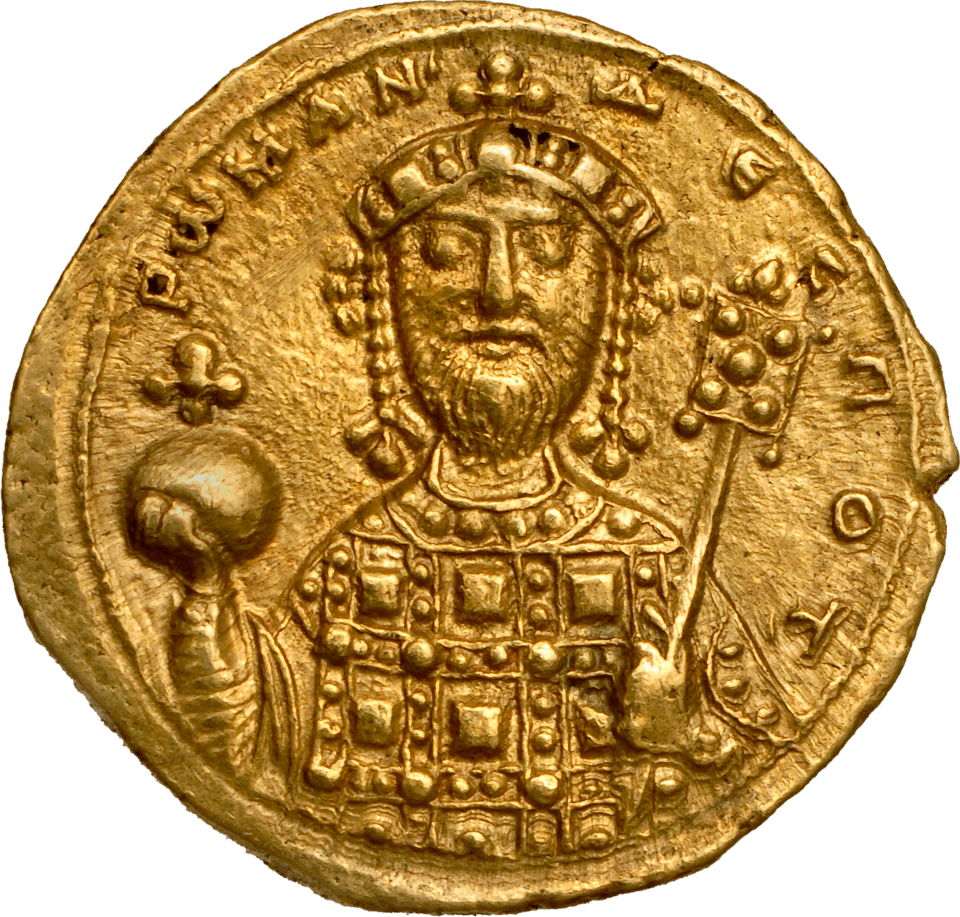

The reign of Romanos III Argyros is the story of an enlightened yet deeply unfortunate man, whose rise to the throne was the result of the desperate haste of a dying monarch, and whose downfall came through betrayal in his own bedchamber. His era was marked by attempts to revive the greatness of Rome through imitation of the great emperors of the past, yet the lack of genuine military talent and the intrigues of the court turned his rule into a succession of ambitious failures.
Romanos Argyros belonged to the highest ranks of the Byzantine aristocracy. His family came from the Armeniakon and was closely intertwined with imperial blood — Romanos I Lekapenos himself was his great-grandfather. The Argyros family held an exceptional position: his brother Basil was a governor under Basil II, another brother, Leo, fell in battle in Italy, and his sister Pulcheria was married to the magistros Basil Skleros. Romanos himself, as a respected senator and eparch of Constantinople, had long been engaged in high-level diplomacy even before his coronation — for example, in 1004 he gave his daughter Maria in marriage to the son of the Doge of Venice.

The crisis came in November 1028. Constantine VIII lay on his deathbed without sons. His elder daughter Eudokia had entered a monastery, while Zoe and Theodora were already over fifty. The empire urgently required a male ruler. The choice fell on the sixty-year-old Romanos. Events unfolded with lightning speed: Romanos, who was already married, was forced to dissolve his marriage, his wife being tonsured as a nun, and on November 12, 1028, he married the fifty-year-old Zoe. Only three days later Constantine died, and Romanos Argyros became emperor.

Romanos III ascended the throne with the desire to become a new Octavian Augustus or Marcus Aurelius. He was kind-hearted and educated, yet, as Michael Psellos aptly observed, his learning was superficial. Nevertheless, he strove to surround himself with scholars, philosophers, and rhetoricians, trying to fan the “spark of wisdom” within the state.

His administrative activity began with acts of mercy:
He spent enormous sums redeeming and returning Byzantines captured by the Pechenegs.
Aristocrats exiled by his predecessors were pardoned.
Romanos built the splendid monastery of the Theotokos Peribleptos and reached an agreement with Fatimid Egypt for the restoration of the Church of the Holy Sepulchre in Jerusalem.
To please the nobility, he abolished the allelengyon — the tax that required wealthy landowners to pay for the abandoned lands of poor peasants. This dealt a serious blow to the budget, but strengthened his position among the aristocracy.
Wishing to win the fame of Alexander the Great, Romanos personally led a campaign against Aleppo in 1030 to avenge the defeat of the strategos of Antioch, Spondyles. The emperor’s overconfidence ended in disaster: the Byzantine army, unused to the heat and poorly organized, fell into panic and fled in disorder. Even the imperial treasury was lost.


The honor of the empire was saved by the talented general George Maniakes, who managed to recover part of the property captured by the Arabs. Realizing his own lack of military talent, Romanos no longer tempted fate and entrusted warfare to Maniakes, who in 1032 triumphantly captured Samosata and Edessa. It is noteworthy that during this period the future legendary king of Norway, Harald Hardrada, arrived in Byzantium and entered service in the Varangian Guard.

The internal life of the palace turned into a theater of intrigue. Romanos, disappointed by the absence of an heir, grew cold toward Zoe and took a mistress. The empress, in turn, found comfort in the arms of the young Michael — the brother of the powerful eunuch John the Orphanotrophos. Dissatisfaction with Romanos’s rule increased, and opposition began to gather around Zoe’s sister Theodora. In response, Romanos accused Theodora of conspiracy and forcibly tonsured her as a nun, while her supporter Constantine Diogenes was thrown into prison, where he committed suicide.
In 1033, the emperor’s health began to deteriorate rapidly. Contemporaries, including John Skylitzes, were convinced that Zoe and Michael had begun poisoning him with a slow-acting poison. The description of Romanos in the last year of his life is horrifying: a swollen face the color of a corpse, shortness of breath, and hair falling out. He could scarcely walk a few steps, yet courageously continued to perform his state duties.
The end came on April 11, 1034, Holy Thursday. Romanos, feeling strangely vigorous, decided to visit the baths before his ceremonial appearance. Michael Psellos left a chilling account of the monarch’s final moments:
“…when the emperor, according to his custom, lowered his head beneath the water, they seized him by the neck and held him in that position for quite a long time, then let him go and departed.”


Dragged from the water, the emperor still showed signs of life. Zoe came into his bedchamber, but after glancing at her dying husband and realizing that he would not survive, silently withdrew. Romanos III died in agony that same day. Without losing time, the aging empress immediately raised her favorite to the throne, and that same evening he was proclaimed Emperor Michael IV. Thus ended Romanos Argyros’s attempt to become a “new Augustus,” leaving behind him only the bitterness of unrealized ambitions and an empty treasury.


