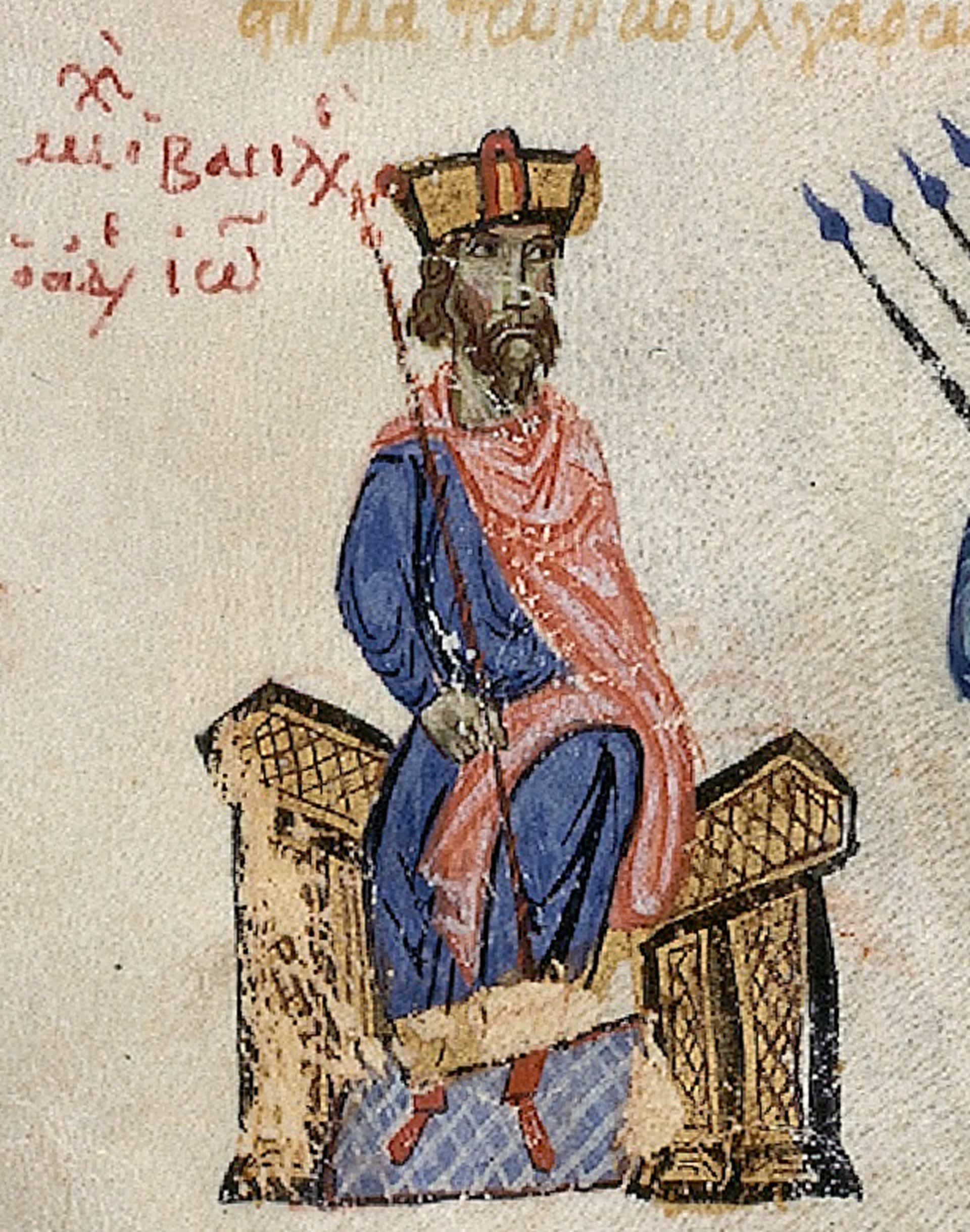

Michael was born in distant Paphlagonia into a family that possessed neither noble rank nor influence at court. His path to power began not with military victories, but with the intrigues of his elder brother — the cunning eunuch John the Orphanotrophos, who already held a prominent place in the palace hierarchy. Michael had three other brothers and a sister as well, and all of them would later become pillars of his regime.
In his youth, according to the historian Kedrenos, the future basileus was engaged in a rather dubious occupation — money-changing and even counterfeiting coins. Yet nature had endowed him with exceptional charm and beauty, which even sudden epileptic seizures could not spoil. Ill-wishers, such as Aristakes Lastivertsi, whispered that a demon had entered the young man after he had turned to witches in order to seize power. Nevertheless, when John the Orphanotrophos introduced his brother to Empress Zoe, the aging daughter of Constantine VIII instantly fell in love with the handsome Paphlagonian and made him her favorite.
This passion became a death sentence for Zoe’s lawful husband, Romanos III Argyros. In 1033, the emperor suddenly fell ill — historians believe that he was being slowly poisoned. The end came in 1034: Michael’s supporters, together with Zoe herself, arranged the murder of Romanos in the bath, where he was first strangled and then drowned in the pool. That same day, without waiting for the mourning period to end, Zoe married Michael and placed the imperial crown upon his head.


Once he became emperor, Michael IV turned the government of the state into a family enterprise. His right hand and the effective ruler of the empire became his brother John the Orphanotrophos. The other brothers also received key offices, forming a powerful but extremely unpopular Paphlagonian clan.
This new ruling group pursued a harshly conservative policy aimed at strengthening personal power. They ruthlessly suppressed opposition: the wealthy Constantine Dalassenos was stripped of his property and exiled. At the same time, the Paphlagonians imposed new taxes and plundered the treasury, which, against the backdrop of the drought of 1037, provoked the people’s fury. This led to a series of revolts beginning in Antioch in 1034. Even such powerful figures as the general George Maniakes and the future patriarch Michael Keroularios rose in opposition to the emperor.

In order to legitimize his rule, Michael, on the advice of John, adopted his nephew in 1035 — the future Michael V — although he himself felt no affection for him. At the same time, the emperor tried to buy heavenly forgiveness for the murder of Romanos III: he spent enormous sums on charity, built shelters for the poor, and even founded a monastery for repentant prostitutes. In 1039, he showered gold upon all the monks of the empire and became the godfather of many children, hoping thereby to obtain divine mercy. It was also during his reign that Theopemptos was appointed metropolitan of Rus’.

Michael IV’s foreign policy was active, but highly unstable. In the East and the South, success attended him:
In 1035, the Byzantine fleet ravaged the Nile Delta, forcing the Fatimid caliph to conclude a thirty-year peace.
After a first unsuccessful campaign in Vaspurakan, the Byzantines succeeded on a second attempt in capturing the city of Berkri, thereby ending Arab influence in that region.
The empire intervened skillfully in the struggles between King Bagrat IV of Georgia and the general Liparit, securing its influence in the Caucasus for decades.

In the West, events unfolded more dramatically. In 1038, George Maniakes launched his great expedition to Sicily. He succeeded in retaking Messina, winning at Rometta, and triumphantly entering Syracuse in 1040. Yet because of court intrigues, Maniakes was recalled and arrested, after which almost all of Sicily, except for Messina, heroically defended by Katakalon Kekaumenos, was lost again.
In southern Italy, Byzantine positions were shaken by the arrival of the Normans. In 1040, they captured Melfi. In 1041, the new katepano, Michael Doukeianos, suffered three crushing defeats and himself fell captive to the “barbarians.” The situation was worsened by the fire of 1040, which destroyed a considerable part of the imperial fleet.
The greatest and most dangerous challenge was the Bulgarian uprising led by Peter II Deljan, which broke out as a protest against taxation and Hellenization. The rebellion spread across the lands of present-day Serbia, Macedonia, and Greece. Imperial troops were defeated near Thebes, and the Bulgarian treasury fell into the hands of the insurgents.
At this time, Michael IV was in Thessalonica. His illness — epilepsy combined with dropsy — had reached a critical stage. Nevertheless, showing unbending will, the emperor returned to the capital, assembled an army, and personally led the campaign. Taking advantage of divisions among the Bulgarian leaders — Deljan was blinded by his rival Alusian — Michael crushed the rebels.
Returning to Constantinople as a victor, but utterly exhausted by disease, Michael IV finally renounced the world. He took monastic vows, hoping for the salvation of his soul. On December 10, 1041, the emperor died in the Monastery of Saints Cosmas and Damian. He passed away leaving behind an empire that he had been able to defend with the sword, but could not heal from within from the corrosion set in motion by his own Paphlagonian clan.


