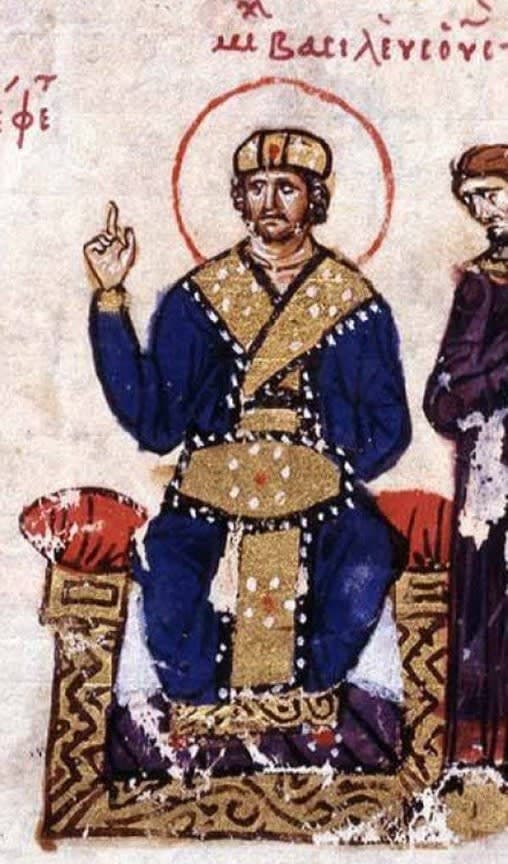
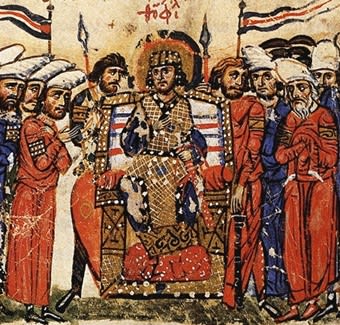
Michael was born at the very beginning of 840, probably on January 9 or 10, and was the youngest child of Emperor Theophilos and his wife Theodora. The political instability of the time demanded swift decisions, and already on May 16, 840, the infant was crowned as his father’s co-ruler. He was barely two years old when, in January 842, Theophilos died, leaving the empire in the hands of a regency council.

During Michael’s minority, the state was in fact governed by his mother, Empress Theodora, relying on the support of her brother Bardas, the logothete Theoktistos, and the military commander Sergios. The most significant achievement of this period was the final restoration of the veneration of icons in 843. The iconoclast patriarch John VII was deposed, and Methodios I took his place, bringing to an end a century of religious strife.

As Michael grew older, a struggle for influence over the young basileus flared up at court. Theoktistos, who had effectively become the second man in the state, aroused the irritation of the emperor’s uncle — the charismatic and ambitious Bardas. Michael, increasingly burdened by the guardianship of his mother and Theoktistos, sided with his uncle.
In November 855, Bardas, with the silent consent of his nephew, arranged the murder of Theoktistos. This marked the beginning of the end of the regency. On March 15, 856, Michael III officially deposed the regents and declared himself sole ruler. A year later, in 857, he showed harsh resolve by sending his mother Theodora and his sisters to a monastery, thereby completely clearing the political field of the influence of the old guard. Bardas received the title of Caesar and became the emperor’s effective co-ruler and mentor.
Despite his reputation as a reveler, the reign of Michael III was marked by an unprecedented cultural revival. It was under him, between 860 and 866, that the University of Constantinople was reopened in the Magnaura Palace under the direction of the great scholar Leo the Mathematician.
The most important events unfolded on the diplomatic and religious fronts:
In 860–861, the Rus’ attacked Byzantium. The siege of Constantinople by Varangian warbands was a shock to the empire, yet it was after this event that the so-called “First Baptism of Rus’,” also known as the “Photian Baptism,” took place, when some of the attackers accepted Christianity.


Under the patronage of Michael and Patriarch Photios, the holy brothers Cyril and Methodius were sent first to the Khazars, in an attempt to restrain the spread of Judaism, and then in 863 to Great Moravia. There they developed the Glagolitic alphabet, laying the foundation of Slavic literacy and liturgy.

Michael also actively supported Patriarch Photios in his prolonged conflict with Pope Nicholas I. In 867, at a synod in Constantinople, the pope was even anathematized, an event that became a forewarning of the Great Schism between the churches.
Michael III’s military activity was extremely intense, though uneven in its results. In the East, Byzantium waged an exhausting struggle against the Abbasid Caliphate. In 856, troops under the command of the emperor’s uncle Petronas struck against the Paulicians, resettling them in Thrace.
Michael himself personally took part in campaigns:
In 857, he sent a 50,000-man army against Umar al-Aqta, the emir of Melitene.
In 859, he personally directed the siege of Samosata.
In 860, he was forced to interrupt a campaign because of the Rus’ attack.
In 863, a turning point came: Petronas won a grand victory at the Battle of Lalakaon, completely defeating the Arabs and killing the emir of Melitene.


On the Bulgarian front, Michael and Bardas in 855–856 successfully restored control over a number of Thracian cities, including Philippopolis, Anchialos, and Mesembria. The culmination came in 864, when they compelled the Bulgarian khan Boris I to accept Christianity according to the Byzantine rite. Boris took the name Michael in honor of his godfather, the Byzantine emperor.
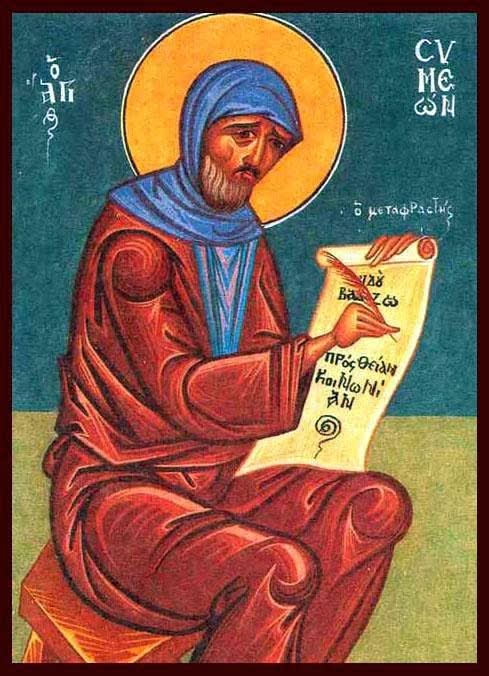
Byzantine chroniclers, especially Symeon Metaphrastes, portrayed Michael as a tyrant given over to vice. It was said that he appeared in the Hippodrome as an ordinary charioteer, squandered the treasury on drinking parties, and rewarded those who could “pass wind” with such force as to extinguish candles. One of the most scandalous episodes concerns a mockery of his mother: the emperor supposedly persuaded his drinking companion Gryllos to dress as a patriarch and, instead of giving the Augusta Theodora a blessing, to expose his backside to her.
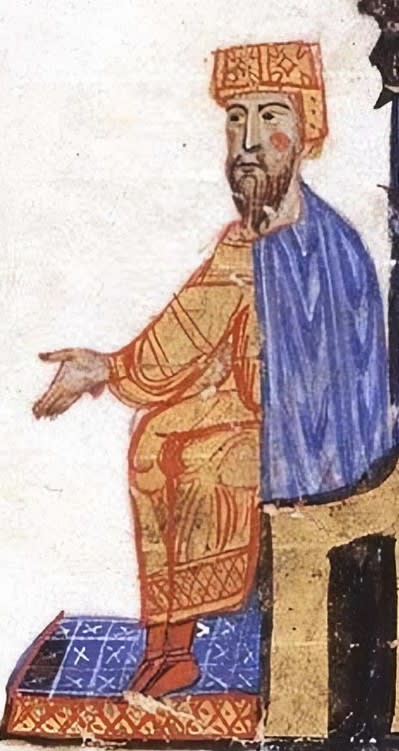
Modern historians, however, generally regard these stories as the product of the propaganda of his successor, Basil the Macedonian. Claims that Michael ordered the destruction of the optical telegraph, the warning system used to report Arab raids, so that news would not interrupt his horse races, are contradicted by the fact that the telegraph continued to function afterward. Most likely, Michael was an energetic but eccentric ruler who placed too much trust in his favorites.
Michael’s tragedy lay in his inability to recognize in time the threat posed by his new favorite, Basil, a simple stableman possessed of extraordinary strength. Basil managed to gain the emperor’s confidence and convince him of Bardas’s disloyalty. On April 21, 866, during an expedition against Crete, Basil and his associates brutally murdered Bardas before the emperor’s eyes.
After this, Basil was appointed magistros and then co-ruler. Michael, whose addiction to alcohol was growing ever stronger, behaved unpredictably. Once, in a state of deep drunkenness, he took off his imperial boots and placed them on the patrician Basiliskianos, declaring that he was more fit to be co-ruler than Basil.
This escapade became the signal for Basil to act. On the night of September 24, 867, around three in the morning, conspirators burst into Michael’s bedchamber in a suburban palace and stabbed him to death. Michael III died without leaving legitimate heirs, and Basil I ascended the throne, founding the new Macedonian dynasty. Despite his inglorious end, it was under Michael that Byzantium made the civilizational leap that allowed it to become the spiritual center of the entire Orthodox world.


