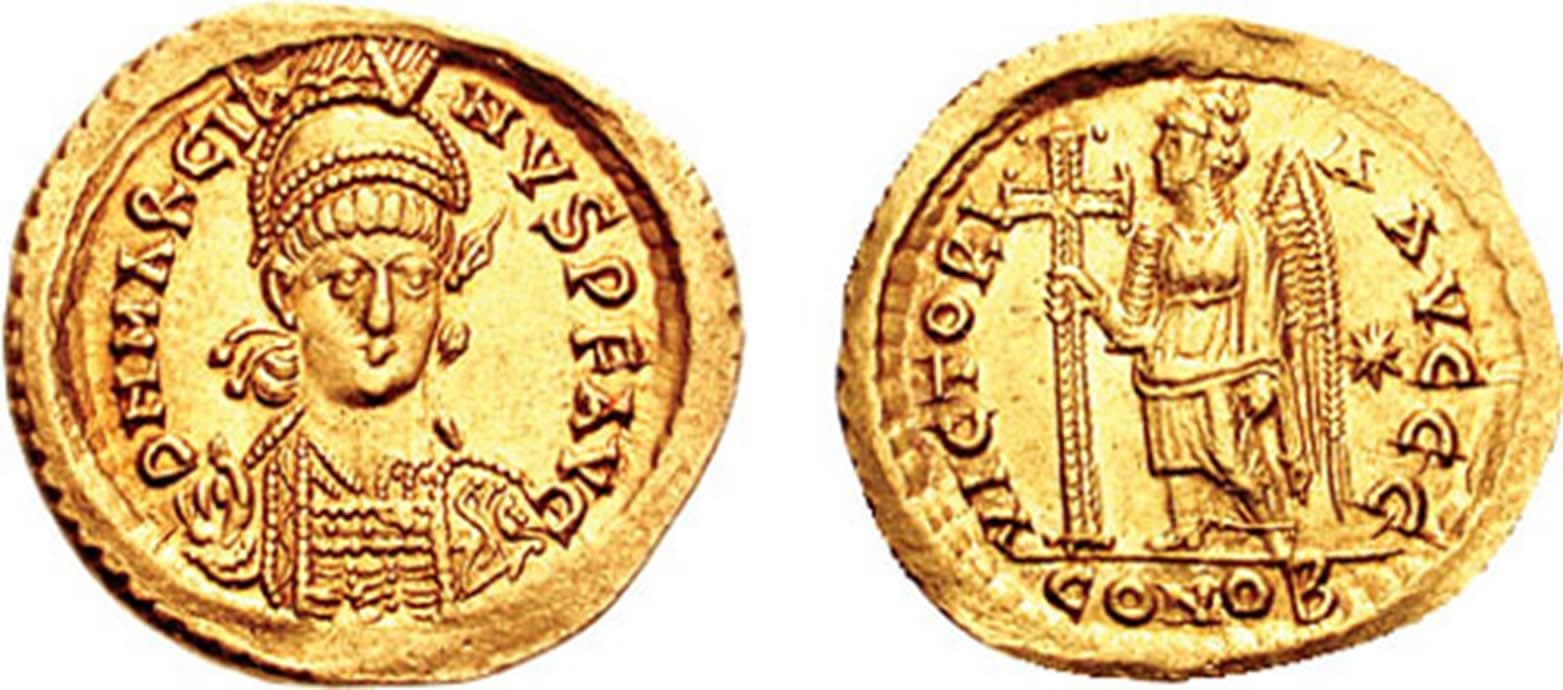
The story of Emperor Marcian is a classic chronicle of how personal valor, loyalty to duty, and a touch of mystical providence can raise the son of a simple soldier to the summit of the world. His path began in 392, when the future ruler was born into the family of a modest military man, in the lands of Illyricum or, according to other accounts, Thrace. Having no noble origin, Marcian chose from his youth the only path available to him — military service. He spent his early years in the exhausting routine of garrison life in Philippopolis, gradually hardening his character and advancing through the ranks.
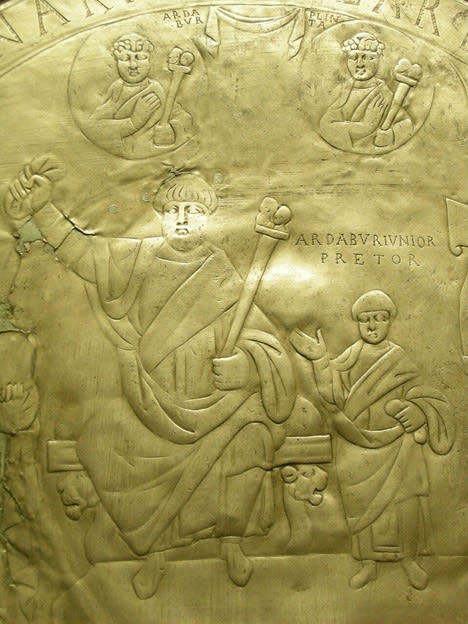
Fate first tested his strength when Marcian’s unit was sent east to take part in a campaign against the Sasanids. However, on the road, in the territory of Lycia, he became seriously ill. At that time, he probably already held the rank of tribune and commanded his own detachment, but illness forced him to step aside for a while. After recovering, Marcian arrived in Constantinople, which became his home and the arena of his future triumph. There, for fifteen years, he faithfully served as a domesticus — a trusted assistant and adjutant — under the powerful generals Ardabur and Aspar. It was precisely this closeness to the highest levels of power and military command that prepared the ground for his later rise.

Marcian’s military biography was full of dangers. Between 431 and 434, during fierce battles in Africa, he was captured by the Vandals. There is a legend according to which the prisoner was brought before King Geiseric himself. According to tradition, the king saw an eagle above the sleeping Marcian, protecting him from the sun with its shadow — a clear omen of his imperial future. Geiseric, struck by this sign, released Marcian after taking from him a solemn oath never to raise arms against the Vandals. Whether this episode was true or a later myth, it emphasizes the exceptional quality that contemporaries saw in this figure.

Thanks to the support of his patrons, Ardabur and Aspar, Marcian first became commander of the guard and was then granted the rank of senator. The decisive turning point came in 450 after the death of Emperor Theodosius II. His sister, the pious and strong-willed Pulcheria, decided to raise Marcian to the throne, entering into a formal marriage with him in order to preserve dynastic continuity. Having become emperor, Marcian proved himself a wise and decisive reformer. His first decrees were the cancellation of tax arrears owed to the treasury for the previous ten years and the return of disgraced exiles. To cleanse the court of corruption, he ordered the execution of the eunuch Chrysaphius, hated by the people, thereby instantly winning the sympathy of his subjects.
The religious life of the empire under Marcian was marked by a crucial event — the convocation in 451 of the Fourth Ecumenical Council at Chalcedon. At this council, Monophysitism was finally condemned as heresy. This decision caused a storm of indignation in Alexandria, a stronghold of the Monophysites. When the Egyptian capital tried to blackmail Constantinople by stopping grain supplies, the emperor showed enviable composure and strategic thinking. He ordered the grain caravans to be redirected along the Nile to Pelusium, and from there straight to the capital of the empire. Finding themselves in the very conditions of famine that they had tried to impose on others, the inhabitants of Alexandria quickly ended the unrest.


On the international stage, Marcian became famous for his firmness in relations with the Huns. When the legendary leader Attila demanded the customary tribute, the emperor replied through his envoys with the famous phrase: “I have gold for friends, but for enemies — only iron.” Realizing that he could not take impregnable Constantinople, Attila was forced to turn his hordes westward, into Gaul and Italy. In 452, when the Huns were ravaging the Apennine Peninsula, Marcian did not remain aside and sent auxiliary troops to help the Western Roman emperor Valentinian III. Although later, in 455, he did not intervene in the Vandal sack of Rome — possibly remembering his oath to Geiseric — many historians believe that his role in the struggle against the Hunnic threat was far more significant than is commonly assumed. Some even connect the circumstances of Attila’s death in 453 with Marcian’s active actions. Shortly before the end of his enemy, the emperor allegedly saw in a dream Attila’s broken bow, which became for him a sign of imminent victory.

In 455, Marcian officially recognized Avitus as emperor of the Western Roman Empire, trying to maintain at least some stability in the collapsing state. His domestic rule was an era of prosperity: he reformed finances, eased the tax burden, and actively resettled borderlands devastated by war. In 452, he successfully repelled attacks on Syria and Egypt, and in 456 suppressed the revolt of King Gubazes I of Lazica on the Caucasian frontier, confirming his reputation as an energetic defender of the borders.
Marcian’s earthly path ended on January 27, 457. He died of illness — presumably gangrene, which developed during one of his pious pilgrimages. The emperor was buried in the Church of the Holy Apostles in Constantinople beside his wife Pulcheria. History remembered him as a just ruler and defender of Orthodoxy. In church tradition, his memory is honored in February, and in the Synaxarion of the Church of Constantinople his name is inseparably connected with the triumph of faith in the cathedral of Hagia Sophia. As a holy right-believing emperor, he also entered the lives of the saints compiled by Demetrius of Rostov, remaining in the memory of posterity as a symbol of stability and honor in the troubled times of the decline of Antiquity.


