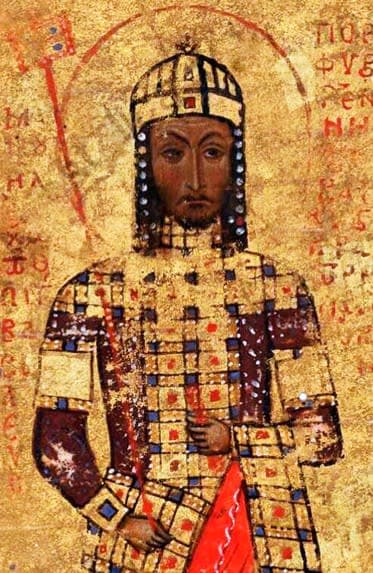
The life of Manuel I Komnenos (1143–1180) is a majestic chronicle, full of brilliance and tragedy, of a ruler who sought to restore Byzantium to the status of the sole world superpower. He was the fourth son of Emperor John II and the Hungarian princess Piroska, and his chances of inheriting the throne initially seemed remote. Yet fate decided otherwise: in 1142, a sudden fever took the lives of his elder brothers, Alexios and Andronikos. Seeing in Manuel a resolute warrior who had accompanied him on campaigns for years, John II appointed him his successor in 1143, bypassing his third son, Isaac.
When John II died in Cilicia on April 8, 1143, Manuel displayed remarkable political instinct. To secure the throne, he sent his loyal general John Axouch to Constantinople with orders to arrest his uncle and brother — both named Isaac — who had access to the treasury. Having strengthened his position, Manuel was solemnly crowned in August 1143. He began his reign with broad gestures: he released his relatives and gave every householder in the capital two gold coins, trying to win the affection of his subjects.


Manuel inherited an empire that had risen from the ashes thanks to his grandfather Alexios I and his father John II, but it was still surrounded by enemies: the Normans in Sicily, the Seljuks in Anatolia, and ambitious Crusaders in the Levant.
In 1144, the ruler of Antioch, Raymond, insolently violated his oath of loyalty by attacking Byzantine Cilicia. Manuel responded harshly: the imperial fleet devastated the principality’s coasts, and the army threw out the invaders. Realizing the emperor’s power and the threat posed by Emir Zengi, Raymond personally came to Constantinople in 1145 to ask forgiveness.
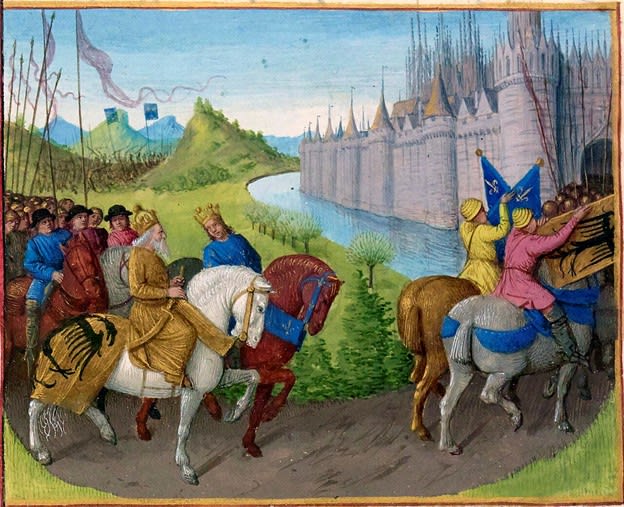
In 1146, Manuel carried out a demonstrative campaign against Konya, defeating the Turks at Akroinon. Soon, however, his attention shifted to the Balkans: in 1147, the participants of the Second Crusade moved through the lands of the empire. The emperor received them with deep suspicion, remembering the outrages of the First Crusade. He repaired the walls of the capital and even concluded a temporary alliance with the Seljuks in order to secure his rear. The Germans of Conrad III were defeated by the Turks at Dorylaion, while the remnants of their forces joined the French under Louis VII. After the crusade, relations with Conrad improved — Manuel even married his relative, Bertha of Sulzbach.

In 1156, the new prince of Antioch, Raynald of Châtillon, carried out a monstrous raid on Cyprus, torturing and maiming the local population. Manuel’s vengeance was swift. In the winter of 1158–1159, the Romans suddenly invaded Cilicia. The frightened Raynald appeared before the emperor at Mopsuestia barefoot, with a rope around his neck, begging for mercy. Manuel forced him to wait a long time for an audience, enjoying the Latin’s humiliation. In the end, on April 12, 1159, Manuel made a triumphal entry into Antioch, where the Latin princes walked on foot, leading his horse by the bridle.

Manuel dreamed of restoring the Roman Empire within its former borders. In 1147, he clashed with Roger II of Sicily, whose fleet was plundering Greece. After concluding an alliance with Venice and Pope Adrian IV, Manuel sent troops to Italy in 1155. The south of the peninsula rose against the Normans, and Bari opened its gates to the Romans.

The emperor seriously discussed with the Pope the possibility of a union between the Orthodox and Catholic Churches in exchange for recognition of his secular authority over the West. Yet the stumbling block was the question of supremacy: the Pope demanded spiritual submission, while Manuel demanded political unity under his own scepter. The defeat at Brindisi in 1156 and the withdrawal of the Byzantines from Italy in 1158 put an end to these dreams. The Italian campaign cost the empire the colossal sum of 2,160,000 hyperpyra, which was never recovered.
In the Balkans, Manuel strove for absolute dominance. In 1150–1152 he subdued the Serbian župan Uroš II, and during the prolonged wars with Hungary from 1151 to 1168 he achieved the annexation of Sirmium, Bosnia, and Dalmatia. The brilliant victory of Andronikos Kontostephanos at Sirmium in 1167 secured for Byzantium the entire eastern coast of the Adriatic.
In relations with Kievan Rus’, Manuel showed flexibility: he supported Yuri Dolgoruky and Volodymyrko of Galicia against the hostile Iziaslav Mstislavich. In 1165, the emperor even pardoned his fugitive cousin Andronikos Komnenos, who had been hiding with Yaroslav of Galicia, in order to eliminate the threat of conspiracy. Rus’ detachments often served in the Byzantine army, taking part in campaigns against the Hungarians and the Cumans.

In 1169, in alliance with King Amalric I of Jerusalem, Manuel organized a grand campaign against Egypt. The emperor sent a huge fleet of more than 200 ships, hoping to capture Damietta. However, because of discord between the allies and a shortage of provisions, the siege failed.
The most devastating blow for Manuel came from his relations with the Seljuk sultan Kilij Arslan II. For a long time, the emperor believed in the possibility of peaceful coexistence, but the sultan was merely gathering strength. In 1176, Manuel assembled a huge army, stretching 16 kilometers in length, and marched toward Konya. On September 17, 1176, in the mountain pass near Myriokephalon, the Byzantines fell into an ambush. It was a crushing defeat, which Manuel compared to the catastrophe at Manzikert. Although the army was not completely destroyed, the empire’s prestige in the West collapsed, and the emperor himself never psychologically recovered from the blow.
Manuel’s internal administration was marked by “Latinophilia.” He flooded the court with foreign knights and merchants — Venetians and Genoese — which caused quiet resentment among the Greeks. In 1171 he even took a drastic step, arresting 20,000 Venetians and confiscating their property. Under him, the system of pronoia, or military land grants, reached its peak, strengthening the power of the landed aristocracy.
Manuel was a passionate theologian, personally taking part in the councils of 1157 and 1166, where the most delicate questions of the Eucharist and the nature of Christ were debated. In 1180 he even entered into a dispute with the Church over the formula of renunciation for Muslims.
Manuel’s personality was a unique fusion of Byzantine basileus and Western knight. Tall, athletically built, and very dark-skinned — a legacy of his Hungarian roots — he loved tournaments, where he personally unhorsed some of the strongest knights of Europe. Legends spoke of his incredible strength: supposedly no one could lift his shield. At the same time, he was educated, interested in medicine, and, unfortunately, toward the end of his life, in astrology.
On September 24, 1180, Manuel I Komnenos died, taking monastic vows before his death under the name Matthew. He left behind an empire at the height of its external power, but financially exhausted and torn by internal contradictions. With the death of this “last great Komnenos,” the rapid decline of Byzantium began.



