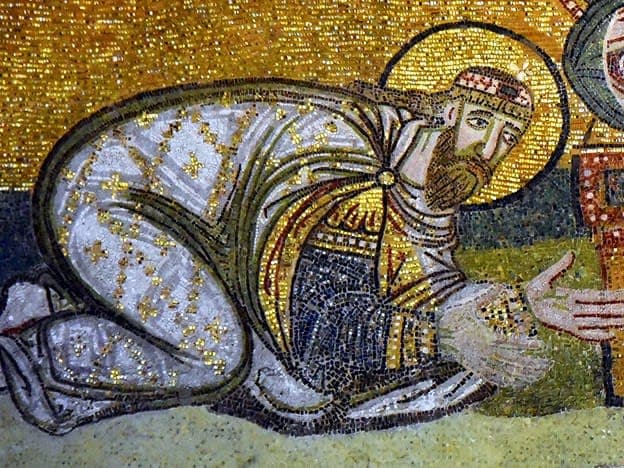

The life of Emperor Leo VI, surnamed the Wise, is a gripping Byzantine drama in which doubts about the legitimacy of his birth, a fierce struggle against ecclesiastical canons, and attempts to hold together the empire’s crumbling frontiers were all tightly interwoven. His fate began with a great mystery: Leo’s mother was Eudokia Ingerina, officially the wife of Basil I, but at the same time the long-time mistress of the murdered Michael III. Basil, though he acknowledged the boy as his son, treated him with hostility throughout his life, seeing in him a living reminder of his predecessor.
This suspicion nearly proved fatal. When Basil’s elder son Constantine died in 879, Leo became the heir, which only intensified the old emperor’s fears. The court intriguer Santabarenos skillfully exploited this by reporting that Leo was hiding a knife in his boot, preparing to commit parricide. During a hunt, Basil demanded the dagger, and when his son obediently drew it from his boot, the basileus flew into a rage. Leo was thrown into prison and only by a miracle, under pressure from advisers, was not blinded. It was not until July 20, 886, that the heir was fully rehabilitated. According to a legend later recorded by his son Constantine Porphyrogennetos, the decisive role was played by a court parrot, which during a banquet plaintively cried out, “Alas, alas, Leo is master!” This moved the revelers and even the emperor himself, reminding them of the prince wasting away in captivity.

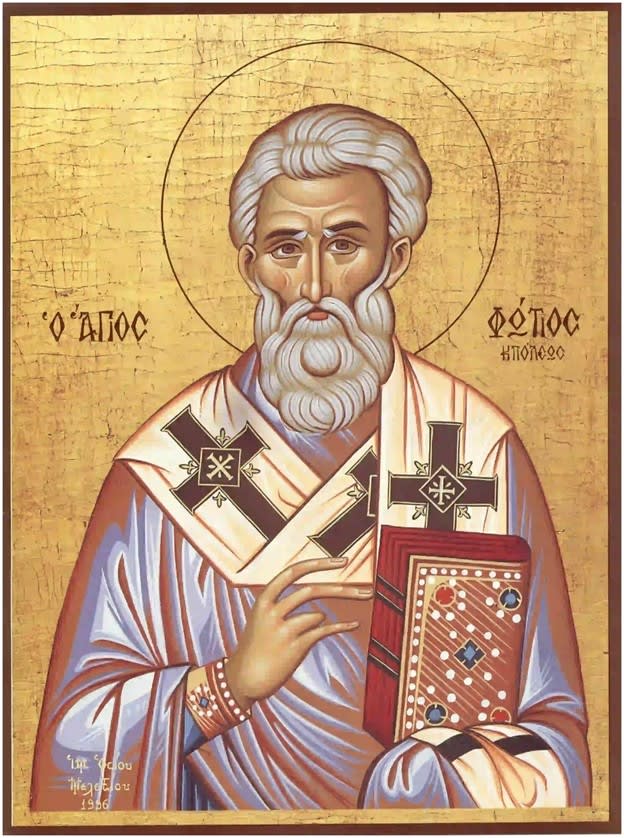
On August 29, 886, Basil I died during a hunt, and Leo VI ascended the throne. His first act was a symbolic one that caused much talk: he solemnly reburied the remains of Michael III in Constantinople, thereby indirectly confirming rumors about his true parentage. Seeking absolute control, Leo immediately turned to ecclesiastical affairs. He deposed the great Photios and installed his eighteen-year-old brother Stephen as patriarch. When Stephen died in 893, the patriarchal throne was occupied in succession by imperial protégés — Antony II and Nicholas Mystikos.
Leo VI entered history as a great legislator. One of his most important acts was the law of 893, which established that a church wedding was mandatory for a marriage to be legally recognized, substantially changing the empire’s civil law. Contemporaries also noted his particular sympathy for Armenians, which was reflected in his appointments.
Unlike his warlike father, Leo VI was not fortunate on the battlefield. In 887, his army suffered defeat near Bari, although Nikephoros Phokas the Elder later managed to restore order. His most dangerous opponent was the Bulgarian ruler Simeon I. In 894, a prolonged war began. Leo tried to use the Magyars as allies in order to strike the Bulgarians from the rear, but this strategy failed. In 896, at the Battle of Bulgarophygon, the Byzantines were utterly defeated, and the emperor was forced to resume payment of a humiliating annual tribute.


At sea the situation was no less alarming: In 888, the fortress of Hypsela was lost.
On August 1, 902, the Arabs captured Taormina, the empire’s last stronghold in Sicily.
In 904, the renegade Leo of Tripoli, at the head of Arab pirates, subjected Thessalonica to a terrible sack.
A rare glimmer of hope came with the victory of the logothete Himerios, who on October 6, 906, destroyed an Arab fleet. However, already in 912, Himerios’s new expedition against Crete ended in disaster off the island of Samos. The only success in the East was the expansion of the frontier through the Armenian prince Mleh, who reconquered territories for a new theme.
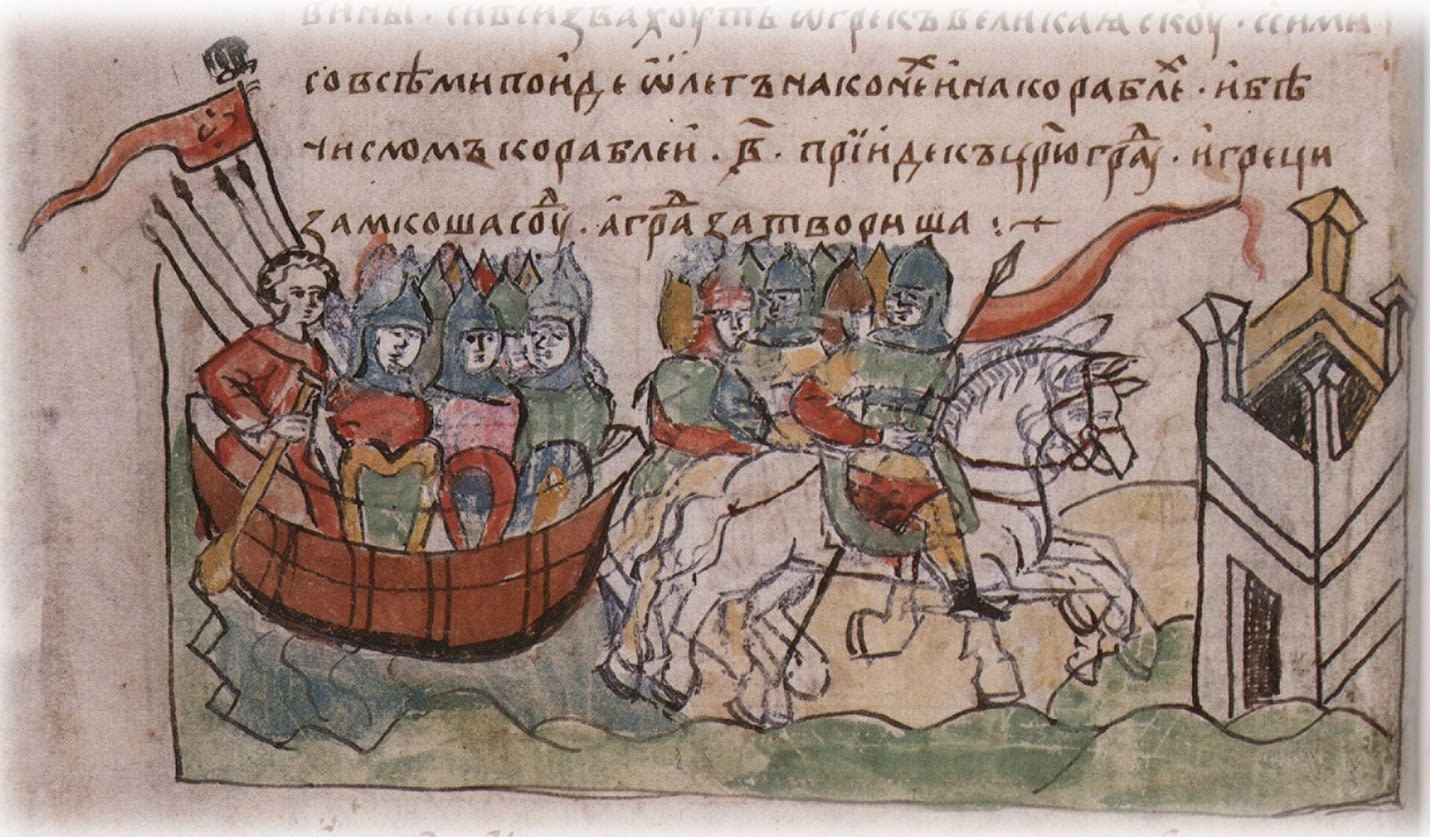
Leo’s relations with the Rus’ occupy a special place in history. The legend of Prince Oleg’s campaign against Constantinople in 907 and of his shield hung upon the city gates finds no confirmation in Byzantine chronicles, yet the commercial treaty of September 2, 911, remains a historical fact. This document became the first official recognition of Rus’ as a political entity in Byzantine sources.

The greatest scandal of Leo’s reign was his struggle for an heir, which entered history as the controversy of the “tetragamy.” His first wife, Theophano, imposed on him by his father in 882, was pious and after her death in 895/896 was canonized. His second wife, Zoe Zaoutzaina, died in 899, and his third, Eudokia Baïana, died in childbirth in 901, as did her infant.
Left without an heir, Leo took an unprecedented step — cohabitation with the beautiful Zoe Karbonopsina, “the Black-Eyed.” A fourth marriage was categorically forbidden by the Church. In May 903, there was even an attempt on the emperor’s life in the church of Saint Mokios: he was struck on the head with a club, which nearly killed him. When in May 905 Zoe gave birth to the long-awaited son Constantine, Patriarch Nicholas Mystikos agreed to baptize the child only in January 906 and on the condition that Zoe be removed from the palace.

However, Leo deceived the Church: a few days later he secretly married Zoe. Thus began a great confrontation. The patriarch forbade the emperor to enter the church. Leo VI, displaying theatrical skill, staged scenes of humility before the people, tearfully begging to be admitted into Hagia Sophia, thereby winning the sympathy of the crowd. In the end, in February 907, the emperor took decisive action: he exiled Nicholas Mystikos, accusing him of treason, and installed the loyal Patriarch Euthymios, who recognized the marriage as lawful.

The earthly path of Leo VI the Wise ended on May 11, 912. Like his predecessors, he suffered from a severe stomach illness. As he was dying, he handed power to his brother Alexander, leaving behind an empire torn by ecclesiastical division, yet one that had preserved the continuity of the Macedonian dynasty. Despite his military failures, his legal works and his struggle to secure the legitimacy of his son determined the internal order of Byzantium for decades to come.


