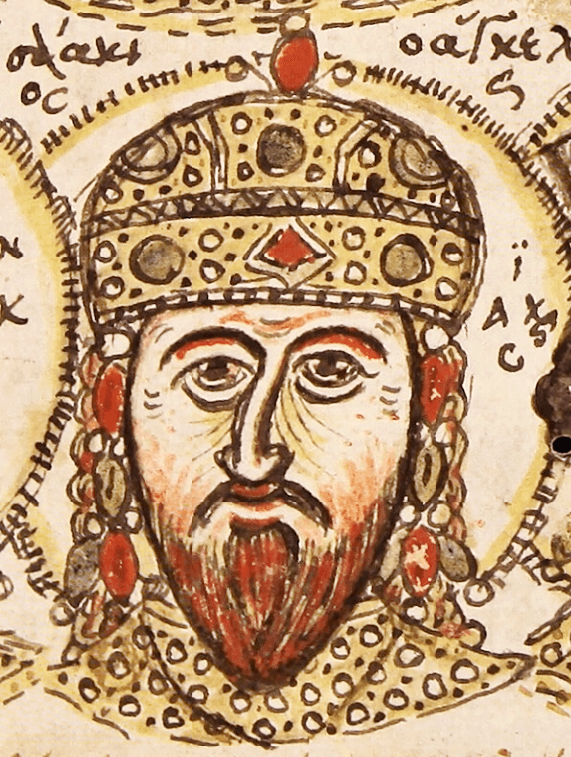

The Angelos family entered the highest aristocracy of Byzantium thanks to Constantine Angelos, admiral of Sicily, who became related to the ruling dynasty by marrying Theodora, the youngest daughter of Emperor Alexios I Komnenos. By the time Isaac was born into the family of the Asia Minor commander Andronikos Doukas Angelos and Euphrosyne Kastamonitissa, the Angelos surname already possessed enormous influence. However, the stability of the empire was shaken on September 24, 1180, with the death of Manuel Komnenos. The throne was inherited by his underage son Alexios II, whose reign turned into a fierce struggle between two parties: the “Latin” faction, oriented toward the West and led by the widow Maria of Antioch, and the “patriotic” faction, which opposed the dominance of foreigners.

The ambitious Andronikos Komnenos took advantage of this turmoil. In the spring of 1182, he marched his troops toward Constantinople. Notably, Isaac’s father, Andronikos Angelos, initially commanded the government forces against the rebel, but after wasting the treasury and suffering defeat at Charax, he defected to the future usurper together with his six sons. Andronikos Komnenos greeted them with a quotation from the Gospel: “Behold, I send My angel before Thy face...” Soon the capital trembled from the Massacre of the Latins on May 2, 1181, when tens of thousands of Europeans were slaughtered, and Andronikos, having seized power, began the systematic destruction of the Komnenian dynasty. Maria of Antioch was strangled, and the young Alexios II was killed with a bowstring in September 1183.

At first, Isaac Angelos was not regarded by the tyrant as a threat. Even when Isaac took part in the revolt in Nicaea, where Andronikos used his mother Euphrosyne as a human shield by tying her to a battering ram, the emperor spared Isaac, considering him too insignificant. Everything changed with the prophecy of the oracle Seth in the autumn of 1185, which predicted that the name of the next ruler would begin with “I” and that he would ascend the throne on September 14.
On the evening of September 11, Stephen Hagiochristophorites, a loyal servant of Andronikos, decided to arrest Isaac as a precaution. However, Angelos, driven by desperation, killed the envoy with his sword and took refuge in the cathedral of Hagia Sophia. By the morning of September 12, a crowd had gathered around him, exhausted by Komnenos’ executions. The people proclaimed Isaac emperor. Andronikos tried to defend himself in the Great Palace, personally shooting arrows at the rebels, but was forced to flee. He was caught while attempting to escape to the Black Sea and was subjected to a torturous execution: Isaac II ordered his hand to be cut off, his teeth knocked out, and one eye gouged out, after which the mob tore the former emperor apart in the Hippodrome.

The first steps of the new basileus were encouraging: he united five Byzantine armies and, under the command of Alexios Branas, defeated the Normans on November 7, 1185, at the Battle of Demetritzes, recovering captured Thessalonica. However, on other fronts fortune turned away from the empire. Isaac Komnenos seized Cyprus, which in 1191, during the Third Crusade, passed into the hands of Richard the Lionheart, and then to the Templars and the Lusignan dynasty.
Relations with the Crusaders became a separate headache. The arrival of Frederick Barbarossa’s army in 1189 caused panic in Constantinople. Despite agreements, Isaac II concluded a secret alliance with Saladin, which led to armed clashes with the Germans. Only after the Crusaders captured Philippopolis and threatened to storm the capital did Isaac agree to ferry them across the Dardanelles in the spring of 1190.

In the Balkans, the reign of Isaac II was marked by the revival of the Bulgarian Empire. The brothers Peter and Ivan Asen raised a revolt in 1186 after the emperor arrogantly refused to grant them estates. Byzantium undertook several campaigns, but they ended either in temporary truces or in catastrophes, as in 1190, when Isaac himself barely escaped from an ambush in the mountains. At the same time, Serbia grew stronger under Stefan Nemanja, who, despite his defeat on the Morava River in 1190, managed to retain significant territories under the peace treaty.
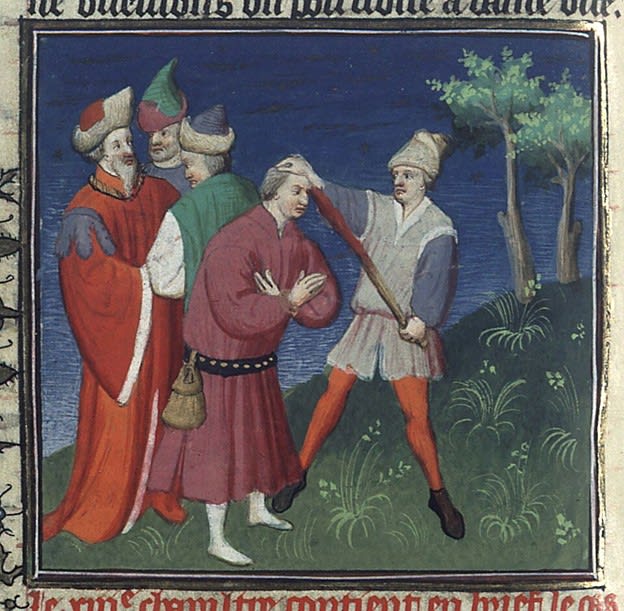
Inside the country, Isaac fought endless rebellions. The commander Alexios Branas, who had earlier saved the throne from the Normans, besieged Constantinople in 1186, but was killed in a duel by Conrad of Montferrat. Later, pretenders appeared, claiming to be the miraculously saved Alexios II, and with Seljuk support they devastated the eastern provinces.
Isaac II’s domestic policy was based on abandoning the harsh reforms of Andronikos. He restored the privileges of Venetian merchants and encouraged corruption, effectively selling state offices. The luxury of the court contrasted with the poverty of the provinces. In March 1195, while preparing for another campaign against the Bulgarians, Isaac became the victim of betrayal by his own brother Alexios. On April 8, at Kypsela, he was seized, blinded, and thrown into prison.

It seemed that Isaac’s story was over, but his son, the future Alexios IV, fled to Europe and persuaded the participants of the Fourth Crusade to turn toward Constantinople. On July 19, 1203, after the flight of the usurper Alexios III, the blind and weakened Isaac was released from prison and once again proclaimed co-emperor. However, the joy was short-lived. The city had been ruined by fires and debts to the Latins. The people’s hatred of the Angeloi led to the coup of Alexios Doukas Mourtzouphlos in January 1204. Upon learning of the death of his son, who had been strangled by order of the new ruler, Isaac II died, only a few months before the final fall of Constantinople under the blows of the Crusaders. His reign became a tragic prologue to the destruction of the empire, trapped between the ambitions of the aristocracy and the power of external enemies.


