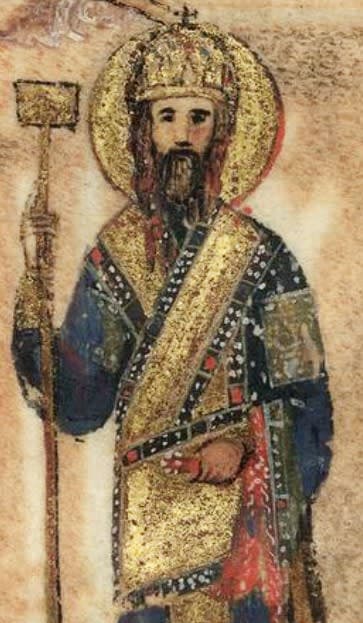

Constantine was born around 1006 and came from the upper ranks of Byzantine society, although the historian John Zonaras questioned his direct descent from the ancient Doukas family. His father, Andronikos Doukas, was a distinguished strategos of the Bulgarian themes, while the future emperor himself most likely spent his childhood on the wealthy family estates in Paphlagonia. Although in adulthood Constantine called himself a “military man,” his early career was connected less with warfare than with the struggle to survive amid the political intrigues of Constantinople.

His name first became widely known in 1034, when he openly defended his father-in-law, the influential aristocrat Constantine Dalassenos, who had been arrested by order of Michael IV. This boldness cost Doukas his freedom: he was imprisoned in a fortress and only by 1039 was he able to return to Paphlagonia, where he temporarily withdrew from public affairs and devoted himself to agriculture.

Only almost two decades later, in 1057, did Constantine return to the forefront of history. Holding the rank of vestarches, he joined the revolt of Isaac Komnenos against Michael VI. Doukas was an ideal mediator: a provincial aristocrat who at the same time had very strong ties with the capital’s elite and with Patriarch Michael Keroularios himself, whose niece, Eudokia Makrembolitissa, he had married as his second wife. Michael Psellos even claimed that the conspirators had initially intended Doukas himself to become emperor, but that he allegedly refused out of modesty.

When Isaac Komnenos emerged victorious, Constantine received the title of proedros, although secretly he had hoped for the rank of Caesar. Relations between the two men were complicated: Doukas did not approve of Isaac’s harsh reforms, which were directed against the bureaucracy. Constantine’s hour came in November 1059, when the gravely ill Isaac decided to abdicate. The chief architect of this accession was the famous philosopher and historian Michael Psellos, who persuaded the emperor to enter a monastery and Doukas to place the crown upon his own head. Even when Komnenos recovered and regretted his decision, Psellos had already secured Constantine’s power so firmly that there was no way back.

Constantine X ascended the throne as a representative of the “civilian party” — officials, intellectuals, and senators. He immediately repealed many of Isaac’s strict measures, paid compensation to disgraced nobles, and opened the doors of the Senate to representatives of the merchant and artisan classes. Yet behind this outward liberalism lay a dangerous practice: the emperor permitted the open sale of offices, turning state administration into a marketplace.
After becoming emperor, Constantine Doukas showed generosity toward the Church and his friends, but the army had to pay the price for this. At a moment when the borders of Byzantium were beginning to tremble under the blows of new enemies, the basileus made what historians consider his most fatal mistake: he sharply reduced soldiers’ pay and cut defense spending.
This decision led to the degradation of the regular army. Soldiers, deprived of prospects, sought to transfer into civil service. In their place, Constantine relied on mercenaries. It was under him that Normans began to enter Roman service in large numbers, and after 1066 so did Anglo-Saxons fleeing from William the Conqueror. For the first time, “barbarians” were given access to high court titles, which provoked fury among the Byzantine nobility. The discipline of these units was poor, but the defense of the empire now rested precisely on them.

The internal stability of the empire was illusory. As early as April 1060, a conspiracy against Constantine had taken shape, involving even the eparch of the capital. The conspirators planned to drown the emperor while he was returning by boat from the monastery of Mangana. Constantine survived only by chance, having boarded a different vessel. The guilty were punished only with exile — the emperor understood the fragility of his position and did not dare shed the blood of aristocrats.
At the same time, the emperor, being deeply devout, began persecuting Monophysites in the eastern provinces. By his decree, sacred books were burned in Melitene and local residents were expelled. This policy of “religious unity” turned into a catastrophe: the population of the eastern borderlands came to hate the emperor and the capital, which made the advancing Turks’ task easier.
Doukas’s foreign policy was a sequence of bitter losses. The main threat was the Seljuk Turkish Empire under Sultan Alp Arslan. In 1064, an event occurred that shocked the Christian world: the Turks besieged and captured Ani, the ancient capital of Armenia. The city, famous for its seemingly impregnable walls, fell because of the negligence of the authorities, and its inhabitants were massacred. The only consolation was the voluntary transfer of the Kingdom of Vanand, or Kars, under imperial rule: King Gagik-Abas surrendered it in exchange for lands in Cappadocia.

In the West, matters were no better. In Italy, the Normans under Robert Guiscard were finally driving out the Byzantines. In 1059, the Pope legitimized Norman rule, while the expedition sent by Constantine in 1060 only briefly recovered several cities in Apulia, which were lost again by 1062.

The Balkans were also in flames. At the end of 1064, hordes of Oghuz Turks crossed the Danube and defeated the local strategoi. Constantine was able to gather only a pitiful force of 150 guardsmen, and the empire was saved only by a miracle — an epidemic and famine that destroyed the invaders. Then, in 1066, the revolt of Nikoulitzas Delphinas broke out in Thessaly, caused by unbearable taxes; it was suppressed only through a promise of tax amnesty.
In October 1066, Constantine X Doukas became gravely ill. For several months he slowly faded away and, according to contemporaries, was almost incapacitated toward the end. On May 22, 1067, the emperor died. He was buried in the Monastery of Saint Nicholas, leaving the empire in a state of profound crisis.
Before his death, Constantine made his wife Eudokia Makrembolitissa swear never to remarry, hoping to preserve the throne exclusively for his children. But reality was harsh: the borders were collapsing, the treasury was empty, and the army was demoralized. Eudokia, understanding that the state needed a sword rather than an oath, soon broke her vow and married Romanos IV Diogenes.
Constantine X left behind an ambiguous memory. For Michael Psellos, he was a “just and pious” ruler and a patron of learning. For the historian Michael Attaleiates, he was a tax-hungry litigant who “exchanged swords for pens.” As the Byzantinist Demetrios Polemis rightly observed, Constantine Doukas might have been remembered as a worthy ruler if he had happened to reign in quiet and peaceful times, but amid the storms of the eleventh century, his softness and bureaucratic mindset became, for Byzantium, the beginning of the end.


