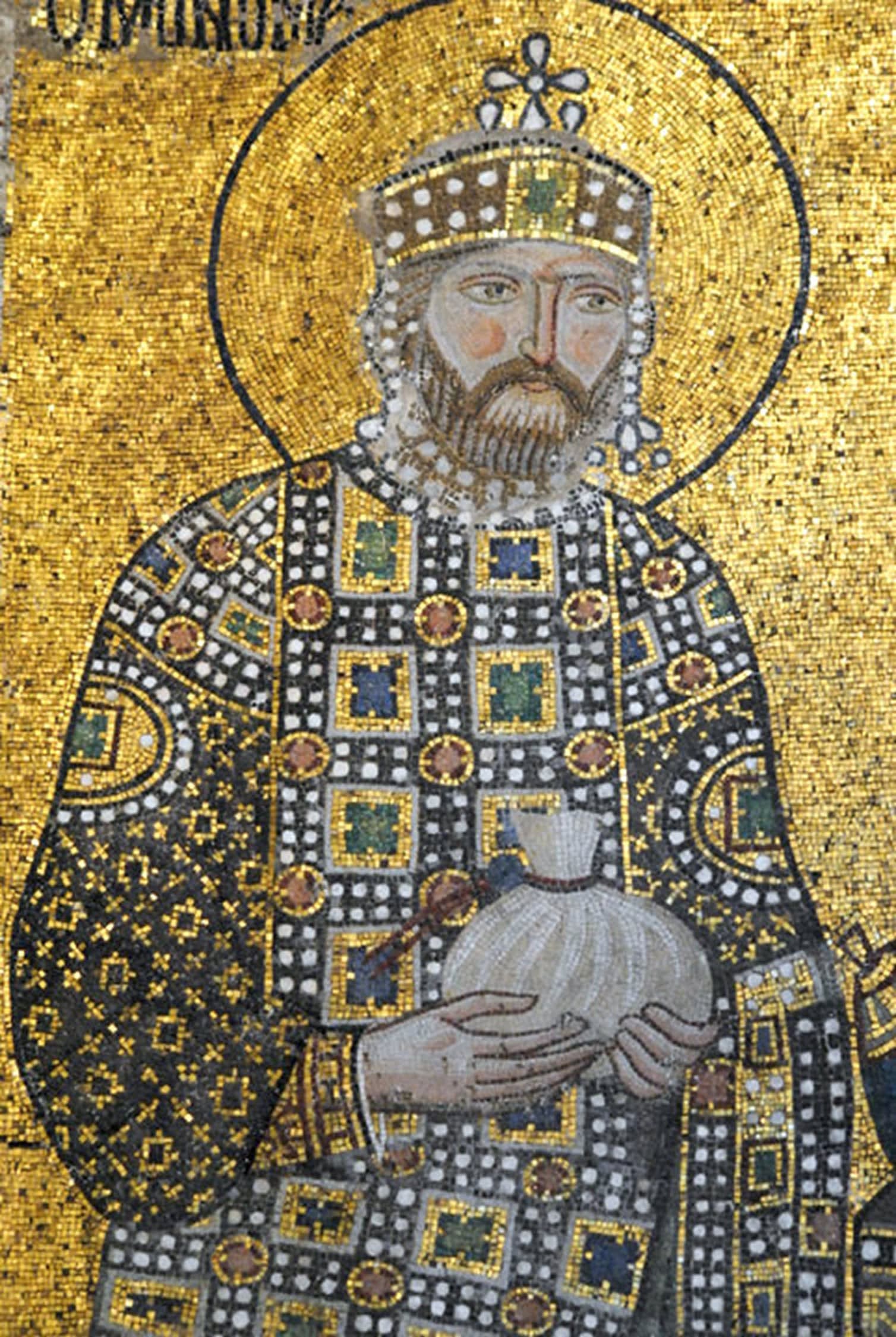

The Monomachos family, whose name in Greek means “single combatant” or “duelist,” is shrouded in historical debate. Some scholars see them as descendants of Armenian aristocrats who had settled in the capital, while others insist on a thoroughly Greek origin. The first references to the family date back to the ninth century: a certain Eustathios Monomachos served as a judge under Emperor Theophilos. The judicial career became a family tradition. Constantine’s father, Theodosios Monomachos, held a prominent place in the judicial hierarchy under Basil II the Bulgar-Slayer, probably as a member of the supreme panel of judges of the Hippodrome.

It is believed that this “ancient house” came from the city of Dalassa on the Euphrates, which linked them to another famous family — the Dalassenoi. Yet Constantine’s road to the throne was darkened by disgrace. His father Theodosios became involved in a conspiracy against Basil II and was executed. Constantine inherited from his father what one might call “the hatred of emperors”: Basil II and Constantine VIII, though they did him no direct harm, carefully kept him away from high office. Even so, Constantine held the title of protospatharios and sat in the Senate, patiently awaiting his hour.

Constantine’s career changed dramatically under Romanos III Argyros (1028–1034), to whom he was related by marriage. The handsome and charming Monomachos captivated Empress Zoe. His rapid rise frightened the courtiers, who saw in him a dangerous pretender to the throne. When the Paphlagonian clan headed by Michael IV came to power, Constantine was immediately exiled to Mytilene on the island of Lesbos. He spent seven long years in exile, watching as Michael IV and then Michael V succeeded one another on the throne.

Fortune returned to him in 1042. After the popular uprising and the overthrow of Michael V, Zoe remembered her former favorite. Constantine was summoned to Constantinople and on June 11, 1042, married the empress. It was a scandalous union: both spouses were over sixty, and for both it was a third marriage, which the Church disapproved of. The wedding was performed by a simple presbyter, while Patriarch Alexios Studites merely “embraced” the couple after the ceremony. Zoe declared that she had taken this step solely “for the interests of the empire.”

Constantine IX was no enthusiast for affairs of state, preferring luxury and pleasure. Nevertheless, the strength of the Byzantine bureaucratic apparatus allowed the empire to continue functioning. The emperor surrounded himself with brilliant minds such as Michael Psellos.

Key internal reforms under Monomachos included: Legal education: A special institution for the study of Roman law was created, headed by a nomophylax.
Ministry of justice: A new judicial sekreton was established, led by a special minister.
Construction: Monomachos founded the magnificent Monastery of Saint George at the Mangana and the monastery of Nea Moni on Chios. Hostels and charitable houses were established alongside churches.

Monomachos’s reign was shaken by uprisings. The most dangerous was the revolt of the general George Maniakes (1042–1043), caused by intrigues involving the aristocratic Skleros family. Constantine had long lived with Maria Skleraina, whom he had brought back from exile and settled openly in the palace, granting her the title of sebaste. This aroused the fury of the Macedonian party and the people. In 1043, crowds protested against “Skleraina the Empress,” fearing for the lives of Zoe and Theodora.
In 1047, Leo Tornikios revolted and laid siege to Constantinople, but he was captured by trickery and blinded. Monomachos dealt ruthlessly with his enemies: under his rule even the former “gray cardinal” John the Orphanotrophos was blinded and killed.


Constantine’s foreign policy became a chain of failures that undermined the empire’s strength:
Loss of the Balkans: Duklja in 1042 and Zeta in 1052 slipped from Byzantine control.
Nomadic Pechenegs terrorized the northern frontiers, reaching the suburbs of the capital.
In 1046, Byzantium annexed the Armenian principality of Ani, thereby destroying the buffer between itself and the Seljuks. In 1048, the Turks devastated Vaspurakan and the city of Arzen. Although the Romans took revenge at Kapetrou, the Seljuk pressure on Manzikert in 1054 showed how fragile the defenses had become.
In 1043, the last Rus’ campaign against Constantinople took place, led by Vladimir Yaroslavich. The Byzantine fleet defeated the Rus’ with the help of Greek fire. Yet the conflict ended in peace and a dynastic alliance: Constantine gave his daughter — or, according to another version, a close female relative — in marriage to Vsevolod, the son of Yaroslav the Wise. Their son, born in 1053, received his grandfather’s byname: Vladimir Monomakh.

A few months before Constantine’s death, an event occurred that forever changed the Christian world. The conflict between Patriarch Michael Keroularios and Pope Leo IX led to the moment on July 16, 1054, when papal legates laid a bull of excommunication on the altar of Hagia Sophia. In response, Keroularios anathematized the legates. The one Church split into Catholicism and Orthodoxy. The emperor, already gravely ill, was unable to prevent the rupture.

Constantine IX Monomachos died in January 1055 of pneumonia. After Zoe’s death in 1050, he had ruled jointly with Theodora, who became his successor.
In Russian history, Constantine’s image became surrounded by legend. The Tale of the Princes of Vladimir claimed that he presented the famous Cap of Monomakh to his grandson. In reality, the emperor died when Vladimir was only two years old, and the cap itself was made much later, in the fourteenth century. The only real regalia given by Constantine was a crown sent to the Hungarian king Andrew I.
Constantine IX left behind an empire that still seemed great, but whose internal and external supports had already been hopelessly weakened by his frivolity and strategic miscalculations.


