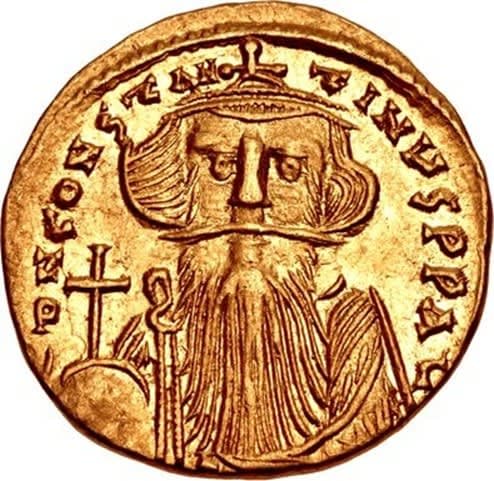

The story of Flavius Heraclius, who entered the annals as Constans II, is one of the darkest and most dramatic chapters of seventh-century Byzantine history. Born into the family of Emperor Constantine III Heraclius and Empress Gregoria, he found himself from an early age at the center of bloody dynastic intrigues. After the sudden death of his father, Constantine III, sinister rumors spread through society that the emperor had been poisoned by his stepmother Martina and her son Heraclius II. Under pressure from the army and with the support of the influential general Valentinus, the young Constans was appointed co-ruler and soon, after the deposition and exile of Martina, became the sole ruler of the empire. Speaking before the Senate, he publicly accused his stepmother of “unlawful cohabitation” with his grandfather Heraclius I and of murdering his father, thereby legitimizing his own power, although until he came of age he was in fact under the guardianship of Patriarch Paul II.
The reign of Constans II coincided with a period of catastrophic contraction of the Christian world’s frontiers under the pressure of the Arab Caliphate. In 642 Byzantium finally lost the “granary of the empire” — Egypt. On September 22 of that same year, Byzantine troops evacuated Alexandria, and only a week later Arab detachments entered the city in triumph, soon also capturing the province of Pentapolis. Within the empire itself, the situation was no less tense: in Italy, the chartoularios Maurice launched a rebellion against the emperor and the exarch, plundering the Lateran.


Although in 645 the Byzantine fleet under Manuel made a bold attempt to retake Alexandria, taking advantage of the fact that Caliph Uthman had left only a small garrison there, the success was short-lived. Already in 646 the Muslims regained the city, this time permanently. The Arab advance continued in an unstoppable stream: by 647 Armenia and Cappadocia had been seized, and in 654 the Muslims organized their first major naval expedition to Crete, signaling their claim to dominion in the Mediterranean.
The internal life of the empire was darkened by a profound religious split over the question of Monothelitism — the doctrine of Christ having only one will, which Constantinople imposed as official teaching for the sake of doubtful political unity. Elected in 642, Pope Theodore I devoted his pontificate to the struggle against this heresy, demanding that Constans II revoke the Ecthesis — the decree of his grandfather Heraclius. The conflict deepened under Patriarch Paul II, who persuaded the emperor to issue a new decree — the Typos — which did not resolve the issue but merely forbade any discussion of Christ’s wills under threat of severe punishment.

The West’s answer was the Lateran Council of 649, convened by the new pope, Martin I. The bishops of Italy and Africa officially rejected both the Ecthesis and the Typos, anathematizing the leading Monothelites of Constantinople. Enraged, Constans II ordered the exarch Olympius to arrest the pope, but Olympius himself launched a rebellion and ruled Italy as a usurper for two years until he died in Sicily. Only in July 653 did the new exarch, Theodore Calliopas, enter Rome and seize Martin I. The ailing pontiff was taken to Constantinople, where, after a humiliating trial and formal condemnation, he was exiled to Cherson in Taurica (Crimea), where he died of starvation in 655.
On the foreign-policy front, Constans II showed personal courage, but often suffered defeat. In 648, after an Arab raid on the Exarchate of Carthage, the ties of this wealthy province with the capital were weakened by unbearable exactions. Meanwhile, Muawiya, governor of Syria, was building a powerful fleet at Tripoli. A clash became inevitable. In 654 there occurred the great battle off the coast of Lycia, known as the “Battle of the Masts” near the city of Phoenix. The Byzantine fleet of 500 ships was completely destroyed, and the emperor himself escaped only by a miracle, exchanging clothes with one of his soldiers.
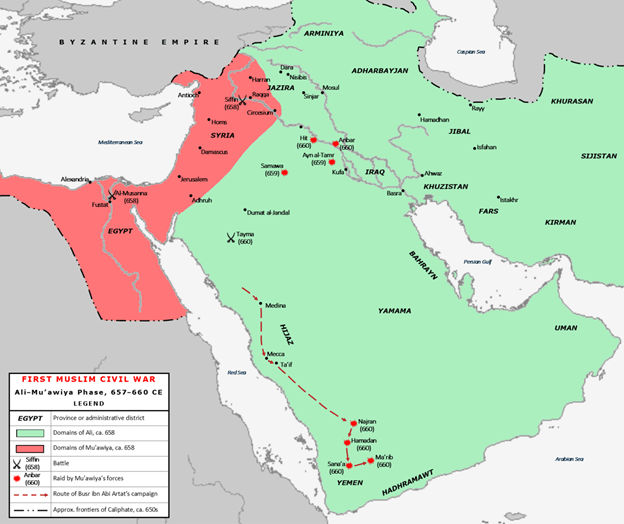
Only the outbreak of civil strife among the Arabs saved Constantinople from immediate siege. A temporary peace was concluded, under which the Arabs evacuated Rhodes and Carthage in exchange for monetary compensation. Constans used this respite for a campaign in 658 into the Macedonian Sclavinia, where he subdued the Slavic tribes that had settled as far as Corinth.

The last decade of Constans II’s reign was marked by growing paranoia and estrangement from the capital. In 660 the emperor ordered the murder of his younger brother Theodosius, seeing in him a potential rival. This act aroused such hatred among the people of Constantinople that Constans decided to leave the “reigning city” forever. He transferred his residence to Syracuse in Sicily, planning to make it the new capital of the empire, but the scheme failed: the Byzantine elite refused to move, and would not even allow his own family to join him there.
In 663 the emperor undertook his final large-scale Italian campaign, hoping to recover the peninsula from the Lombards. However, after a heavy defeat at Forlì at the hands of King Grimoald, in which the empire lost 20,000 men, Constans retreated to Rome. His visit to the Eternal City was remembered not as a liberation but as a plundering: the emperor ordered bronze statues and ornaments removed from ancient monuments and sent to Sicily. In the West, he was even suspected of a secret alliance with the Anglo-Saxons against the Franks, amid fears that he intended to impose direct imperial rule in Europe.

The end of this troubled reign came on July 15, 668. Constans II, burdened by debts and unpopular because of harsh taxes and religious persecutions, was murdered by conspirators while bathing in Syracuse. The sakellarios Andrew, who was attending the emperor, struck him a crushing blow to the head with a soap dish while he was lathering himself. The stunned ruler fell into the water and drowned, leaving the empire in a state of the gravest political crisis, which the usurper Mizizios attempted to exploit.


