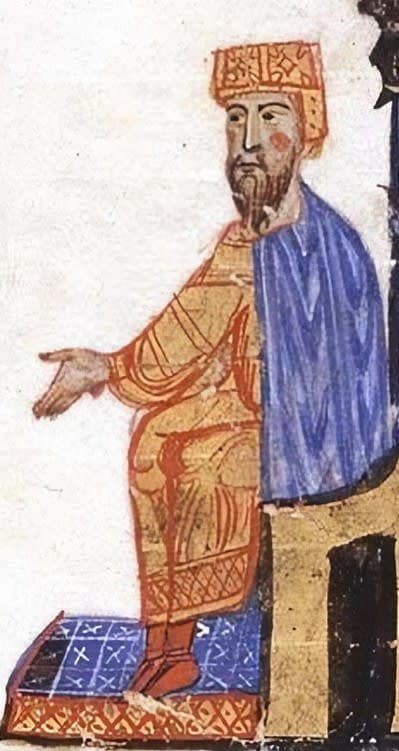

His origins remain shrouded in a dense fog of dispute: some sources call him a Slav, others an Armenian settled in Macedonia, while Arab chroniclers confused the two altogether, considering all Macedonians to be Slavs. The only certain fact is that the future basileus was born into a peasant family, probably in Adrianople or Chariopolis. His childhood was harsh: in 813, when Basil was still a small child (although the dates of his birth vary from 811 to 836), his family was taken captive by the Bulgarian Khan Krum. Only in 836 did he manage a daring escape into Thrace, which belonged to Byzantium, and there he began his ascent to the summit of power.

Arriving in Constantinople, Basil possessed neither connections nor education, but nature had endowed him with an athletic build and rare beauty. Beginning his service in the imperial stables, he quickly attracted attention. Legends say that he possessed almost superhuman strength: once in the Peloponnese he won the favor of a wealthy widow named Danelis, who bestowed upon him a great fortune, and later in the capital he defeated, before all eyes, a gigantic Bulgarian wrestler in single combat and tamed a wild horse that even the best grooms could not control. These exploits opened for him the doors to the immediate circle of Emperor Michael III. Basil became the emperor’s favorite and received the rank of protostrator, and later that of parakoimomenos.

The relationship between the emperor and his favorite was so close and so tangled that Michael even married Basil to his own mistress, Eudokia Ingerina, while continuing his affair with her himself, whereas Basil consoled himself in the arms of the emperor’s sister Thekla. Caesar Bardas, Michael’s uncle and a perceptive politician, already then compared Basil to a lion that would one day destroy them all — and he was not mistaken.

Basil’s path to sole power was drenched in blood. First he removed Bardas; then in 866 he was officially adopted by Michael and proclaimed co-emperor. Yet friendship with the emperor soon gave way to suspicion. In 867, when their relationship had finally deteriorated, Basil organized the brutal murder of his benefactor and himself seized the throne, founding a new dynasty. He had to suppress the uprisings of yesterday’s allies, such as Symbatios and George Peganes, whom he mercilessly blinded. Once on the throne, Basil discovered that the finances and the army were in a miserable condition. Acting with the energy of a man accustomed to struggling for survival, he began a sweeping purge of the bureaucracy and a systematization of the laws. Under him the legal code known as the Procheiron was issued, and the famous Epanagoge was prepared, in which, for the first time in Byzantine history, an attempt was made to define clearly the duties of the emperor, the patriarch, and the state. To fill the treasury, he did not shrink from confiscations, seizing property even from his former lover Thekla and forcing the rich, who had prospered under the previous regime, to surrender half their wealth.
His military activity was no less extensive. He increased the soldiers’ pay and began a methodical offensive against the Arabs. In Asia Minor he succeeded in recovering Samosata, Loulon, and Melitene. One of the brightest pages of his reign was the struggle against the Paulician sect: in 868 they captured Ephesus and threatened the empire, but were eventually crushed in the Battle of Bathys Ryax. During the solemn triumph, Basil showed his harsh nature by personally shooting arrows into the head of the slain Paulician leader Chrysocheir.
In the West, his actions were just as decisive. The fleet he dispatched under the command of Niketas Ooryphas lifted the siege of Ragusa, and in 872–875 the allied Frankish-Byzantine forces captured Bari, which passed under Byzantine protection. Although Syracuse fell in 878, Basil managed to preserve Byzantine influence in the region by sending to Italy the brilliant general Nikephoros Phokas the Elder, who won a series of important victories over the Saracens.


Basil’s ecclesiastical policy was a subtle game played on the contradictions between Constantinople and Rome. At first he restored Patriarch Ignatios, a supporter of rapprochement with the pope, but later he recalled the disgraced Photios from exile and entrusted him with the education of his son Leo. Although Pope John VIII once again anathematized Photios in 880, Basil succeeded in reaching an understanding with the next pontiff, Stephen V, on the joint defense of Italy. The emperor’s personal life in the later years of his reign was darkened by tragedy: in 879 his beloved eldest son and co-emperor Constantine died, a loss that broke the spirit of the basileus.
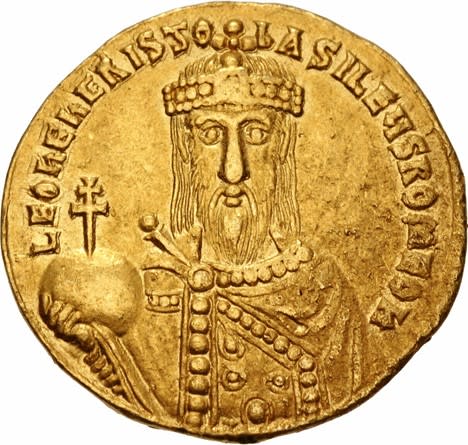
The end of Basil’s life was as unusual as its beginning. In 886, during a hunt, a terrible accident occurred: a huge stag caught Basil by the belt with its antler and dragged him through the forest for a long distance. When one of the bodyguards cut the belt with a sword in order to save his master, Basil, once he regained consciousness, ordered the execution of his rescuer, suspecting him of attempted murder. A few days later, on August 29, 886, the emperor died from his injuries, although Constantine Porphyrogennetos diplomatically described the cause of death as a stomach illness. Leo VI ascended the throne, though many considered him the illegitimate son of the murdered Michael III, which became an ironic ending to Basil’s long struggle to legitimize his dynasty. Despite all his crimes, Basil I left behind a powerful state, renewed law, and an army prepared for new achievements.


