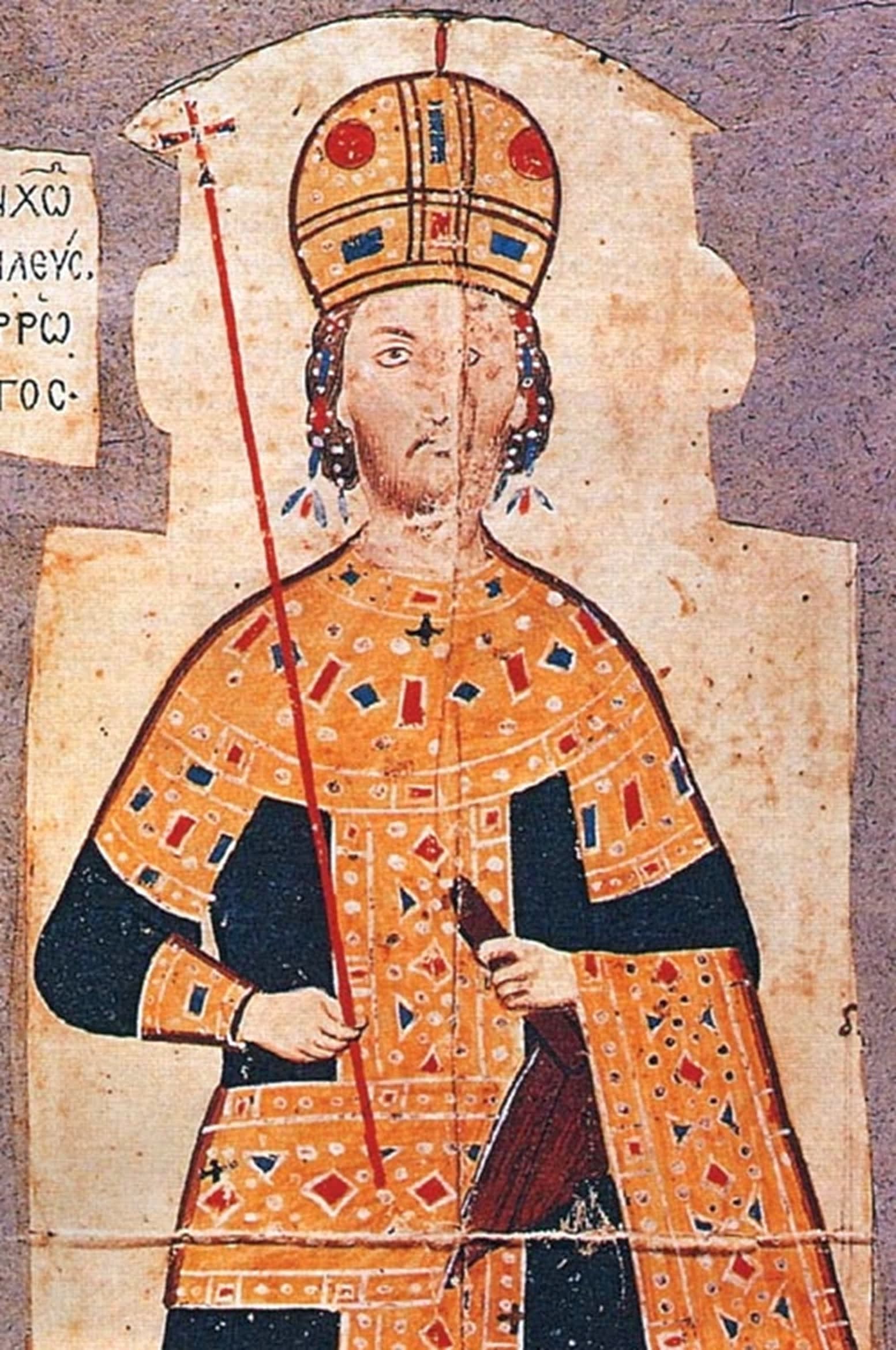

Andronikos III was born in 1296 in the very heart of the empire — Constantinople. He was the son of the co-emperor Michael IX Palaiologos and the Armenian princess Rita II. The young prince grew up in an atmosphere of adoration: his grandfather, Emperor Andronikos II, doted on his grandson, who, according to contemporaries, possessed rare beauty and a sharp mind. However, the character of the future ruler was far from asceticism — Andronikos loved hunting with hounds, noisy feasts, and luxury, for which he often fell into debt to Genoese bankers from Galata.

The turning point came in 1320. Andronikos’ romantic infatuation with a noble lady led to catastrophe: having learned of a rival, he hired men to teach him a lesson. But the hired killers, by tragic mistake, killed not the rival but Andronikos’ own brother Manuel, who happened to be passing by. This news finished off their father, Michael IX, who died of grief on October 12, 1320. Relations between grandfather and grandson instantly turned into open hostility: Andronikos II, shaken by the death of his son and grandson, decided to deprive the “murderer” of his rights to the throne.
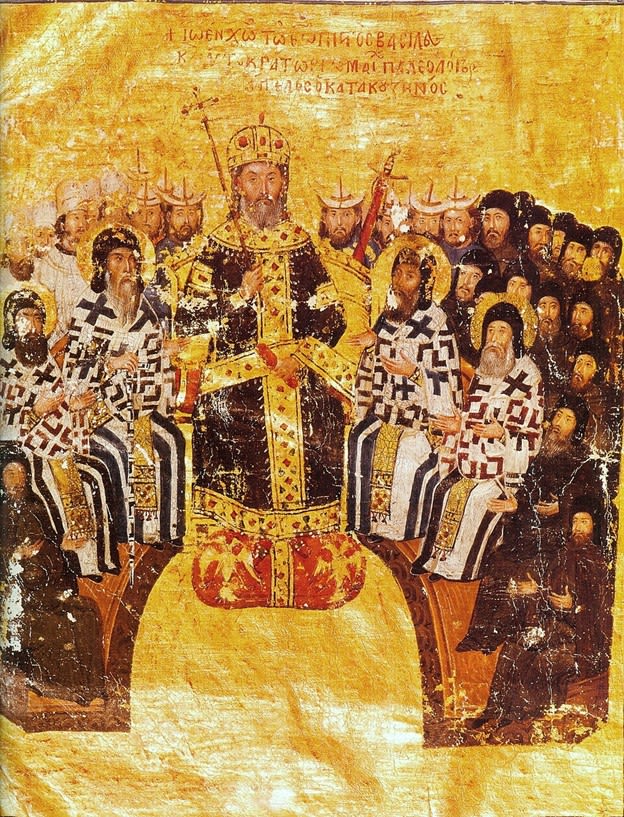
The conflict quickly grew into a large-scale confrontation. Andronikos II began collecting oaths of loyalty from courtiers in favor of his second son Constantine, while Andronikos the Younger found support among the young military aristocracy. His key allies were John Kantakouzenos, who became his “shadow” and chief strategist, as well as the treacherous Syrgiannes Palaiologos.

Andronikos the Younger fled the capital on Easter 1321 after learning of his impending arrest. In Adrianople, he proclaimed himself emperor and made a brilliant move: he abolished a number of taxes for the inhabitants of Thrace. The people, burdened by taxation, went over to his side en masse. His frightened grandfather agreed to peace, dividing the empire: Thrace went to the grandson, while Constantinople and the islands remained with the grandfather.
Syrgiannes, dissatisfied with the rise of Kantakouzenos, defected to Andronikos the Elder. War broke out with renewed force. However, Andronikos III proved himself a talented commander: he defeated his grandfather’s Seljuk mercenaries, captured Thessaloniki, and took his uncle Constantine prisoner. In June 1322, peace was signed at Epibatai, under which the grandfather undertook to pay his grandson enormous sums for the maintenance of his court and army.

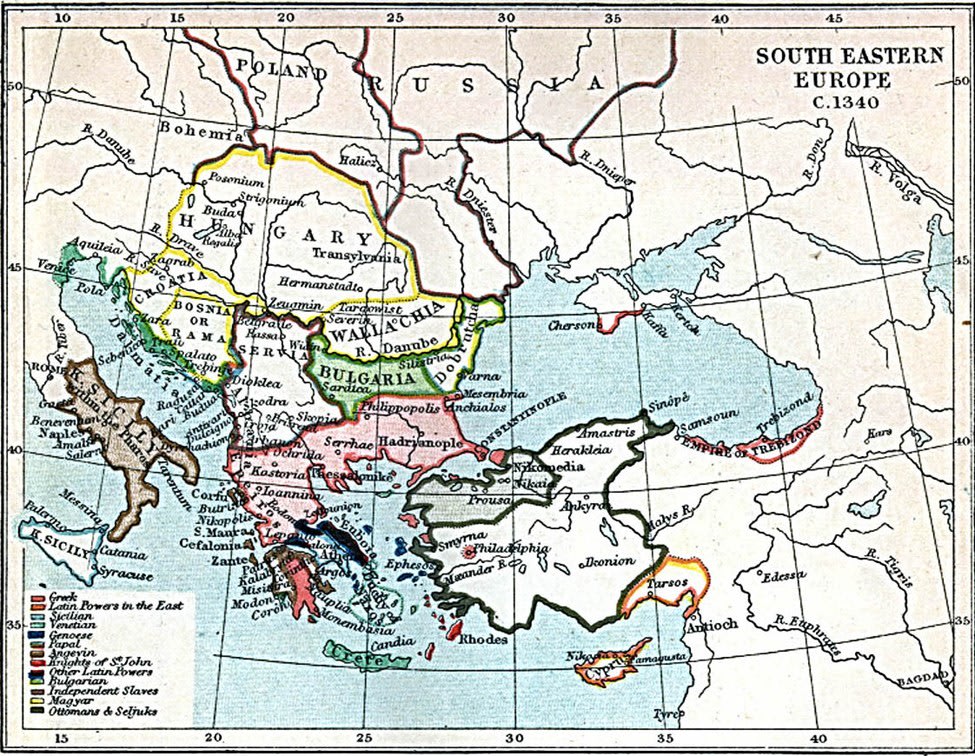
While turmoil raged inside the empire, the Bulgarians decided to exploit the moment. In 1322, Tsar George II Terter captured Philippopolis, or Plovdiv. Andronikos III immediately set out on campaign, recovered the city, and launched an offensive deep into Bulgaria, capturing key ports: Mesembria and Sozopolis.
In 1324, the situation was complicated by the intervention of the Golden Horde. Khan Özbeg sent a huge cavalry force to aid the Bulgarians. However, Andronikos III, in a brilliant battle between Didymoteicho and Adrianople, utterly defeated the Tatar-Mongol army. In 1326, a firm peace was concluded with the new Bulgarian tsar Michael Shishman, sealed by the tsar’s marriage to Andronikos’ sister Theodora.

By 1327, Andronikos II had finally lost authority. He concluded an alliance with the Serbian king Stefan Dečanski, which provoked the anger of the Greek population of Macedonia, who suffered from Serbian raids. Andronikos III, by contrast, formed an alliance with the Bulgarians.
Andronikos the Younger’s victorious march through Macedonia was swift: Edessa, Kastoria, and Ohrid opened their gates without a fight. The decisive moment came on the night of May 24, 1328. A small detachment of 24 elite fighters entered Constantinople through the Gate of Romanos and opened it to the army. The city fell almost bloodlessly. Andronikos II, who was praying before the icon of the Hodegetria, was deposed. Although his grandson spared his life, the old emperor was later forced to take monastic vows under the name Antonios and died on February 13, 1332.
Having become sole ruler, Andronikos III faced a catastrophic situation in Asia Minor. The Ottomans under Emir Orhan had already taken Prusa and were besieging Nicaea.

In 1329, the emperor ferried 2,000 veterans of the Thracian cavalry across the Bosporus. On June 10, 1329, the Battle of Pelekanon took place. The Byzantines stubbornly held their defensive position, but a fatal accident decided the outcome: Andronikos was wounded, and when he was carried away to have his wound dressed, panic broke out among the militia. Thinking that the emperor had been killed or had fled, the army rushed toward the ships. This defeat effectively predetermined the fate of Byzantine Anatolia.
Andronikos III understood that the empire needed order. In 1329, he carried out a radical judicial reform, creating the “Imperial Court” of four judges — the “universal judges of the Romans.” They possessed absolute authority, and their verdicts could not be appealed. Even when three of them were exposed for corruption in 1337, the structure itself proved so viable that it survived until the very fall of Constantinople in 1453.
At sea, Andronikos also achieved successes: in 1329, a powerful fleet of 105 ships restored the island of Chios to the empire, defeating the Genoese lordship of Martino Zaccaria.

The period of 1329–1330 became a time of trials for the emperor. He suffered a grave illness during which he nearly abdicated the throne. At this time, behind his back, Syrgiannes once again began weaving intrigues and eventually fled to the Serbs, becoming their guide in future campaigns against the empire.
By 1330, the international situation had become extremely tense. The Bulgarian tsar Michael III Shishman, who four years earlier had expelled his wife Anna, the sister of the Serbian king Stefan Dečanski, had inflicted a blood insult on the Serbian court. In response, the heir to the Serbian throne, Stefan Dušan, began large-scale military preparations, purchasing weapons in Dubrovnik and hiring hundreds of western knights.
Byzantium and Bulgaria decided to unite their forces in order to crush Serbia’s growing power. The plan of Andronikos III and Michael Shishman was ambitious: a simultaneous invasion from the south and the west with the aim of joining their armies. However, a fatal lack of coordination and strategic miscalculations led to disaster. While Andronikos III delayed in Pelagonia — whether because of insufficient forces or because he intentionally did not wish the Bulgarians to become too strong — Michael Shishman overconfidently invaded Serbia on his own.
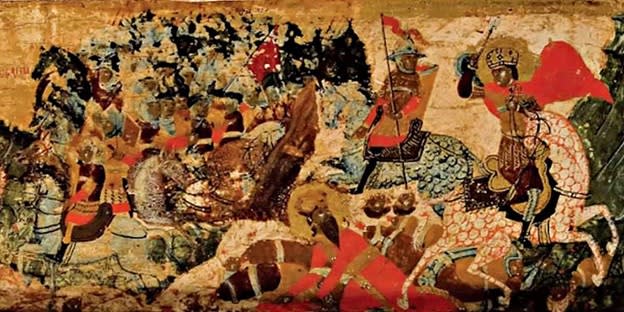
On July 28, 1330, near the town of Velbazhd, a battle took place that changed the course of history. The Serbs, under the command of Stefan Dušan, caught the Bulgarians by surprise. The blow of a thousand steel-clad German knights crushed the Bulgarian ranks. Michael Shishman fell in battle, or died of his wounds in captivity; his army was destroyed, and the battlefield was covered with bodies. The Byzantine troops, having learned of their ally’s defeat, immediately left Serbian territory.
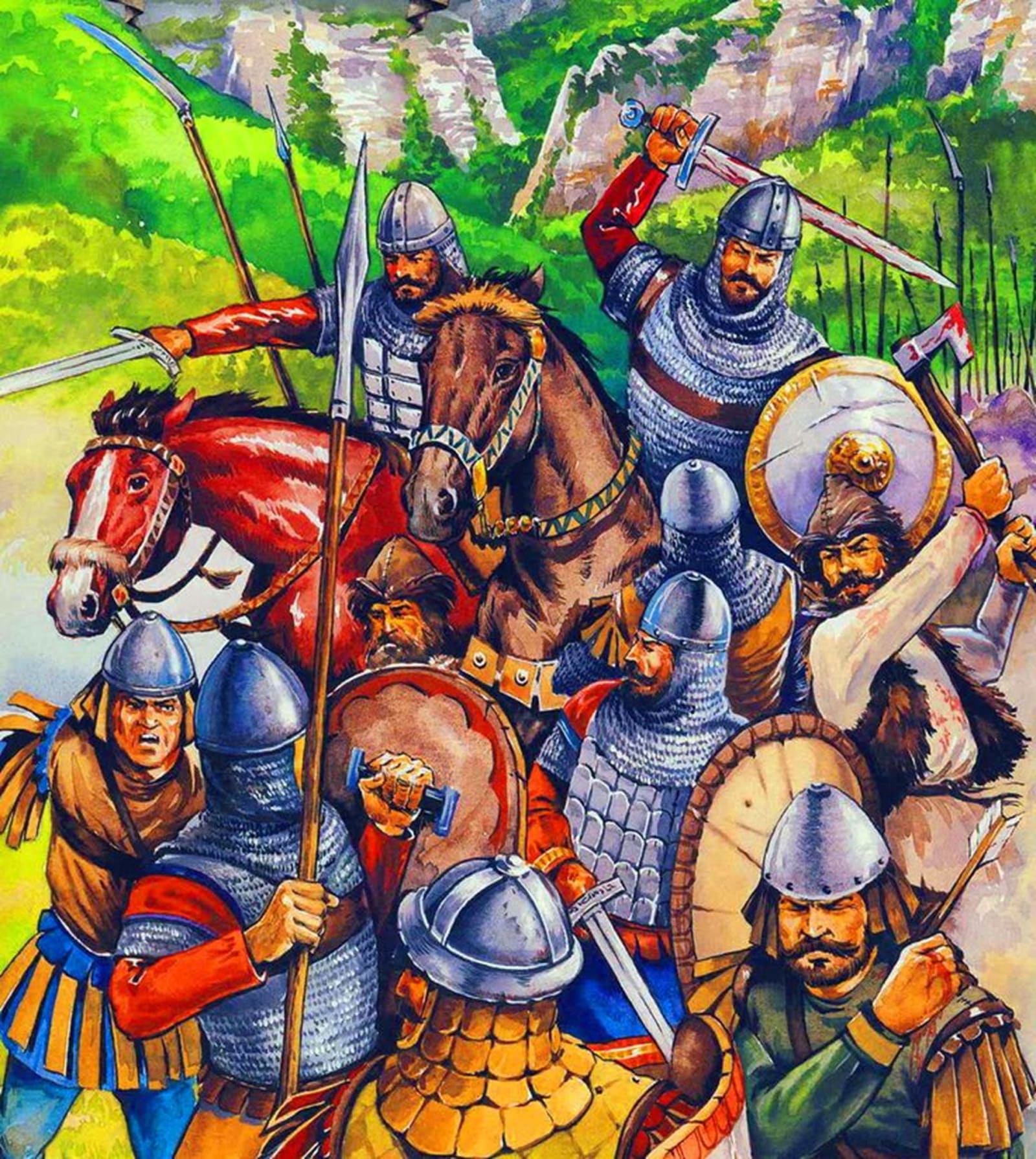
The victory at Velbazhd set off a chain reaction of coups. In Serbia, the young nobility, hungry for expansion, overthrew and strangled Stefan Dečanski, raising Stefan Dušan to the throne. In Bulgaria, power was seized by the nephew of the dead tsar — Ivan Alexander. These two quickly found common ground, forming an alliance against Byzantium, sealed by Dušan’s marriage to the Bulgarian tsar’s sister Helena.
Andronikos III, taking advantage of the turmoil in Bulgaria, occupied southern Bulgarian lands, which led to the Battle of Rusokastro in the summer of 1332. Despite the emperor’s personal courage, the Bulgarian-Wallachian army of Ivan Alexander, supported by Tatar cavalry, defeated the Byzantines. Besieged in a fortress, Andronikos was forced to sign a peace that preserved the status quo.
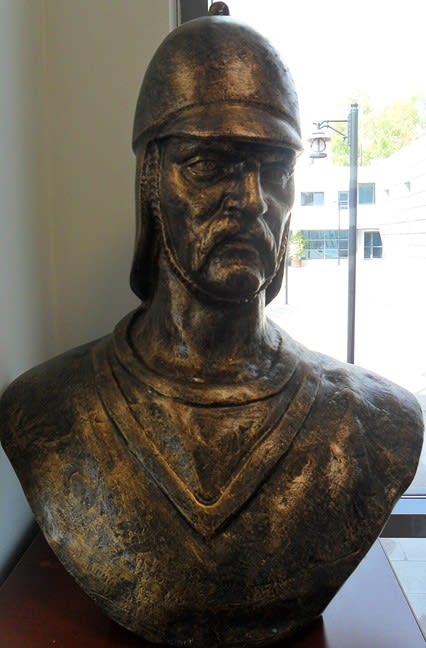
The most dangerous opponent remained Stefan Dušan. In 1334, the Serbs, with the support of the elusive Syrgiannes Palaiologos, began seizing the cities of central Macedonia. Kastoria fell, and Syrgiannes himself was already dreaming of taking Thessaloniki. The threat was so great that the Byzantines resorted to extreme measures: the officer Sphrantzes Palaiologos, posing as a defector, entered Syrgiannes’ camp and killed him on August 23, 1334.
Having lost his chief strategist, Dušan entered negotiations. Under the terms of the peace, Byzantium permanently lost the regions of northern and central Macedonia, retaining only the southern areas. From that moment, Serbia officially became the hegemon of the Balkans.
On the eastern front, the situation was tragic. In March 1331, legendary Nicaea fell. Andronikos III, tied down by wars in Europe, was forced in August 1333 to sign a humiliating peace with Emir Orhan, agreeing to pay the Ottomans an annual tribute of 12,000 hyperpyra. This was the price of temporary calm for the remaining Bithynian cities, although Nicomedia still fell in 1337, becoming the first Ottoman shipyard.
However, at sea Byzantium was experiencing a renaissance. Andronikos III skillfully maneuvered among the Latin powers. When Genoa began intriguing against the empire, Andronikos formed an alliance with the Seljuk emirs of Saruhan and Aydin. In 1336, a powerful Byzantine fleet, supported by Turkish allies, besieged Galata, forcing the Genoese to tear down their fortifications, and then recaptured Lesbos and Phocaea. The emir of Aydin, Umur Bey, became the emperor’s loyal friend, seeing in him a worthy warrior.
The main achievement of Andronikos III was the almost complete restoration of imperial authority over western Greece. In 1333, after the death of the ruler of Thessaly, Stephen Gabrielopoulos, Byzantine troops swiftly occupied the region, outpacing the Epirotes.
In 1337, the turn of the Despotate of Epirus came. Taking advantage of internal strife after the death of John II Orsini, Andronikos, supported by 2,000 warriors of Emir Umur, abolished the independence of Epirus. An attempted revanche by Nikephoros II Orsini, supported by the Latins in 1340, ended in failure. After the long siege of the impregnable Thomokastron, where Kantakouzenos blocked the delivery of provisions by sea, the Epirotes capitulated. Epirus was finally subordinated, and John Angelos became governor.
A life spent in endless campaigns undermined the emperor’s health. Soon after returning from Epirus, on June 15, 1341, at the age of only 45, Andronikos III Palaiologos died in Constantinople after five days of exhausting fever.
Andronikos III was an atypical Palaiologos. He despised court etiquette, went about without bodyguards, and spent the fabulous sum of 15,000 hyperpyra every year on hunting. But behind the image of a reveler stood an energetic commander who personally led cavalry charges and restored the fleet from 20 to 70–100 pennants.
With the death of Andronikos III, Byzantium lost its last energetic warrior-ruler. Almost all of his western conquests would soon be swallowed up by the Serbian Empire of Stefan Dušan, while Byzantium itself would sink into the abyss of a new and destructive civil war.