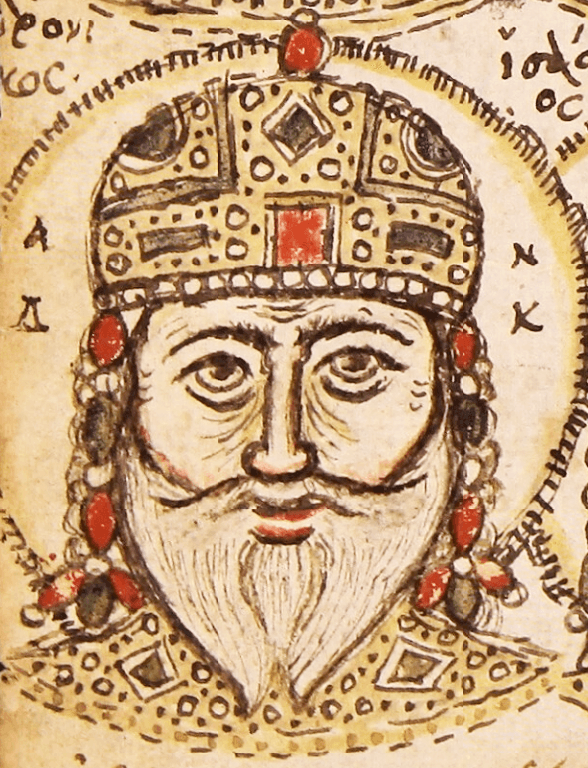

Andronikos was born into the family of Isaac Komnenos, the son of the great emperor Alexios I. The identity of his mother still remains a matter of debate among historians: some name her as Irene, the daughter of Prince Volodar Rostislavich of Peremyshl, while others identify her as Kata, the daughter of the great Georgian king David IV the Builder. From childhood, Andronikos found himself at the center of family intrigues. His father Isaac, despite supporting his brother John II during his accession to the throne, later attempted to seize power himself in 1122. This failed coup forced Isaac and the young Andronikos to flee to the Seljuks in the Sultanate of Konya, where they unsuccessfully tried to assemble a coalition against Constantinople.

Andronikos’s upbringing took place in the Boukoleon Palace under the supervision of his uncle, Emperor John II. He grew up side by side with his cousin Manuel, the future basileus. They were educated according to the classical curriculum: rhetoric, grammar, geometry, music, and astronomy. Even then, an unspoken rivalry arose between them. Andronikos, endowed with incredible physical strength, beauty, and a sharp mind, always sought to surpass his cousin. Their enmity was also fueled by personal scandals: while Manuel cohabited with his niece Theodora, Andronikos openly lived with her sister Eudokia, responding to reproaches with jokes that subjects merely imitate the vices of their ruler.
When Manuel I became emperor in 1143, Andronikos entered imperial service. He took part in campaigns against the Seljuks in 1145–1146, where he was even captured. Later, in 1151, he was sent to Cilicia against the Armenian prince Thoros II. However, the siege of Mopsuestia ended in disgrace: while Andronikos indulged in leisure, the garrison made a sortie, routed the Byzantines, and the commander was forced to flee.


Despite these failures, Manuel forgave his cousin, appointing him governor of Niš and Braničevo in 1154. But Andronikos was already plotting the emperor’s murder, conducting secret negotiations with the Hungarian king Géza II. The conspiracy was uncovered, and Komnenos spent the next nine years in the prison of the Great Palace. His escapes became legendary: once, he staged his own disappearance by walling himself up with bricks in an underground passage, which even allowed him to meet his wife in his cell and conceive a son. The second time, in 1164, he used a wax impression of a key and a rope hidden in an amphora of wine to escape to freedom.
His path led him to the Principality of Galicia, to Yaroslav Osmomysl. In Halych, Andronikos, who received the nickname Polyphron, “the Many-Wise,” became an honored guest, hunted with the prince, and participated in councils. In 1165, after a temporary reconciliation with Manuel, he returned to Byzantium and distinguished himself at the siege of Zemun. However, a new conflict over the succession — Andronikos opposed the appointment of the Hungarian Béla III as heir — sent him into exile again. He wandered across the East: Antioch, the Kingdom of Jerusalem, where he seduced the emperor’s niece Theodora, Damascus, Baghdad, and finally Georgia. Only after many years of raiding the borderlands of Chaldia did he appear before Manuel in chains, begging for forgiveness.

The death of Manuel I in September 1180 opened a “Pandora’s box.” The heir, Alexios II, was only 10 years old, and power was seized by his mother Maria of Antioch and her lover, the protosebastos Alexios Komnenos. The people hated this “Latin” government for its pro-Western sympathies. Andronikos, sensing the moment, marched out of Paphlagonia in the spring of 1182.

His advance toward the capital was accompanied by triumph. The provinces surrendered one after another. When the fleet came over to his side, a terrible Massacre of the Latins erupted in Constantinople. Around 60,000 Europeans were killed or sold into slavery. The protosebastos was blinded, and Andronikos entered the city as a “savior.”
After becoming regent, Andronikos began the systematic destruction of the family of the late Manuel. First, the emperor’s daughter Maria and her husband Renier of Montferrat were poisoned. Then came the turn of the dowager empress Maria of Antioch — Andronikos forced her young son to sign his mother’s death warrant, after which she was strangled. In September 1183, Andronikos was proclaimed co-emperor, and a few days later the young Alexios II was strangled with a bowstring. The 65-year-old tyrant then married the murdered child’s widow — the 11-year-old French princess Anna.

The brief reign of Andronikos, lasting two years, was a paradoxical combination of wise state policy and inhuman cruelty. He dealt a crushing blow to corruption by granting officials high salaries and executing those who continued to take bribes. He abolished the “right of wreck,” protecting trade from the plundering of coastal inhabitants, and eased the tax burden on peasants. Agriculture began to flourish, and the people in the provinces sincerely loved their basileus.
For the aristocracy, however, this was a time of nightmare. Any suspicion of treason led to blinding or execution. The uprisings in Nicaea and Prusa in 1184 were suppressed with incredible ferocity: aristocrats were thrown from the walls, while Turkish allies were impaled.
The foreign-policy situation deteriorated rapidly. Béla III seized Dalmatia, Stefan Nemanja subdued Serbia, and in 1185 the Normans from the Kingdom of Sicily captured Dyrrhachium and Thessalonica. The massacre in Thessalonica, where thousands of Greeks perished, undermined Andronikos’s authority in the capital.

The denouement came suddenly in September 1185. A prophecy of the oracle Seth indicated that the name of the new ruler would begin with “Isaac.” Andronikos did not take his cousin Isaac Angelos seriously, considering him worthless. However, the attempt to arrest Angelos on September 11 led to Isaac cutting down the emperor’s messenger and taking refuge in Hagia Sophia.

Constantinople erupted. The crowd proclaimed Isaac emperor. Andronikos, who tried to defend the Great Palace and personally shot arrows at the rebels, was forced to flee. He hoped to reach the Black Sea, but because of a calm his ship was captured.
The death of the overthrown basileus was horrifying. Bound in chains, he was brought before Isaac Angelos. The enraged mob tore out his beard, knocked out his teeth, and cut off his hand. For several days he was kept in prison without food or water. On September 12, 1185, blinded in one eye and seated on a mangy camel, he was paraded through the streets of the city. At the Hippodrome, he was subjected to endless tortures: people stabbed him with sticks, threw stones, and poured boiling water over him. Andronikos endured the torments stoically, repeating only: “Lord, have mercy,” and “Why do you still break a bruised reed?” In the end, he was cut to pieces.
Thus ended the life of a man who could have become Byzantium’s greatest reformer, but remained in memory only as a “bloody tyrant.” His fall marked the end of the rule of the Komnenian dynasty and the beginning of the empire’s long agony under the Angeloi.


