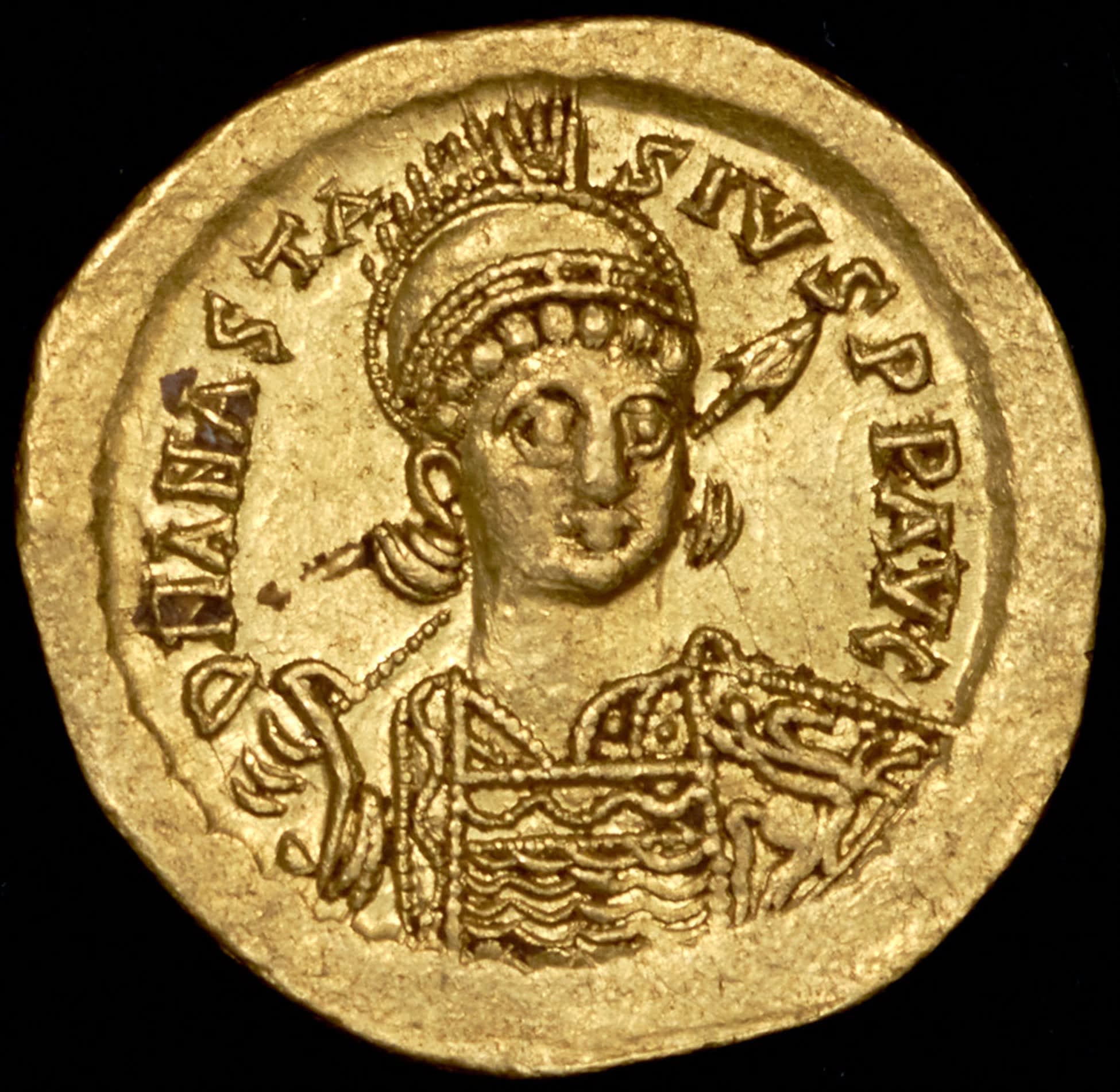

Anastasius was born in Dyrrachium, in the territory of modern Illyricum, around 430 or 431. He came from an aristocratic family: his father Pompeius and his mother Anastasia Constantina belonged to influential circles of the region. The family tree of the future emperor was closely intertwined with the religious currents of that era — his mother was a convinced Arian, which may have left its mark on Anastasius’ own future religious tolerance and flexibility.
However, the most striking feature of Anastasius was his appearance. Nature had endowed him with a rare phenomenon — heterochromia: one of his eyes was brown, and the other was bright blue. It was for this reason that his contemporaries nicknamed him Dicorus, from the Greek Δίκορος, which literally meant “two-pupiled” or “different-eyed.” This unusual gaze seemed to reflect the duality of his policy — that of a calculating financier and a cautious theologian.
For a long time, Anastasius remained in the shadows, holding the court rank of silentiarius under Emperor Zeno. He had an impeccable reputation and was known for his restraint. When Zeno died in 491, the question of succession became extremely acute. The emperor’s widow, Ariadne, faced a difficult choice. Standing against her will was Longinus, the native brother of the late Zeno, who sought to keep power in the hands of the Isaurian clique. However, Ariadne placed her bet on the experience and nobility of Anastasius. On May 20, 491, shortly after his official proclamation as emperor, she married him, thereby legitimizing his power in the eyes of the people and the court.

The first serious challenge for the new ruler was the dominance of the Isaurian nobility, which had become accustomed to dictating its terms under Zeno. Anastasius I acted decisively: he stripped the Isaurians of all offices, confiscated their colossal wealth, and expelled them from the capital. This led to the prolonged and bloody Isaurian War of 492–497. For six years, imperial troops suppressed centers of resistance in the mountains of Asia Minor. In the end, the Isaurians were finally subdued, and a significant part of them was forcibly resettled in Thrace, which permanently eliminated their influence over the central government.

On the eastern frontiers, the situation was no less tense. In 502, the Persian king Kavadh I broke the peace and invaded Byzantine Armenia. The cities of Theodosiopolis and Martyropolis fell almost without a fight, while the siege of Amida, which lasted all winter, ended in catastrophe for the defenders in 503. However, Anastasius showed energy: the Byzantines launched a counteroffensive, retook Theodosiopolis, and starved out the Persian garrison in Amida by 504. In 506, a peace treaty was signed which, although it cost Constantinople a contribution payment, confirmed the pre-war borders. To prevent such invasions in the future, Anastasius ordered the rapid construction of the powerful fortress of Dara, which became a strategic counterweight to Persian Nisibis.

If wars brought Anastasius the reputation of a commander, then his economic reforms made him a legend among merchants and townspeople. In 498, he carried out a fundamental monetary reform, which is considered the starting point of the entire Byzantine coinage system. He introduced new copper coins into circulation — folles — whose weight and convenience in transactions restored confidence in small coinage.
The emperor took an unprecedented step by abolishing the chrysargyron — a heavy and humiliating tax on artisans and merchants that had existed since the fourth century. To compensate for the treasury’s losses, he introduced a monetary land tax, the chrysoteleia, replacing natural deliveries of provisions and recruits with it. This made it possible to organize state finances and create a huge gold reserve, which would later become the foundation for Justinian’s conquests. In 500, he also issued a law protecting the rights of tenant farmers: after 30 years of tenancy, a plot was secured to them, which stimulated agriculture.
Anastasius’ religious policy continued the course of Zeno. He supported the Henotikon, trying to find a compromise between the Chalcedonians and the Miaphysites. This persistence cost him relations with Rome — the Acacian Schism continued throughout his reign. Believers often accused him of heresy, calling him “the Impious,” which at times led to revolts. One of the most dangerous was the rebellion of Vitalian in 513–515, which was suppressed only through a combination of military force and cunning.
Understanding the vulnerability of the capital before new enemies — the Slavs, whom chroniclers often called Getae — Anastasius completed a grand construction project. The so-called Long Walls, or Anastasian Walls, were built, stretching from the Black Sea to the Sea of Marmara. This marvel of fortification became for many years a reliable shield for Constantinople against sudden raids by northern barbarians.


Anastasius I Dicorus died at the age of almost 88 on the night of July 8–9, 518. His death was as unusual as his life: he died during a violent thunderstorm. Christian authors, who did not forgive him for supporting the Henotikon, later created a legend that the emperor was struck by lightning as punishment for his sins against the faith.
Anastasius left behind a prosperous state, defended borders, and a treasury full of gold. He was a pragmatic and at times unprincipled ruler — he himself believed that, for the interests of the empire, a sovereign had the right to break any oath. Despite this, history remembered him as a just reformer whose rational approach allowed the empire to withstand one of the most critical periods of its existence. After his death, Ariadne raised Justin I to the throne, opening the way for a new great dynasty.


