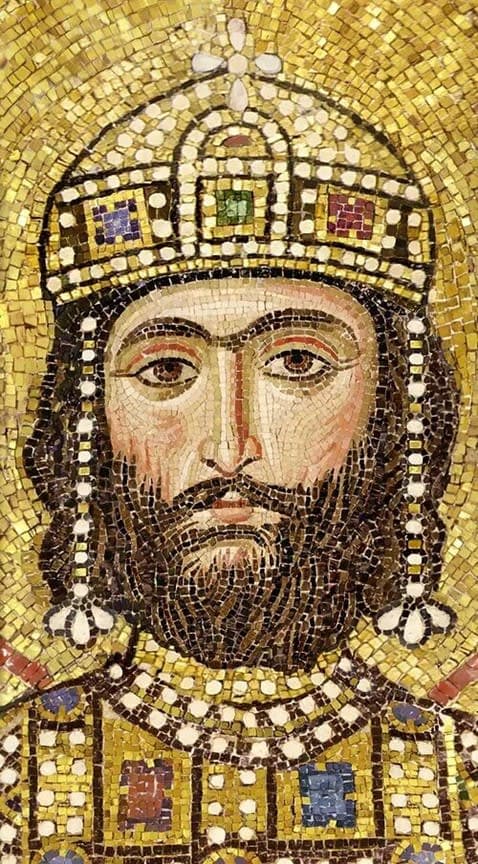

The Komnenos family traced its origins to the locality of Komne, near Philippopolis in Thrace. The first rays of glory illuminated this family name as early as the reign of Basil II the Bulgar-Slayer, when Alexios’s grandfather, Manuel Komnenos, proved himself a subtle diplomat by persuading the rebel Bardas Skleros to lay down his arms. Manuel’s legacy was inherited by his sons — Isaac and John. They became powerful magnates of Paphlagonia and leaders of the military aristocracy that opposed the bureaucracy of the capital. In 1057, Isaac even managed to overthrow Michael VI and ascend the throne, but his reforms met resistance from the court and the Church. In 1059, exhausted by the struggle, he handed power over to Constantine Doukas.
The father of the future savior of the empire was John Komnenos, whose wife was Anna Dalassene — a woman of exceptional intelligence and will, who apparently had Armenian roots. After her husband’s death in 1067, she became the “iron core” of the family, raising her sons in strict discipline and loyalty to the interests of their house. Alexios longed for battle even under Romanos Diogenes, dreaming of fighting the Seljuks, but his mother, who had only just buried her eldest son Manuel, kept him from taking part in the catastrophic Battle of Manzikert, which took place in 1071, thereby preserving his life for future achievements.


Alexios’s military career began in an age of chaos. In 1073, together with his brother Isaac, he faced the betrayal of the Norman mercenary Roussel de Bailleul. While the Seljuks were roaming freely through Anatolia after Manzikert, Roussel decided to found his own state in the Armeniac theme. The young Alexios displayed here not only courage, but also astonishing cunning.
In 1075, after receiving the title of strategos-autokrator from Michael VII Doukas, Alexios, lacking sufficient forces for a pitched battle, played a diplomatic game. He convinced the Seljuk leader Artuk to capture Roussel in exchange for an enormous reward. To extract money from the dissatisfied inhabitants of Amaseia, Alexios staged the Norman’s blinding — Roussel was given a bandage over his eyes, and the crowd, believing that the enemy had been neutralized, handed over the gold. This triumph of cunning allowed Alexios to deliver the rebel to the capital.

The next challenge was Nikephoros Bryennios the Elder, who proclaimed himself emperor in 1077. In the decisive Battle of Kalavrye in 1078, Alexios commanded a small army against superior forces. When his “Immortals” were defeated and the situation seemed hopeless, Alexios noticed that Bryennios’s allies — the Pechenegs — had become distracted by plundering their own baggage train. Taking advantage of the chaos, Komnenos captured the usurper’s horse and spread a rumor of his death. Rallying the remnants of his troops and joining forces with arriving Seljuks, he lured the enemy into a trap through a feigned retreat and captured Bryennios. A similar fate befell the next claimant, Nikephoros Basilakes, on the Vardar River, whom Alexios defeated with a night maneuver, leaving burning campfires in his camp as a deception.
Despite his military successes, Alexios remained under suspicion from Emperor Nikephoros III Botaneiates, whose court was dominated by the freedman favorites Borilos and Germanos. Realizing that blinding was only a matter of time, Alexios and Isaac secretly fled Constantinople for Tzouroulos on February 14, 1081. There, with the support of Caesar John Doukas and George Palaiologos, the army proclaimed Alexios emperor.

At the end of March 1081, his multinational army approached the walls of the capital. The bribery of German mercenaries allowed the Charisian Gate to be opened. Alexios’s entry into Constantinople turned into a tragedy: his soldiers, including both barbarians and Romans themselves, subjected the city to three days of pogrom and plunder, sparing not even the churches. Nikephoros Botaneiates, seeing the futility of resistance and the betrayal of the fleet, abdicated and withdrew to a monastery, regretting only that the monastic rule forbade eating meat.
On April 4, 1081, the coronation took place. Alexios began his reign with a severe penance imposed by the patriarch for the sins committed during the capture of the city. He had to maneuver between the interests of his own family and the influential Doukas clan, confirming the status of Constantine Doukas as co-emperor and crowning his wife Irene Doukaina.

No sooner had he put on the purple sandals than Alexios faced a threat from the West. The Norman duke Robert Guiscard, who had seized Southern Italy, landed in the Balkans under the pretext of defending the rights of the deposed Michael VII, using a monk impostor for this purpose. In October 1081, at the Battle of Dyrrhachium, the Byzantine army suffered a crushing defeat. The Varangian Guard, composed of Anglo-Saxons thirsting for revenge against the Normans for Hastings, was trapped inside a church and burned alive. Alexios, wounded, barely escaped.

Yet the emperor showed unbending will. While Guiscard advanced along the Via Egnatia, Alexios used gold confiscated from church treasuries to raise a rebellion in Italy and bring the German emperor Henry IV over to his side. Robert’s distraction by Italian affairs and the epidemic that took the duke’s life in 1085 allowed Byzantium to clear the Balkans of the Normans.

By 1085, Asia Minor was a patchwork of Seljuk emirates. The capital of the Sultanate of Iconium was located in Nicaea, very close to Constantinople. Alexios, lacking the strength for a full-scale war, shifted to a strategy of “divide and rule.” His loyal commander Tatikios, a Seljuk by origin, exhausted the enemy with raids, while diplomats wove their intrigues.
The most dangerous opponent in the East became the emir of Smyrna — Chaka. A former Byzantine captive and protonobelissimos, he created a powerful fleet, seized the islands of the Aegean Sea, and proclaimed himself emperor. In the winter of 1090–1091, Chaka planned a joint assault on Constantinople together with the Pechenegs.

Alexios struck a preemptive blow not with a sword, but with a letter. He sent a message to the new sultan, Kilij Arslan I, convincing him that Chaka’s ambitions threatened the sultan himself. In 1092, during a feast, Kilij Arslan personally stabbed Chaka, his own father-in-law, thereby eliminating the main naval threat to Byzantium.

In the mid-1080s, clouds gathered over Byzantium’s northern frontiers. In 1086, a huge Pecheneg horde crossed the Danube. In the very first clashes, the grand domestic Gregory Pakourianos — one of the emperor’s closest friends and loyal comrades-in-arms — was killed. The situation was worsened by betrayal within the country: the Paulicians of Philippopolis, led by Travlos, began a guerrilla war, joining forces with the nomads.
In the autumn of 1088, Alexios personally led a campaign against Dristra, or Dorostolon. The siege turned into a disaster: the Romans were defeated and fled. The emperor had to take refuge in the fortress of Goloe, which provoked mocking laughter in the capital — the inhabitants of Constantinople sang a song: “From Dristra to Goloe, what a fine stopping-place, Komnenos!” Yet Alexios knew how to extract advantage even from defeats. By paying the Pechenegs a huge ransom, he provoked a quarrel between them and their Cuman allies, who considered themselves cheated in the division of the booty.
The climax came in the winter of 1090, when the Pechenegs approached the walls of Constantinople, coordinating their actions with the fleet of Emir Chaka. The empire hung by a thread. Alexios achieved a diplomatic masterpiece: he invited the Cuman leaders Tugorkan and Boniak to the palace and persuaded them to strike the Pechenegs in the rear. On April 29, 1091, at the Battle of Levounion, the 40,000-strong army of Cumans and Byzantines literally wiped the Pecheneg people off the face of the earth. Thousands of prisoners were killed at night “by divine voice” — or, more likely, by the unspoken order of commanders terrified by the scale of the threat. The Cumans, horrified by such Roman cruelty, fled back into the steppes without even waiting for the full payment of gold.


Peace on the Danube did not last long. In 1092, the first False Diogenes appeared, claiming to be the son of Romanos IV. The Cumans, led by Tugorkan, supported the impostor. A number of fortresses, including Goloe, opened their gates to the rebel because of hatred for Alexios’s tax burden. Yet the emperor once again displayed cunning: he lured the False Diogenes into the fortress of Poutza, where he was arrested and immediately blinded.
History repeated itself in 1116, when a new impostor secured the support of the Grand Prince of Kiev, Vladimir Monomakh. Monomakh even captured several Danubian cities, including Dorostolon, planning to create a bridgehead there for the “prince.” Alexios solved the problem radically: on August 15, 1116, mercenaries sent by him killed the False Diogenes directly in his residence. The conflict with Rus’ dragged on until 1123, but the direct threat to the throne had been eliminated.

For years Alexios Komnenos had asked the West for help against the Seljuks, hoping to receive detachments of mercenaries. But the response exceeded all expectations and fears. After the Council of Clermont in 1095, tens of thousands of people began moving toward Constantinople.
In the spring of 1096, the first to arrive was an unorganized crowd of poor people led by Peter the Hermit and Walter the Penniless. They plundered Byzantine lands, and Alexios hastened to transport them into Asia Minor, where they were almost completely destroyed by the Muslims.

They were followed by professional crusader knights. Alexios, knowing the arrogant nature of the Latins, used a tactic of “feudal restraint.” He forced the leaders — Godfrey of Bouillon, Bohemond of Taranto, and others — to swear vassal oaths to him, obliging them to return to the empire all lands they reconquered.
The main conflict flared up at Antioch. Bohemond of Taranto, dreaming of his own principality, deceitfully forced the Byzantine representative Tatikios to leave the camp by spreading a rumor of a knightly plot against him. After the capture of the city, Bohemond refused to hand it over to Alexios and created the independent Principality of Antioch. This marked the beginning of centuries of confrontation between Byzantium and the Crusader states.

The height of Alexios’s diplomatic triumph over the Normans was the Treaty of Devol in 1108. After Bohemond’s failed invasion of Illyria, the emperor pressed him to the wall. Under the treaty, Bohemond recognized himself as Alexios’s vassal, returned Cilicia, and agreed to the restoration of the Orthodox patriarchate in Antioch.
Alexios I also reformatted the very structure of the empire:
He finally crushed the old families — the Skleroi, Phokades, and Argyroi — replacing them with his own relatives: the Palaiologoi, Doukai, and Melissenoi.
In 1092, instead of the debased solidus, a new gold coin was introduced — the hyperpyron, which became a symbol of stability for centuries.

Military men were granted lands to administer in exchange for service, which made it possible to revive the army without relying on unreliable militia forces.
Alexios’s relations with the Church were complex. At the beginning of his reign, Alexios confiscated church vessels for the war, for which he later publicly repented. But in matters of faith, he was merciless. His main enemy became the Bogomil sect. Toward the end of his life, Alexios personally arranged a debate with the sect’s leader, Basil. While Basil explained his teaching, a scribe hidden behind a curtain recorded every word. On the basis of this record, Basil was sentenced to be burned at the stake. The emperor even ordered two pyres to be lit: one with a cross, for those who repented, and one without. Those who chose the “pure” pyre were burned alive.
Alexios’s final years were darkened by gout and heart attacks. His palace turned into an arena of struggle over the succession. The emperor’s wife Irene Doukaina and his daughter Anna Komnene plotted against the legitimate heir John, trying to promote Anna’s husband, Nikephoros Bryennios.
On August 15, 1118, Alexios Komnenos was dying. In his final hours, while Irene demanded that he name his successor, he remained silent, but secretly handed his son John the signet ring. When Irene learned of this, she threw a bitter reproach at her husband: “You were always treacherous in life, and now you do not change yourself.”
Alexios I died that same night. He left John II an empire risen from the ashes, with a powerful army, a stable currency, and recovered lands in Asia Minor. Despite all his cruelties and intrigues, he is rightly considered one of the greatest restorers of Roman greatness.


