
In AD 43 the Romans, under Emperor Claudius, began the conquest of Britain, turning it into a Roman province. Celtic tribes led by the chiefs Caratacus and Togodumnus resisted but were defeated. The Romans established their rule, though it was often harsh and accompanied by heavy taxation.

Prasutagus, chief of the Iceni, hoping to preserve his family’s power, bequeathed half of his kingdom to the Roman emperor Nero. After his death, however, the Roman authorities ignored his will. Lands and property were confiscated; his widow, Boudicca, was publicly flogged, and her daughters were raped. These events—together with demands by the procurator Catus Decianus to repay a large loan—were the last straw.
In AD 60 or 61 the Iceni, supported by neighboring tribes, rose in revolt under Boudicca, whom Cassius Dio described as a woman “more intelligent than women usually are.”
The rebels’ first target was Camulodunum (modern Colchester), former capital of the Trinovantes and now a colony for Roman veterans. Its inhabitants, who had previously mistreated the local population, offered little resistance. The insurgents stormed the town, looted it, and burned it. The garrison took refuge in the Temple of the Deified Claudius but was destroyed after a two-day siege.
Quintus Petillius Cerialis, commander of the Ninth Legion, attempted to retake the town, but his forces fell into an ambush. The Romans lost their entire infantry, and Cerialis managed to save only his cavalry.
Learning of the revolt, the governor Gaius Suetonius Paulinus hurried to defend Londinium (London). Assessing his scant forces, he made the hard decision to abandon the city. The rebel Britons entered it, carried out a brutal massacre, and burned it. The same happened to Verulamium (St Albans). Historians estimate that about 70,000 people—both Romans and Britons loyal to them—were killed in these three cities. The rebels took no prisoners and showed extreme cruelty.

Suetonius Paulinus regrouped and assembled an army of 10,000—legionaries, veterans, and auxiliaries. According to Cassius Dio, Boudicca commanded an enormous force of 230,000, though modern historians consider such figures greatly exaggerated.
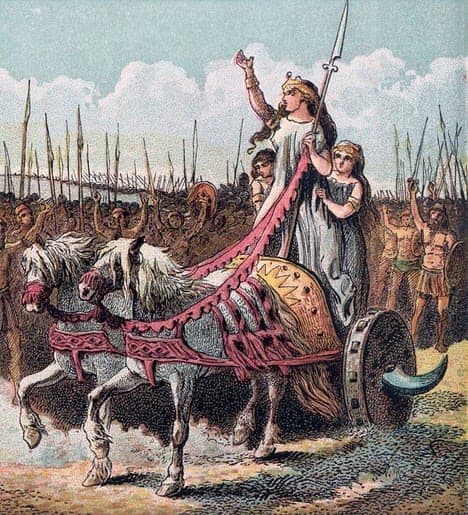
Suetonius chose a narrow defile backed by woodland for the decisive battle, preventing the Britons from exploiting their numerical advantage. Before the fighting, Boudicca drove among the warriors in a chariot with her daughters, urging them to avenge their stolen freedom and violated honor.
With wild shouts the Britons charged, but were met by a hail of Roman pila. The legionaries, formed in wedge order, advanced, using their superiority in tactics and weaponry. Roman cavalry and archers struck at the Britons’ wagon laager—where women, elders, and children stood—cutting off any route of retreat. A savage battle ensued, turning into a slaughter. The Britons’ losses were colossal. By one account Boudicca took poison after the defeat; by another, she died of illness.

After crushing the revolt, the Romans continued a punitive expedition. Concerned by events, Nero sent reinforcements to Britain but ordered the new governor, Publius Petronius Turpilianus, not to wage further wars and instead to focus on restoring peaceful relations. The site of the final battle remains unknown, though historians have proposed many theories.
Despite its tragic outcome, Boudicca’s uprising became one of the most striking episodes in the history of Roman Britain. It demonstrated the strength and spirit of resistance among the native tribes and forced Rome to moderate its provincial policy.


