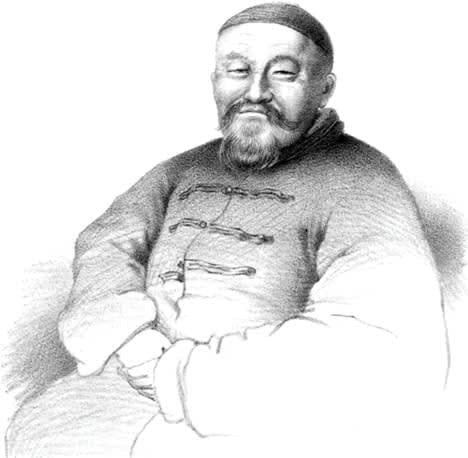

Although the exact year of his birth is disputed, it is generally held that he was born around 1779. He was the son of the influential manap Bekmurat (Menmurat). From a young age Borombai displayed keen intelligence and exceptional organizational talent. Contemporaries described him as a farsighted and calculating leader who always put his people’s interests first.
Borombai’s path to power began when he replaced his kinsman Birnazar as supreme manap of the Bugu tribe. His influence grew rapidly, and he came to enjoy great authority among his people. In 1816 Borombai led an uprising of the Kyrgyz of the Issyk-Kul basin against the Kokand Khanate. Seeking to regain control of the lake’s southern shore seized by Kokand, he gathered an army, defeated the Kokand forces, and expelled them from the region—actions that greatly strengthened his position and enabled him to establish diplomatic relations with neighboring powers.

Borombai-biy built solid diplomatic ties with the Russian and Qing empires. The Chinese emperor recognized him as the legitimate ruler of Issyk-Kul and Tekes, sending him the symbols of sultanic authority. In documents of the time Borombai bore the title “Sultan of Issyk-Kul and Tekes, supreme and lawful lord of the Bugu tribe.” He also dispatched several embassies to Russia, which led to trade agreements. These accords ensured the safe passage of Russian caravans through his lands and fostered the economic growth of the Bugu.
In 1842 a great kurultai (assembly) was held at Kutmaldy, where the Kyrgyz nobility gathered to choose a single ruler and form a strong state. Borombai, as the most powerful manap, was regarded as the leading candidate for the khan’s title, but he declined the honor, citing his advanced age. As a result, the head of the Sarybagysh tribe, Ormon, was elected khan.

At first Borombai supported Ormon Khan, but over time their relations deteriorated. Envious of the Bugu’s wealth and influence, Ormon adopted a despotic policy, provoking numerous conflicts. The breaking point came with the detention and punishment of Borombai’s right-hand man, Balbay batyr, which finally ruined their relations. After victory over the Kazakh khan Kenesary Qasymov, Ormon Khan became a tyrant outright and demanded that Borombai cede control of Issyk-Kul to him.
Borombai tried to resolve the conflict peacefully, but Ormon Khan, taking this for weakness, invaded his domains in 1854. The Bugu army, battle-hardened and disciplined, crushed Ormon’s forces and took him prisoner. Borombai wished to release the khan upon an oath not to attack again, but Balbay batyr—who hated Ormon—killed him with a spear thrust.
After Ormon’s death, endless wars with the Sarybagysh tribe and with the Kokand Khanate weakened the Bugu. Realizing that his people could not withstand these conflicts, Borombai sought protection from the Russian Empire. From 1844 he sent embassies to Russia, and on January 17, 1855, his envoys in Omsk swore allegiance to the Russian emperor, marking the Bugu tribe’s acceptance of Russian subjecthood. Borombai himself received the rank of colonel in the Russian army and other honors.
Borombai-biy died in 1858. Under his leadership the Bugu tribe reached the zenith of its power, becoming the strongest and most influential of the Kyrgyz tribes, with an army of up to 20,000 warriors. After his death, however, the tribe lost its unity and its former influence quickly waned. This enabled the Russian Empire to strengthen its protectorate over these lands, which ultimately led to their incorporation into the empire.


