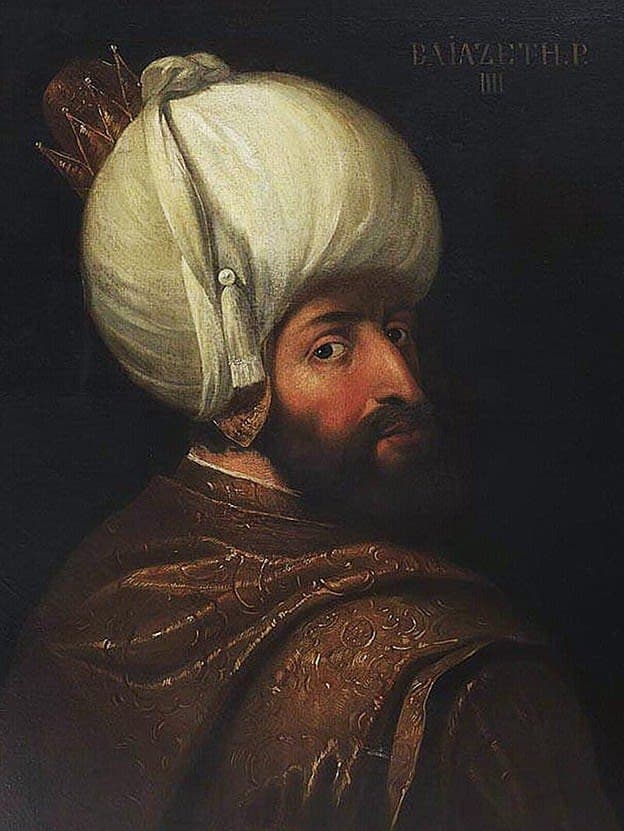
Bayezid was born in Edirne, probably in 1360, to Sultan Murad I and his concubine Gülçiçek Hatun. From an early age he took part in his father’s campaigns, gaining military experience. His path to power was cleared after Murad I brutally suppressed the revolt of his elder son Savcı Bey in 1373—who, some say, had more support among the Turks than Bayezid. Murad had Savcı blinded and executed, and Bayezid, who is thought to have informed on his brother, thereby won his father’s trust. This was the first step in a grim series of fratricides that later became a dark tradition in Ottoman history.


In 1381 Bayezid made a political marriage with the daughter of the emir of the Germiyanoğulları beylik, receiving part of its lands as dowry. Soon he was appointed sanjak-bey of Kütahya, from where he secured the eastern frontiers while Murad I campaigned in the Balkans.
Bayezid earned the epithet “the Thunderbolt” (Yıldırım) after his first major Anatolian campaign. When his brother-in-law Alaeddin, ruler of the Karamanid beylik, attacked Ottoman lands, Bayezid rapidly redeployed his forces and defeated him near Konya.
On 15 June 1389 at the Battle of Kosovo Polje, Bayezid commanded the right wing of the Ottoman army. When his father Murad I was killed, Bayezid immediately assumed command and finished off the enemy. He was proclaimed sultan on the battlefield. To forestall future conflict, Bayezid ordered his brother Yakub who was also with the army strangled. This was the first time a sultan ordered a brother’s death to secure the throne.


After Kosovo, Bayezid swiftly shifted his troops to Anatolia, where local beys, taking advantage of Murad’s death, tried to regain their lands. In a single winter Bayezid crushed the minor beyliks (Aydın, Saruhan, Germiyan, Menteşe, and Hamid), annexing their territories and greatly expanding the state.
In 1396, alarmed by Ottoman expansion, European monarchs organized a major crusade. An army of 30–35,000 knights and soldiers, led by King Sigismund of Hungary, advanced into Ottoman territory and besieged the Bulgarian fortress of Nicopolis. Bayezid, then besieging Constantinople, lifted the siege and marched to meet them. On 25 September 1396, at the Battle of Nicopolis, the Ottoman army routed the crusaders. After the victory Bayezid ordered most prisoners executed in retaliation for Ottoman losses, releasing only the highest-ranking knights for enormous ransoms. This triumph strengthened Bayezid’s standing in Europe and enabled him to subjugate Bulgaria completely.

The sultan then resumed the siege of Constantinople, which lasted eight years 1394–1402. The city was on the verge of falling; its inhabitants starved and the treasury was empty.
Meanwhile, trouble brewed in the east of the Ottoman realm. The rulers of conquered beyliks fled to the court of Timur (Tamerlane), the powerful Central Asian conqueror, and sought his help. Bayezid and Timur exchanged haughty, insulting letters. Angered by Bayezid’s conduct and intent on punishing him for “kidnapping” his vassals Timur led his army into Anatolia.

On 20 July 1402, at the Battle of Ankara, the armies of the two great rulers clashed in a decisive engagement. Bayezid’s forces, exhausted by heat and a long march, were defeated. Tatar and Anatolian contingents bribed in advance by Timur defected during the battle and turned on the Ottomans. Bayezid tried to flee but was captured. Timur treated him with humiliating condescension.
Bayezid I died in captivity on 17 March 1403, apparently of apoplexy. His death ushered in the Ottoman Interregnum, which lasted for more than ten years until his son Mehmed I restored the state’s unity. Bayezid’s body was transported to Bursa, but in 1414 his remains were exhumed and burned by the Karamanid bey Mehmed, who sought revenge for the execution of his father, Alaeddin.


